

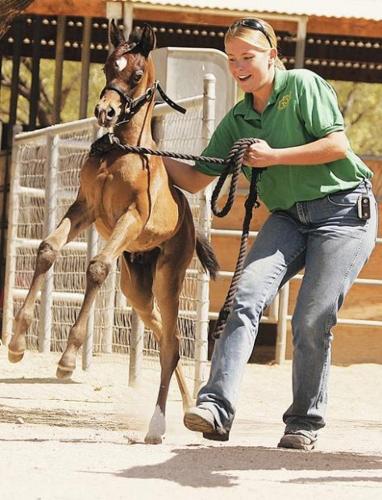
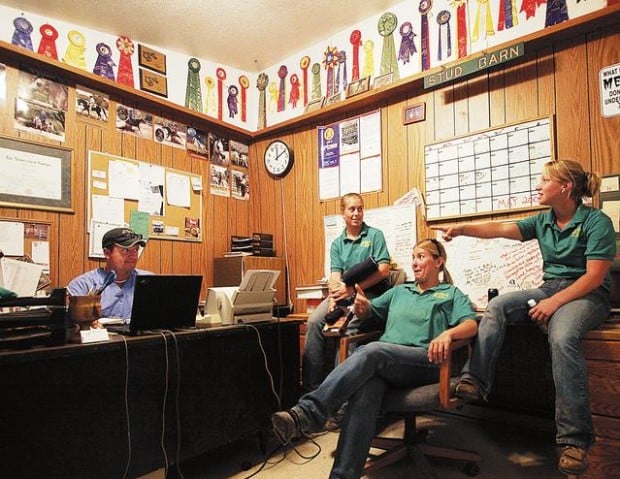
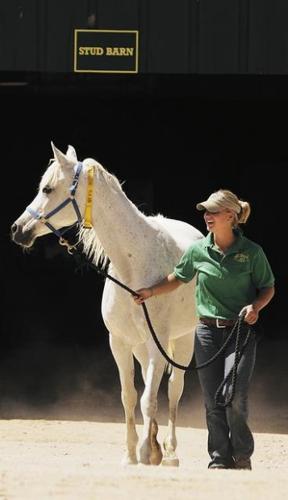
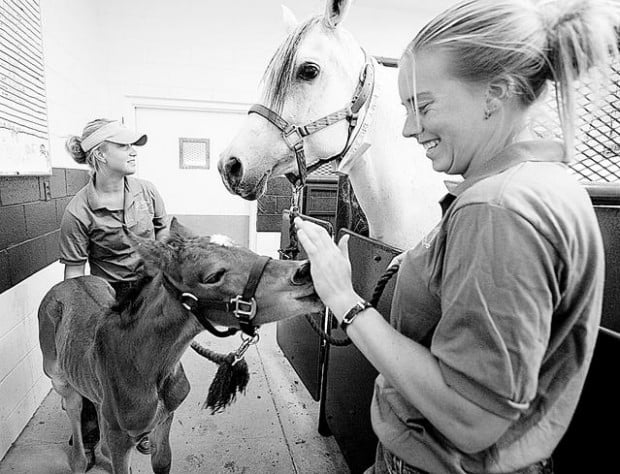
Most students use textbooks and spiral notebooks as study aides, but a select few equine scholars learn their lessons from expert trainers and sleek Arabian horses at Al-Marah Arabians, 4101 N. Bear Canyon Road.
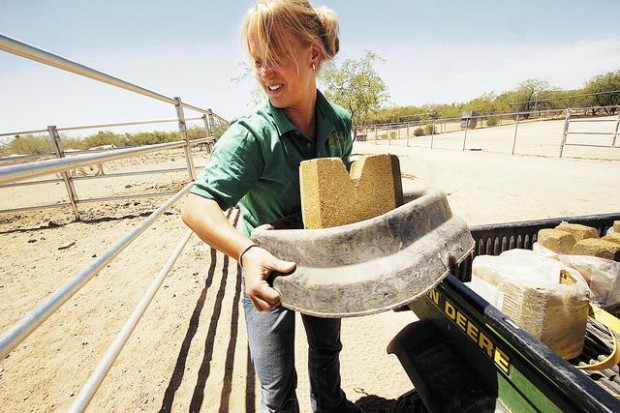
During Al-Marah's two-year apprenticeship program, trainees wake up at daybreak, care for 200 champion Arabians and work 35- to 60-hour weeks — all in the heat of the Arizona sun. It's not an easy or relaxing way to spend two years, but it's a valuable and rare educational experience for horse lovers who want a career in the equine industry, as Al-Marah's program offers practical applications and learning opportunities.
"There are things you can't just teach a person in the horse industry," says Al-Marah breeding manager Jay Faircloth, who has been the apprenticeship program's coordinator for three years. "They've just got to live it, which is exactly what these apprentices do."
People are also reading…
"It has to be hands-on," agrees Tabitha Richards, 21, a native of Tombstone. Richards, who has been an apprentice for 18 months, also says the program is "a lot less stressful, more family-oriented (and) more friendly than going to college."
Applicants plentiful
Al-Marah advertises both the horse-breeding and -training programs in several equine industry publications, and it's certainly not short on applicants. The farm generally hires a new apprentice only when one of the program's 14 current apprentices graduates or quits, and Al-Marah receives so many applications that acceptance to the program is extremely competitive.
Faircloth bases acceptance decisions on equine- and education-related experience, physical ability to handle the labor and temperament.
"It takes a specific type of person to thrive in this environment," Faircloth said. "It's very hot here in the summertime. It's a very intense program, and apprentices have to have social skills."
Much like a boarding school, apprentices live right on the grounds. Consequently, even one unhappy person affects the entire farm, especially the other apprentices. It's not easy to work eight-, nine- or 10-hour days together and then share a living space. This residential arrangement plunges a new apprentice into life on the farm, introducing aspiring horse breeders and trainers to every detail of their chosen professions.
"It's around the clock," Kate Gunning, 23, says of the work. This is especially true now, as breeding season means 60-hour workweeks for Faircloth and the apprentices.
Educational opportunity
Along with hands-on education, Al-Marah apprentices receive $893 to $993 per month in wages with $250 deducted from their pay for board. This is roughly equivalent to minimum wage, but the focus of the experience is learning, not making money.
"This is an educational opportunity, not a job," says Faircloth.
Not everyone can handle the program's full immersion or minimum wage, but its graduation rate has jumped from 15 percent to 80 percent during the last few years, according to Faircloth. He estimates that the program has graduated 13 apprentices during the time that he's been coordinator.
Gunning, who had equine experience before coming to Al-Marah from Ohio, has already completed 20 months of her apprenticeship and will graduate in August.
Like many of the horse farm's apprentices, Gunning and Richards chose to take part in a partnership program Al-Marah has with Pima Community College. If the apprentices take core classes at Pima during the evenings in addition to the Al-Marah apprenticeship, they receive course credit and ultimately an associate's degree.
Faircloth, who has bachelor's degrees in agricultural economics and animal science and a master's degree in equine reproductive physiology from the University of Georgia, teaches the apprentices subjects such as anatomy, equine behavior and farm management within the context of farm activities.
In a lesson on equine reproductive physiology, for example, Faircloth talks about reproduction on the cellular level while performing ultrasounds on or palpating mares, so the apprentices know what he's doing and why.
"It's completely different," Gunning says of the program's teaching method. "I would much rather be working and learning as I go than having to read out of a book six hours a day."
Practical experience
At 23, Laurie Olsker, who is from the Phoenix area, has experienced both university-based animal education and hands-on learning at Al-Marah. In 2005, she graduated from the University of Arizona with a bachelor's degree in veterinary science before coming to Al-Marah to further her studies.
"I learned it all in my (university) classes," Olsker says of Faircloth's lessons, "but now it's nice to put it in the real world."
For example, she said,, "I learned about follicle size and hormones and everything, and now I can put it into application. It's easier to see it in an actual mare than in a book."
The practical experience and certification from the horse farm set the stage for long careers. Richards, for example, already has secured a position as farm manager at a local riding facility.
To learn more
● For more information on Al-Marah Arabians, including the apprenticeship program, call 749-1162 or visit the Web site www. al-marah.com.
Slideshow
On StarNet: See this story in pictures at azstarnet.com/slideshows


