


A bear was shot to death last week in Madera Canyon near Green Valley, another casualty in the conflict that arises when wildlife and humans mix.
No one was harmed by the 30-pound black bear that a state Game and Fish Department officer killed Nov. 20 after trying to chase it from the area by shooting it with less-than-lethal "beanbag" buckshot, said Gerry Perry, Tucson regional supervisor for Game and Fish.
But the bear had become accustomed to getting its food from humans, from campgrounds and trash cans, and had become a nuisance, Perry said.
That can lead to injuries if the animal is sick with rabies or if it's accustomed to getting food from humans and lashes out if it doesn't get it.
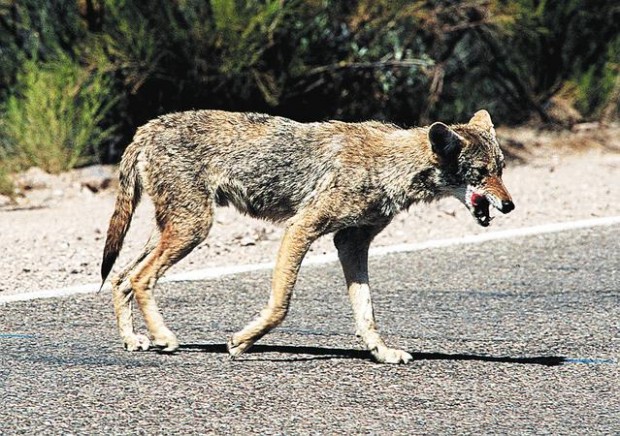
That's probably what caused the rash of coyote bites in Green Valley earlier this month, said Elissa Ostergaard, a Game and Fish Department urban wildlife specialist.
People are also reading…
The coyotes that bit the Green Valley residents all were bigger than normal, probably because they were being fed by humans, Perry said.
Bad deal for wildlife
Feeding wildlife may seem harmless, even kindhearted, but it only makes animals dependent on humans, he said. And it could create a situation in which the animal is likely to cause problems — often resulting in the animal's death.
That's why the Legislature passed a law this past session that prohibits people from feeding animals, except for birds and tree-dwelling squirrels, Ostergaard said. The law says that anyone caught "recklessly, knowingly or intentionally feeding wildlife" can be fined up to $300.
No one has been cited yet under the new law, which took effect in August, she said.
All eight people bitten by coyotes earlier this month are OK, and since the department killed five coyotes in the area, it hasn't gotten any more reports of animal bites, Ostergaard said.
But coyotes are still a common sight around Green Valley and Sahuarita.
Dave Anderson, who lives in the Canoa Estates subdivision, said he still sees coyotes all the time. "I saw a big coyote on one of the streets here in my area just a few days ago," he said.
Ostergaard said that instead of encouraging animals to come around by feeding them, residents ought to try to shoo them away, if they can do so safely.
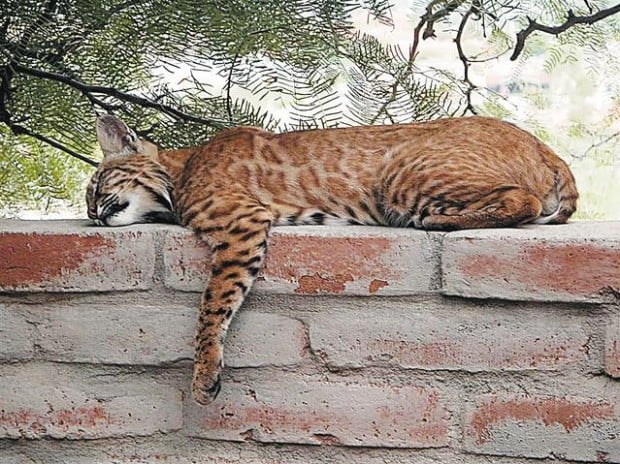
"If everybody scared coyotes and bobcats away every time they see them, those animals wouldn't be as comfortable in coming around and taking pets and causing problems," Ostergaard said.
To scare the bear
Perry said that's what the Game and Fish officer who went to Madera Canyon intended to do. The officer was sent there after Forest Service officials asked for help with a bear that had made a nuisance of itself during the previous two weeks.
"It had been seen in that area, and apparently was showing no signs of being fearful of humans," Perry said. "It kept showing up in areas of close proximity with humans, and it showed signs of being food-conditioned" — accustomed to getting food from humans.
The officer found the bear near Bog Springs and tried to get it to leave by shooting it with "non-lethal" ammunition — rubber "beanbag" buck shot. But that effort badly injured the bear, so the officer had to kill it, Perry said.
Several bear sightings have been reported in recent months in the foothills of the Santa Rita Mountains around Corona de Tucson, he said.
Corona resident Margaret Steuer said she saw a black bear a couple of months ago.
"I came home at night and I saw this thing in the entranceway of a house in our neighborhood," said Steuer, who lives in the Santa Rita Shadows subdivision.
"At first, I thought it was one of those big furry dogs, like a chow," she said.
Looking for water, food
Perry said bears and other forms of wildlife are wandering into areas frequented by humans in search of water and food, which are in short supply because of a drought that has gripped the Southwest for several years.
Ostergaard said that as growth spreads in all directions around Tucson, humans increasingly have taken up residence in areas where previously only animals lived.
Steuer said she thinks that's why animals have wandered onto the campus at Corona Foothills Middle School, which opened in July 2005.
"We had a little fox a couple of months ago, so we locked down some areas of the campus," said Steuer, the school's principal. "We called (county) animal control, but it skedaddled out the back fence before they got here."
Bill Bohling, an assistant chief with the Green Valley Fire Department, said last week that he didn't have statistics, but he's sure that wildlife calls are on the rise.
"It's steadily increased every year, following the increase of population and expansion of the community," he said.
Growth forces animals out of their habitat, but the houses it brings provide substitute sources of water and food — irrigation systems, tasty plants and, for carnivores, a ready supply of plump, well-fed house pets.
For scavengers, there are trash cans waiting to be knocked over and rummaged through.
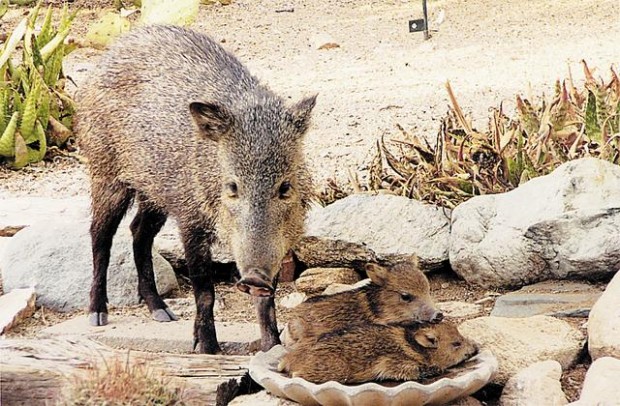
Efficient javelina
Perhaps the desert's most efficient scavenger is the javelina, which can find a home just about anywhere, from posh resorts in the Foothills to a working-class East Side mobile-home park.
"Javelina do tend to be the biggest problem animals in the city, and they do take up a lot of our officers' time," Ostergaard said.
They're hard to shoo away, hard to keep out, and hard to relocate, she said.
Sarah Beal, spokeswoman for Loews Ventana Canyon Resort, said they're a common sight at the resort in the Catalina Foothills.
"We see wildlife all the time here," she said.
Javelina also wander throughout the Tucson area, via the many washes that crisscross the city.
That's apparently how a family of javelina discovered the good life at Far Horizons East mobile home park — by way of the Pantano Wash, which runs along the western perimeter of the park at 7570 E. Speedway.
For the past three weeks, several javelina have roamed the park, living under some of the trailers, said Tracy Dutcher, head of maintenance at the 66-acre park.
And they're not inclined to leave, he said.
"I've tried everything to get rid of these javelinas, and I just can't keep them out, unless I kill them myself," Dutcher said.
"This is a real problem for us," Dutcher said. "This is a park for the elderly, and people are afraid to even go out in their yards. . . . I had one lady who couldn't get out of the car for an hour.
"My biggest concern is I'm afraid one of my residents are going to get bit," he said. "I called our local Game and Fish office, but they didn't help."
Ostergaard said Monday that department officials were trying to work out a solution, perhaps with help from a private animal-relocator business licensed to remove wildlife.
Animals' death sentence
Many people who call Game and Fish about wildlife problems ask that the animal be removed and relocated. But Ostergaard said that often is not advisable, because animals rarely survive when taken far from familiar territory.
"Taking an animal away from its habitat can be a death sentence," she said.
Bruce Whitehouse, Corona's fire chief, said that's why when personnel with his department get calls about reptiles, they remove them but not too far away.
"We relocate snakes, but only a couple of hundred yards away — not so far away as to be out of their territory," he said.
"We try to explain to people that these creatures live here and we moved into their environment, and you've just got to coexist with them," Whitehouse said.
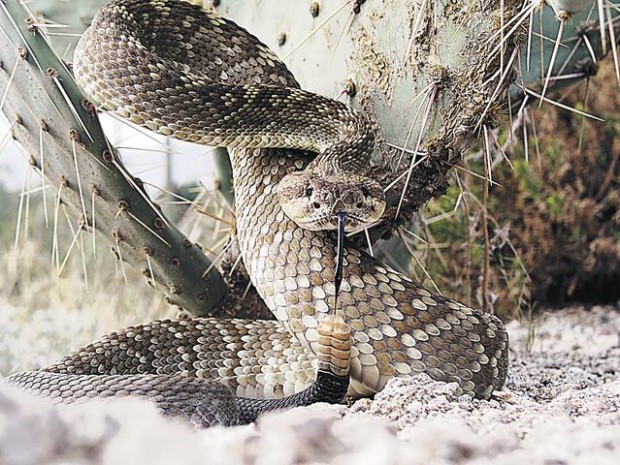
"We tell people, 'Yes, they can be dangerous. You have to be careful around them. But rattlesnakes are good, too. Rattlesnakes eat rats.' "
In the opposite corner of the Tucson metro area, Northwest Fire/Rescue District personnel will remove only animals that present an immediate threat.
Those include "traditional desert pests" like Gila monsters and rattlers, said Katy Heiden, district spokeswoman.
For other animals, such as javelina, department personnel advise callers to "make sure they get their kids and pet indoors, and just wait until the animal leaves the area," Heiden said. "And enjoy the good view of wildlife."
What to do in a wildlife encounter
On the trail:
l Always hike in groups. Make noise so the animals know you're around.
l Always walk pets on a leash.
l If you encounter an animal, keep your distance. Allow it a way to escape.
l Keep small children from panicking and running.
l Do not run from big predators, such as a mountain lion. That may stimulate its instinct to chase. Stand and face it, stay calm, make eye contact, speak loudly. If a vehicle or building is nearby, slowly begin backing away toward it.
At home:
l Keep dogs, cats and other domestic animals indoors or in a secure enclosure with a sturdy roof.
l Do not keep pets' food and water outside, where they may attract wildlife — or prey, such as rodents.
l If an animal wanders into your yard, use common sense. If it presents a danger, such as a mountain lion, stay indoors, keep kids and pets indoors, and call 911 and, if possible, the local Game and Fish office.
l For smaller animals such as coyotes, make sure kids and pets are safe and wait for the animal to leave.
l For smaller animals, make loud noises, using air horns or banging pots together. Spraying some animals with a garden hose also sometimes works.
More information:
Call the Game and Fish Department or go online to www.azgfd.com and click on the Living with Arizona's wildlife link
The Tucson office telephone number is 628-5376. After hours and on weekends, a Phoenix-area radio dispatcher is available by calling 1-602-789-3201.


