


Sabino Canyon is being threatened by an unwanted development, one that has staked claims along the road to the upper canyon and taken over scenic plots on steep hillsides.
No, this is not a condo or a strip mall — such a prospect would likely bring out hikers and environmentalists with pitchforks and torches — but two species of highly invasive foreign grasses that threaten to choke out native plant life.
Buffelgrass and fountain grass, two grass species of African origin, have begun to colonize areas of Sabino Canyon, said Heidi Schewel public information officer for the Santa Catalina Ranger District.
An increasingly common sight along roadsides and hillsides in the Tucson area, these highly adaptive grasses also threaten the wildlife that uses native plants for food, ground cover, nesting and hunting perches in Sabino Canyon, Schewel said.
People are also reading…
"Everything is going to lose out, because the wildlife here has co-evolved with the variety of native plants here," said Schewel, who is also a ranger and the manager of the Coronado National Forest's Invasive Species Program. "As these grasses move in, biological diversity is lost."
Noxious weed
Fountain grass can be bought in nurseries as an ornamental horticulture plant, and it spreads quickly from there, Schewel said. Buffelgrass, which was introduced to the region as cattle forage in the 1940s, is now listed as a noxious weed by the Arizona Department of Agriculture, and may be controlled or quarantined by the state.
Competing with native plants for water and nutrients, these grasses grow in thick tufts, filling in between the more sparse native desert vegetation and creating plentiful fuel for fires, Schewel said. If fire comes, the invasive grasses grow again quickly, but native species do not.
"Fire will sweep through and many of the desert plants will not survive, but these grasses will resprout within days. Then you have grass filling in behind the native plants, and there's the possibility of a landscape conversion from Sonoran Desert to African grassland," Schewel said.
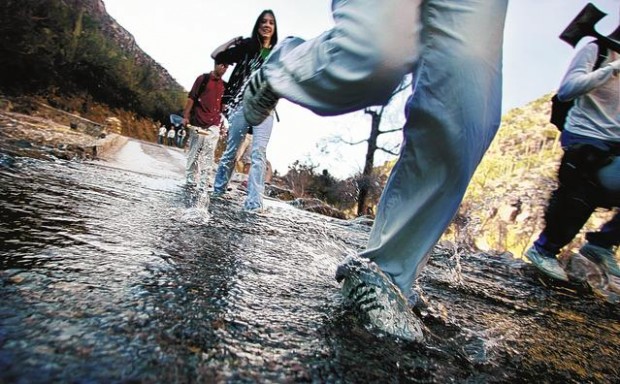
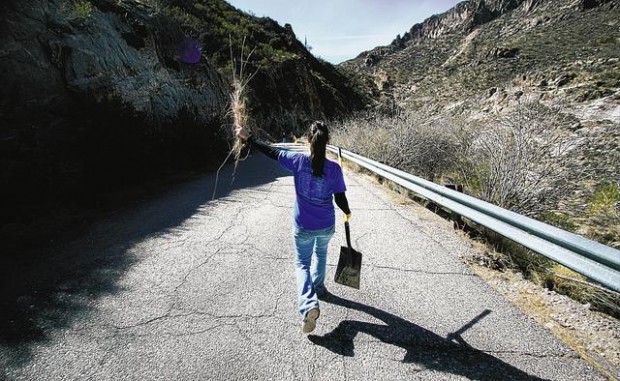
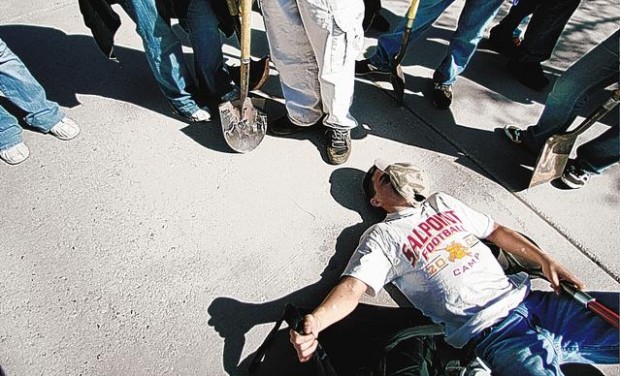
Because herbicides are expensive and leave dead plant matter to fuel fires, rangers have turned to volunteers to combat the problem. On Monday, the entire junior class of Salpointe Catholic High School came to pull out grasses.
Armed with shovels, grass samples and the high spirits of teenagers who've escaped from the classroom, the more than 300 students broke into groups and fanned out across the canyon.
Helping the environmen
Salpointe junior Mark Anderson, 17, enjoyed the chance to protect the local environment, though he was not quite sure if the outing counted as forced labor or dedicated environmentalism.
"It's definitely forced, but it's definitely a good thing. I don't have any objections," Anderson said. "It's a conscientious thing to do, helping out the environment."
The Salpointe group began digging out grass where a previous group of more than 400 volunteers left off last September, during an effort on National Public Lands day.
That previous group pulled grasses for approximately a mile and a half along the canyon road.
At around 11 a.m., on a long trudge up to Sabino Canyon's fourth bridge, Salpointe junior Silvana Martinez, 16, admitted she hadn't paid much attention to the issue of invasive species before Monday.
Asked if she thought the eradication venture worthwhile, she joked, "Not right now, but I think it will be."
She added that the event had a social aspect. "You get to talk a lot with friends, take pictures. It's not only work."
"I can't say enough about the community effort," Schewel said. "The community is very eager to help with the restoration of this place they love. This is a great way they can help."
How to volunteer
● Sabino Canyon is located at 5700 N. Sabino Canyon Road. Volunteers may leave a message for Heidi Schewel at the Sabino Canyon Visitor's Center. The telephone number is 749- 8700.


