

Tucson spends almost $4 on road maintenance for every $1 Pima County spends.
The city put $11.7 million into pavement maintenance this year for its 1,816 miles of paved roads, using a mix of local, state and federal funding. The county puts roughly $3 million per year into its 1,760 miles of paved roads.
The difference is rooted in their divergent philosophies.
The city proactively budgets for road resurfacing and neighborhood street repairs. Pima County pumps as much as it can into finishing long-delayed road-building projects, and puts no general fund money toward maintenance.
Spending on routine maintenance is often limited to whatever is left over from the county's share of state gas taxes, after filling potholes and repairing flood damage.
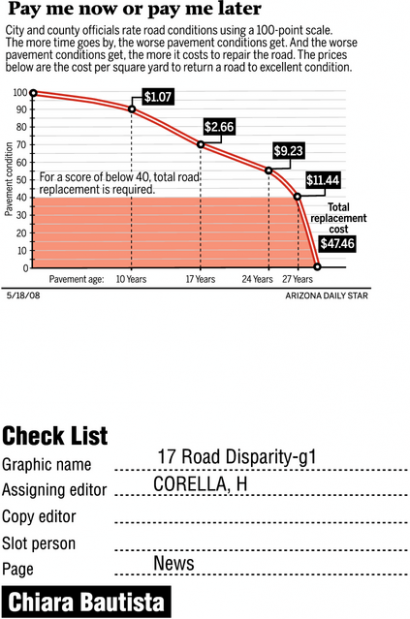
That means the average road in Pima County goes 25 years without any major maintenance.
People are also reading…
And the longer maintenance is delayed, the more expensive it becomes to fix aging roads when they eventually must be repaired, officials say.
In fact, some older county roads are in such bad shape, it's smarter financially to just let them fall apart, and focus on the roads that can be saved.
Pima County Supervisor Ann Day wants the county to increase spending on road maintenance and pointed to the city's financial sustainability plan, which sets aside millions of dollars every year for repairs to neighborhood streets.
"We should have a dedicated funding source," said Day, who called the county's policy "flawed."
County Administrator Chuck Huckelberry countered the county's first priority is to complete the projects it promised to voters in the 1997 bond package. He said the county cannot spare resources for road maintenance.
"We just don't have the money to do it," he said. "What are you going to take it from?"
The city and the county both get gas and vehicle license tax money from the state to spend on roads, and both receive state and federal money distributed regionally through the Pima Association of Governments.
It's how they use those regional funds that sets them apart. Tucson uses federal money to improve pavement conditions on its arterial and collector streets. Pima County uses the money to supplement the 1997 bond package. Many of those projects are long-delayed and far over budget. The County expects to use its federal funds to supplement Regional Transportation Authority projects, as well.
"The first priority is to do what we promised the voters we would do," Huckelberry said. "The greatest need in the county is for increased capacity."
And when roadways are widened or intersections improved as part of new construction, the pavement is redone, as well.
Over the past two years the city also has put additional general fund money toward repaving neighborhood streets. The program — part of the city's financial sustainability plan — is an attempt to make up for years of neglect.
In the early 1990s, the city had a program to address pavement preservation on residential streets every seven years. But then for nearly a decade, the city did almost no work on neighborhood streets.
Like the county, the city is facing budget cuts. But city officials still plan to put $7 million toward repaving neighborhood streets next year, continuing to focus on those in the worst condition, city Transportation Director Jim Glock said.
By the end of 10 years, the plan is to resurface in the neighborhoods that need it most, then to return to a regular maintenance plan, Glock said.
The program includes filling potholes, sealing cracks and then applying a chip seal to make a new surface on the roadway. A fog seal may also be added to prevent water from seeping into the surface and creating potholes.
So far, requests for pothole repairs on streets where the work has already been done have dropped from hundreds a year to zero, Glock said.
The city doesn't have a specific plan for pavement work on major streets because it relies on regional funding, which can vary year to year, Glock said. In 2008 the city received about $5 million in regional funds for resurfacing on arterial and collector streets.
"We are back into a more reactive mode than we would like to be in," Glock said.
This year, at Day's request, an extra $1 million was moved from an emergency fund to pay for neighborhood street repairs. That money almost didn't get spent when the state threatened to take gas tax money away from local governments, but county crews now are going ahead with chip-sealing projects.
Priscilla Cornelio, director of the Pima County Transportation Department, said her department does the best it can. However, rising fuel and labor costs have eaten into the Transportation Department budget of $47 million this year, a 20 percent increase since 2005/06.
"We're not buying more services with that money," Cornelio said. "It's just more expensive."
When roads get so bad they're considered in poor or failed condition, they're basically a lost cause.
"We focus on the good condition about to turn poor, because if we wait longer we have to do reconstruction instead of resurfacing," said Dave Cummings, operations and maintenance division manager for the county Transportation Department.
"You fix the ones that you can make last a lot longer with just a little money," he said.
That's why the county's 25-year maintenance cycle for roads, called pavement preservation, isn't cutting it.
"Streets don't last that long without treatment," Cummings said. "You really need to be doing something to these streets every eight to 10 years — 20 years is not keeping up."
Residents of the Shadow Hills neighborhood on the Northwest Side, near Orange Grove Road and First Avenue, are lucky. Their streets are getting a chip seal, the first in 14 years. That's far better than the county average, but they said their streets needed it badly.
"The cracks were expanding," said Richard Enholm, president of the Shadow Hills Homeowners Association. "There were square-yard chunks not attached to the rest of the street."
Day questioned whether the other supervisors put enough priority on road maintenance. Two of the supervisor districts are largely within city limits and road maintenance there is a city responsibility.
Supervisor Richard Elías, whose district includes Midtown and the Tucson Mountain foothills, strongly disputed Day's view of the issue.
"A lot of the county's roads are newer, so they don't need resurfacing," he said. "And of the money we've spent on road construction, 54 percent is in District 1. And that is because of needs and because the area is growing. So I can understand her concern, but I think it's misplaced."
The county's oldest roads are in the Northwest part of the metro area, and the county spends the most money fixing potholes there, officials say.
While Day's District 1 received the most money for subdivision street maintenance this year, three other supervisor districts received far more money for maintenance of arterial streets: Districts 2 (South Side), 3 (western Pima County) and 4 (East Side/Green Valley).
Huckelberry said the county's emphasis on new construction helps residents by easing congestion and saving them gas money. He also questioned how durable the city's commitment to pavement maintenance will be.
"If you look at it, they still have an $11 million budget hole," he said, referring to the shortage the city needs to overcome to balance year's budget. "I wouldn't count on that $7 million being spent on roads until it actually gets spent on roads."
Glock said the roads program already has been hit by the budget downturn. Before the drop in tax revenue, city officials had hoped to spend $11 million just on neighborhood roads. But he said he has been reassured the city was committed to the maintenance program.
While acknowledging the next budget year will be tough, Day said the county neglects one of its most important duties.
"When the roads get that bad, it's really hard on people's cars. It's a big quality-of-life issue," she said. "To me, it's the most fundamental service the county should do. And if we don't have good maintenance, it costs us even more."
DID YOU KNOW
Roads need surface treatment to keep tiny cracks from developing. If those cracks get a chance to form, water can seep into them during the rainy seasons.
Winter rains are more harmful to the pavement than summer rains, because the slow, steady winter rain allows the water to seep into the cracks. Once the water is there, cool nights cause it to freeze and expand, creating a pothole.
Monsoon rains tend to wash away and evaporate more quickly, leaving less time for the water to penetrate the surface.


