The Pascua Yaqui Tribe is buying up land along West Valencia Road in hopes of annexing it into the reservation. If successful, the tribe could develop it free of county regulations and taxes.
County officials say they recognize tribal sovereignty and want to see development in the area. But they have concerns about tax revenues and future road needs, including a proposed flood-control project on the Black Wash that could save the county millions in road construction costs and alleviate flooding over a 21-square-mile area.
If the land becomes part of the reservation, the businesses wouldn't have to pay state or county sales and property taxes. County officials have no estimate of how much could be lost because they don't know what will be built.
Tribal officials say they have not decided how and when they will develop the property or whether they will ask for it to be made part of the reservation, though a real estate specialist with the Bureau of Indian Affairs confirmed that tribal planners talked to him about adding the lands.
People are also reading…
"It would be natural to use it for commercial purposes, but no decision has been made," said Pilar Thomas, chief of staff to Pascua Yaqui Chairwoman Herminia Frias. "We're looking at the best way to utilize those lands to further the tribe's social goals and economic goals."
Casino revenues provide about 80 percent of the tribe's revenues now, but the tribe wants to diversify.
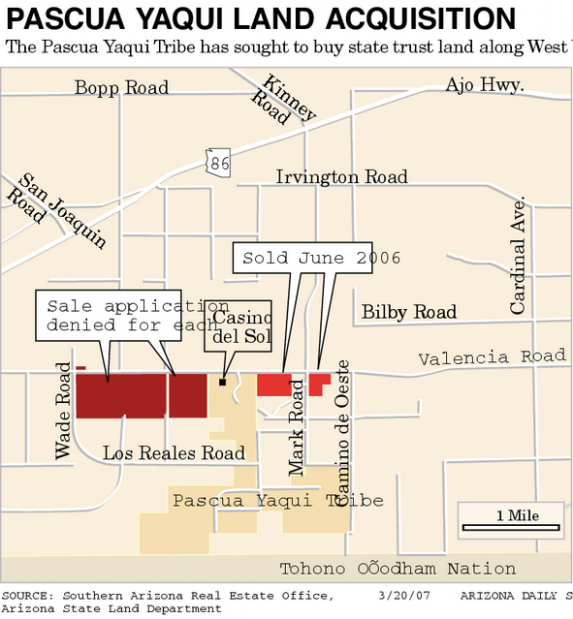
The Pascua Yaqui Tribe filed applications last year to buy four parcels of state trust land totaling 570 acres on the south side of West Valencia Road, on either side of Casino del Sol.
The State Land Department agreed to sell two parcels — one 60 acres, the other 30 — east of the casino and west of Camino de Oeste.
The tribe won a competitive action for the land in June 2006 with a bid of $3.28 million. The state minimum acceptable bid was $2.56 million.
The Land Department turned down requests for 480 acres west of the casino. Those lands aren't in the department's five-year plan, and the department is reviewing a request from Pima County for an easement on one of the properties to build a regional detention basin along the Black Wash, south of Valencia.
The area is prone to sheet flooding that closes three miles of Valencia Road in the summer. The county wants to build a detention basin that will hold water during the monsoon and release it slowly.
The basin, which could cost as much as a billion dollars and has no identified funding source, would cut the flow of water over Valencia by more than half and keep the road dry through a combination of culverts and bridges.
The project would make more surrounding land buildable by taking it out of the flood plain. County officials expect to hit up developers for some of the cost.
Deputy Land Commissioner Jamie Hogue said the tribe told the Land Department it would cooperate on flood-control issues if the tribe becomes the landowner. But the Land Department wants the control that comes from ownership. The detention basin could make state trust lands downstream more valuable.
For now, though, those lands are off the auction block.
But what was sold still raises questions about roads and other services to the property. As county territory, the developer would have to pay impact fees, and the county is preparing to make developers pay even more upfront costs for new infrastructure. Several rezoning requests in the area are on hold until next month, when the county will issue its Southwest Infrastructure Study.
If the tribe follows through on adding the property to the reservation, the county will get a chance to raise those concerns, said Wayne Sumatzkuku, a real estate specialist with the BIA's Western Region office in Phoenix.
While most applications ultimately are approved, applications have become more contentious in recent years as urban areas encroach on reservations. The state Department of Water Resources and local jurisdictions often raise objections.
"The states and local governments do weigh in, and we ask the tribes what they can do to mitigate their concerns," he said.
The parcels on Valencia are further complicated because the tribe doesn't own the subsurface rights — the State Land Department won't sell them — and the eastern parcel is close to, but doesn't actually border, the reservation. Requests to annex nonadjacent lands are held to a higher level of scrutiny.
County Administrator Chuck Huckelberry said if the two sites were privately developed for commercial uses, it might bring in as much as half what the similarly sized La Encantada shopping center pays in property tax, or roughly $350,000 a year — not including any property taxes paid by individual businesses. It also doesn't include sales taxes paid to the state, or the half-cent sales tax for transportation.
Huckelberry said that the county likely would not oppose an attempt to annex the lands into the reservation, but it would raise concerns.
"It makes it that much more difficult to finance the infrastructure that's needed to support whatever they would put in," he said.
Thomas said the tribe couldn't discuss what it might do to offset infrastructure costs until it decides what to build.
"I think we have aligned interests," Huckelberry said. "We just need to make sure we're talking."
Did you know?
The Yaquis, also known as the Yoeme, lived along the Rio Yaqui Valley in Sonora for centuries. Many Yaquis fled from Mexico because of government persecution in the late 1800s, and a large number settled in the Tucson and Phoenix areas.
In addition to the reservation off West Valencia Road and South Camino de Oeste, Yaquis live in four main communities: Old Pascua Village, east of Interstate 10 and south of West Grant Road in Tucson; Barrio Libre, in South Tucson; Yoem Pueblo, in Marana; and Guadalupe, near Phoenix.
On Sept. 18, 1978, the Pascua Yaqui Tribe of Arizona became a federally recognized tribe.
Source: Star archives