

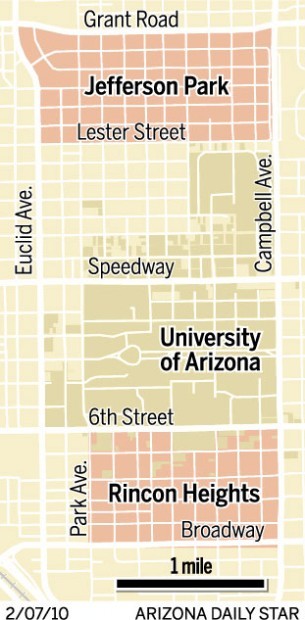
In its quest to fill flagging tax coffers, the Arizona Legislature has identified a new target - dozens of historic neighborhoods, mostly in Tucson and Phoenix, that experts say may never be the same if the proposal goes through.
Sen. Linda Gray's proposed SB1166 would eliminate the state property tax reduction for homes in neighborhoods listed in the National Register of Historic Places.
Gray's bill targets only one group of taxpayers: owner-occupants living in historic houses. Rentals and commercial property, which have their own tax reduction, are not affected by Gray's proposal.
Eliminating the tax break is well worth it, she said, if it means more tax dollars will go to public schools.
But Jonathan Mabry, Tucson's historic-preservation officer, says the bill will decimate historic districts in Tucson and cause property values to plummet, which will generate less in taxes.
People are also reading…
An analysis by Arizona's Joint Legislative Budget Committee supports Mabry's contention that the state will lose money, but for a different reason. The change will result in the state handing out more money under the homeowner's rebate program, which, with other factors, could mean a $1.4 million loss for the state.
Gray is retooling the bill in response to that and other concerns.
For the 2,078 homeowners in Pima County who take advantage of a 30-year, 45 percent property tax break, the effects could be dire, said Mabry.
"In some of our historic districts, there are houses that have been in a family for generations," said Mabry. "This bill could be the difference between them staying in their homes or having to sell it because they can't afford the property taxes."
For a $200,000 historic home, a homeowner participating in the reduced property tax program pays approximately $1,400 in property tax annually. If the program were eliminated, that same homeowner would pay $2,500 annually. Over 30 years, the homeowner who's enrolled in the historic property tax incentive saves about $33,000.
That worries Pedro Gonzales, president of the Barrio Viejo Neighborhood Association, which includes parts of the Barrio Historico Historic District.
"There are a lot of families who have been living in the neighborhood since the early 1900s," said Gonzales. "I'm concerned about the low-income, the elderly who are on fixed incomes and depend on these tax credits."
But Gray thinks, in the face of a budget crisis, property taxes could better serve K-12 education, which saw funding slashed last year and is expected to take another hit this year.
"I don't think it's fair for some people to be paying more in property taxes than others," said Gray. "They are missing out on the funding that needs to go for education."
Kevin McCarthy, Arizona Tax Research Association president, said dropping the break for historic homes won't necessarily give more money to schools. Given the way state law apportions taxes, it could mean lower taxes for other homeowners who are now subsidizing their historic neighbors.
The bill comes at a time when historic neighborhoods in Arizona are seeking National Register status at unprecedented rates.
In the five years since Eric Vondy became the tax incentive program coordinator for the State Historic Preservation Office, about 2,000 properties have been added to the National Register's list.
Vondy anticipates the number will double in the next six to eight months because "more and more neighborhoods began to apply, especially after the economy tanked."
In 2010, the state's Historic Sights Review Committee will review applications from about 15 neighborhoods throughout Arizona before sending them on to the National Register for approval. The committee normally meets three times a year. It will meet four times this year due to the number of nominations, Vondy said.
Mabry fears nominations could drop significantly if Gray is successful.
That's a shame, Mabry said, because homes in recognized historic neighborhoods are worth more than similar homes in neighborhoods with no historic designation - 5.9 percent more, according to a 2004 study of 13 National Register historic districts in Tucson.
For those that are both within a National Register district and participate in the State Historic Property Tax Reclassification Program, the boost in value is an even greater 18.7 percent. Homes that meet both those tests, and are in a designated city historic preservation zone, are valued 25.6 percent higher than those in similar, but undesignated, neighborhoods.
"Canceling this program decreases property values during an economic downturn," said Mabry. "How is that good for the state?"
Despite financial incentives, only about a third of homes in recognized historic districts take advantage of the tax reduction.
In the historic neighborhoods surrounding the university, many homeowners are not eligible for the reduction because they rent out their homes to students. Only owner-occupied homes qualify. Others have built additions to their properties, changing the homes' status from historic to non-historic.
But Mabry said many eligible homeowners don't participate out of ignorance. "They think the tax credit is regulatory, but it's not," he said.
Applying for the owner-occupied tax incentive program is completely optional, and there are no repercussions for a homeowner who decides to drop out of the program, Mabry said.
The only stipulation: If a homeowner makes a change to the exterior of the house, visible from the street, the addition must first be approved by the State Historic Preservation Office.
If not, the homeowner will be dropped from the State Historic Property Tax Reclassification Program.
about the reduction
• What: State Historic Tax Reductions for owner-occupied homes.
• Savings: Up to 45 percent off property taxes annually.
• To qualify: You must live in a National Register Historic District, be living in a contributing property and maintain the historic integrity of your home. Homeowners who obstruct the view of their home from the street or add features not compatible with a contributing property are disqualified. Some additions are reversible and, if completed, may qualify the homeowner for the tax credit.
• To apply for the program: Visit the State Historic Preservation Office's Web site: azstateparks.com/SHPO
Contact reporter Megan Neighbor at 307-0579 or mneighbor@azstarnet.com


