


Radioactive mineral exploration in the Colorado Plateau, including Northern Arizona, began 100 years after German chemist Martin Klaproth discovered uranium oxide UO2 in 1789.
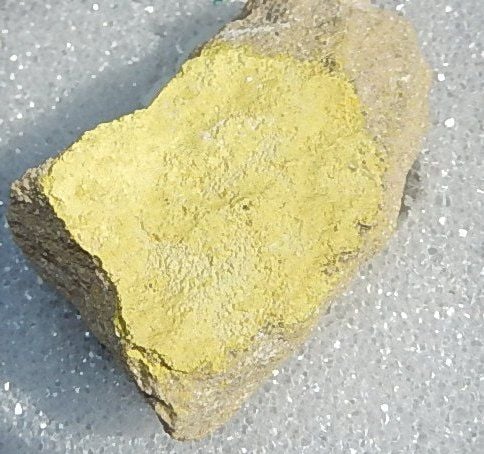
Before 1905, the world economy accommodated two kinds of uranium ore: pitchblende and carnotite.
Early on, uranium was used in glass and ceramics along with stains, dyes, specialized steels and lamps.
During World War I, interest in mining uranium ore for radium recovery grew, with the United States leading the world supply, later supplanted by the Belgian Congo in 1925.
Used today to produce radon gas for cancer treatment, radium once was used as paint on the hands and numbers of clocks and watches, though that practice was discontinued because radium is radioactive and causes cancer when inhaled or swallowed by the workers who made clocks and watches.
People are also reading…
World War II greatly enhanced U.S. atomic research as old vanadium mines in the Colorado Plateau were exploited for the isotope uranium-235, whose ability to undergo nuclear fission was essential to the manufacturing of nuclear weapons and power plants.
Luke Yazzie’s discovery of carnotite (an ore of uranium and vanadium) in the eastern part of Monument Valley in 1942 prompted a heightened interest in prospecting.
Formed more than 200 million years ago by collapsed cavern ceilings, mineralized breccia pipes averaging 350 feet in diameter with a depth of 4,000 feet were later identified by geologists in Northwestern Arizona as containing high-grade uranium ore.
Post-World War II saw atomic energy used for civilian purposes, including nuclear power plants able to convert the energy released by fission into the practical use of electricity. In 1948, the U.S. Atomic Energy Commission initiated a major uranium exploration and development program including bonuses for discovery averaging $3.50 per pound, with some prospectors earning $150,000 per month.
The Atomic Energy Commission hired Navajos to prospect for uranium during the 1950s. Navajo prospector Charlie Huskon made the first uranium discovery in the Chinle Formation near Cameron in Coconino County in 1952.
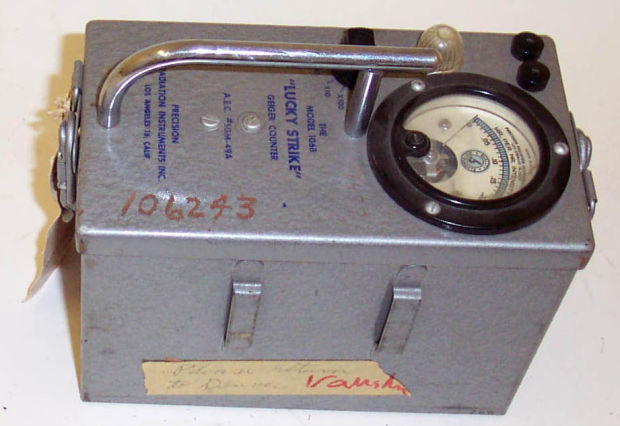
Popular Science magazine issues highlighted the benefits of uranium prospecting. Replete with a Geiger counter, uranium ore samples, electroscope, miniature cloud chamber and spinthariscope, the $50 Gilbert U-238 Atomic Energy Lab educational tool was sold to families in 1952.
Portable field Geiger and scintillation counters used to distinguish high levels of radioactivity from standard levels in rocks and from cosmic rays from outer space became highly sought-after among weekend prospectors.
The latter provide more sensitive readings because of the crystal reactivity to a greater amount of gamma rays than the Geiger tube.
Located on the Navajo Indian Reservation in Monument Valley in the extreme Northwestern corner of Apache County is the Monument No. 2 Mine.
The mine was operated by the Vanadium Corp. of America through a lease-sale held by the Office (now Bureau) of Indian Affairs, U.S. Department of the Interior, in which the Navajo tribe received a 10 percent royalty on the mined value of the ore.
Mills at Naturita and Durango, Colorado; Monticello, Utah; and Shiprock, New Mexico, processed the ore. Open-pit mining supplanted underground mining in 1957 and lasted until 1964.
Low-grade uranium ore at Monument No. 2 was later processed by heap leaching — applying sulfuric acid as an agent to dissolve the uranium, which was later recovered in solution. Byproducts also recovered included arsenic, iron, lead, molybdenum, selenium and vanadium along with the uranium or “yellow cake” finished product (U3O8).
During the height of its production (1947-70), it provided the Atomic Energy Commission with more uranium (more than 760,000 tons) than any other mine site in Arizona.
The Northern Arizona Uranium Strip District, covering 1,000 square miles in northwest Arizona, includes the Pigeon Mine, Hermit Mine, Pinenut Mine, Kanab North Mine and Arizona 1 Mine.
The district contains some of the highest-grade uranium in the United States at 0.64 percent, with 19 million pounds of U3O8 from seven breccia pipes mined from 1980 to 1990.
Falling uranium market prices, foreign competition, federal regulation and environmental concerns — including dust, radon gas and groundwater contamination — have since negatively affected domestic uranium mining.
William Ascarza is an archivist, historian and author. His latest book, “The Chiricahua Mountains: History and Nature,” is available at Barnes and Noble online. Email him at mining@tucson.com
Sources:
George H. Billingsley. 1997. Quest for the Pillar of Gold. The Mines & Miners of the Grand Canyon. U.S. Geological Survey. Grand Canyon Association.
William L. Chenoweth. 2011. The Uranium-Vanadium Production History of the Monument No. 2 Site, Monument Valley, Apache County, Arizona. Contributed Report CR-11-P. Arizona Geological Survey.
F.J. Hahne. September 1989. Early Uranium Mining in the United States. Fourteenth International Symposium, held by the Uranium Institute in London.
Pamela Hill. 2009. The Uranium of the Arizona Strip District, Northern Arizona: An endangered national resource. American Clean Energy Resources Trust.
Robert D. Nininger. Minerals for Atomic Energy. 1950. A guide to exploration for Uranium, Thorium and Beryllium. D. Van Norstrand Co. Inc. New York.


