

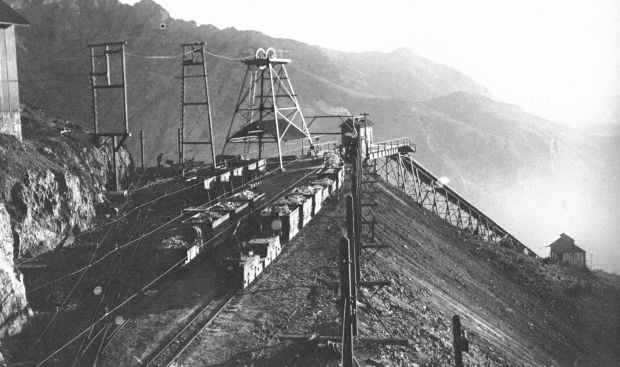
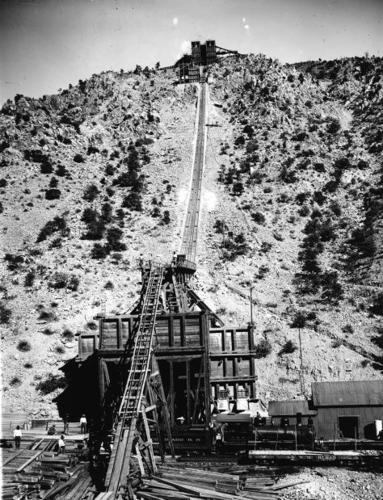
Inclines were used in mining operations to transport ore from mines located at high elevations down the mountainside.
The terrain was often steep between the mine adit and the ore bins below. Connected by a cable reel at the top of the incline, 1-ton, 3-ton and later 6-ton ore cars on mine tracks were loaded with ore, rolled to the edge of a cliff and guided down the canyon while hooked by cable to the ore bins below.
The ore was then fed to mule-drawn ore cars or railroad cars and shipped to the refinery where it was milled and smelted. Empty cars were hauled back up to the mine for repeat performance, often with the aid of a cable reel and steam-powered machinery. Inclines were also used to transport supplies to the distant mine sites.
Nine inclines were used in the early days of the Clifton-Morenci district, whose high cliffs composed of basalt, granite and rhyolite along the San Francisco River marked the region’s rugged character.
People are also reading…
The first incline built in the district in 1879 was the Longfellow incline servicing the Longfellow Mine. Originally 1,600 feet long it was later expanded to 2,200 feet, and was perhaps the only mine incline in the world that traversed through a 600-foot tunnel located halfway up the mountain.
Operating until 1922, it connected to a baby-gauge (20-inch) railroad at its base, which hauled the ore transported by the Longfellow incline 4.5 miles down Chase Creek to the Clifton smelter.
The Coronado incline served the Coronado Mine, located two miles west by rail and pack mule from the top of the incline. Operating until the Coronado Mine’s final closure in 1923, it stretched 3,200 feet, while rising 1,200 feet in elevation with a maximum grade of 68 percent — perhaps the longest mining incline in the United States and known for being extremely steep.
Its history was marred by tragedy on Aug. 13, 1913, when a cable car became detached and careened into another car down the mountain.
Nine miners lost their lives when riding the cable cars downward. However, an additional six miners made a timely jump to safety and avoided their colleagues’ fate.
Ownership of the remote Coronado Mine and Matilda shaft included the Coronado Mining Co., in 1874, followed by the Longfellow Mining Co., the Arizona Copper Co. and Phelps Dodge.
Coronado Mountain northwest of the Morenci Mine was the site of three baby-gauge locomotives built between 1882 and 1896 that were finally rescued in March 1990 when a drill road built by Phelps Dodge enabled them to be transported after having been abandoned for 67 years.
Considered the steepest in the district, the Shannon incline located north and east of Metcalf, included a rise of over 800 feet. Completed in the spring of 1902, it delivered ore to the narrow-gauge Shannon Railroad which transported it through Chase Creek Canyon to the Shannon concentration works on Shannon Hill in Clifton.
Additional inclines in the district included the Eagle incline which serviced the Humboldt Mine, Fair Play incline, King incline, 1,100-foot Metcalf incline rising 500 feet, the 900-foot Queen incline, and 800-foot Wilson incline. Many of these inclines shipped ore to baby-gauge railroads.
Declining copper prices in the 1920s coupled with the introduction of open pit mining in 1937 caused inclines to become impractical in the district.
Their rails were sold for surplus or engulfed by the open pit and other mining operations. Remnants of inclines can still be viewed in the Clifton-Morenci district as well as in other Arizona regions including the Bonanza Mine in the Harcuvar Mountains in west-central Arizona.
William Ascarza is an archivist, historian and author. Email him at mining@tucson.com
Sources: Theodore L. Cogut and William C. Conger (1999), “History of Arizona’s Clifton-Morenci Mining District, Vol. II”; William C. Conger (1987), “History of the Clifton-Morenci District”; James H. McClintock (1916), “Arizona, Prehistoric, Aboriginal, Pioneer, Modern: Vol. 2”; David F. Myrick (1984) “Railroads of Arizona, Vol. III”; Carlos A. Schwantes (2000), “Vision & Enterprise: Exploring the History of the Phelps Dodge Corporation.”
William Ascarza is an archivist, historian and author. Email him at mining@tucson.com
Sources: Theodore L. Cogut and William C. Conger (1999), “History of Arizona’s Clifton-Morenci Mining District, Vol. II”; William C. Conger (1987), “History of the Clifton-Morenci District”; James H. McClintock (1916), “Arizona, Prehistoric, Aboriginal, Pioneer, Modern: Vol. 2”; David F. Myrick (1984) “Railroads of Arizona, Vol. III”; Carlos A. Schwantes (2000), “Vision & Enterprise: Exploring the History of the Phelps Dodge Corporation.”


