


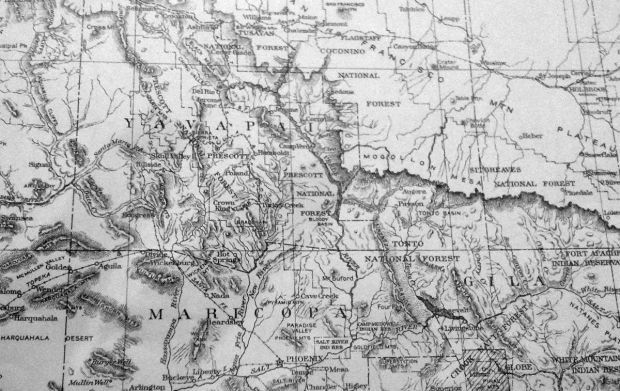
Evidence of early mining in Central Arizona’s Bradshaw Mountains before the Gadsden Purchase of 1853 includes arrastras worked by Mexicans who extracted $35,000 in gold.
The miners were subject to Apache deprivations, the most notable of which occurred in 1864, when five prospectors camped at a site later known as Battle Flat, held their ground against more than 50 Apaches. That year the Bradshaw Mining District was established.
North Carolinian William D. Bradshaw, namesake of the Bradshaw Mountains, arrived as a prospector during the Walker and Weaver expeditions. Credited with having established the Ehrenberg Ferry across the Colorado River in 1862, Bradshaw’s mining fortunes failed to parallel the successes of Joseph R. Walker and Paulino Weaver because his operations were confined to placering Black Canyon and Turkey Creeks on the east side of the Bradshaws.
People are also reading…
After unsuccessfully running for Arizona’s First Territorial Legislature in 1864 and losing a bid against C.D. Poston, “father of Arizona,” for territorial representative to Congress, Bradshaw committed suicide in La Paz in December, 1864 by cutting his throat with a carpenter’s draw knife.
As the largest mine in the Bradshaw Mountains, the Crowned King Mine at an elevation of 5,835 feet (now referred to as the Crown King) was located by Rod McKinnon in July 1875. Forty-five miles north of Phoenix, it produced a bonanza of gold under the Crowned King Mining Co.
The 500-building settlement of Crown King included a post office that operated from 1888 to 1954 with the arrival of electricity and a telephone in 1897.
Greatly aiding ore extraction was cyanide leaching, initiated in 1892, whereby the finely crushed ore was mixed in a tank of recyclable cyanide solution for at least 12 hours, then pumped to a holding tank.
There the solution was leached with zinc shavings that separated the metal from the solution.
By 1900, Crown King had produced $1.5 million in gold with $242,000 in dividends. Hindered by highgrading and embroiled in litigation by company officials Orren F. Place, Noah Shekels and George P. Harrington, the Crown King Mine closed for several years.
Crown King was connected to the community of Cleator over a series of nine hairpin switchbacks by the Bradshaw Mountain Railroad, a 28-mile branch line of the Prescott and Eastern Railroad built by Chinese laborers to transport ore from the mine in 1904 until it was abandoned in 1926.
Although railroad entrepreneur Frank Murphy built the railroad and later bought the Crowned King Mine in 1909, his involvement in its production was minimal. Mined by lessees during the first half of the 20th century, Crown King was played out, only producing small amounts of low-grade ore.
Local mines nearby include the DeSoto, the Peck and Swastika mines.
Another famous mine in the Bradshaw Mountains was the Tiger in what became known as the Tiger Mining District, which included Bradshaw City with a population of 5,000.
Owned by former Arizona territorial governor R.C. McCormick, the Tiger Mine was shipping $40,000 in silver bars to San Francisco in December 1879 with a gross annual yield of over $500,000. However, like the Crown King Mine, Tiger underwent extended periods of closures due to managerial disputes and declining ore deposits.
Recent efforts to reopen some of the historic mines in the Bradshaws include the Gladiator Mine which was operated by a crew of over 40 miners from 1985 to 1988.
The Bradshaw Mountains reach an elevation of 7,979 feet (Mount Union), the highest point in Yavapai County.
Ponderosa pines, Douglas fir and aspen trees, a multitude of mining claims and several dozen historical ghost towns and mining camps make the Bradshaw Mountains a recreational destination for Phoenix residents and visitors from around the world.
Sources
Waldemar Lindgren. 1926. Ore Deposits of the Jerome and Bradshaw Mountains Quadrangles, Arizona. U.S. Geological Survey Bulletin 782.
Robert L. Spude and Stanley W. Paher. 1978. “Central Arizona Ghost Towns.” Las Vegas, Nevada, Nevada Publications.
Bruce M. Wilson. 1990. “Crown King and the Southern Bradshaws: A Complete History.” Crown King Press. Mesa, Arizona.


