

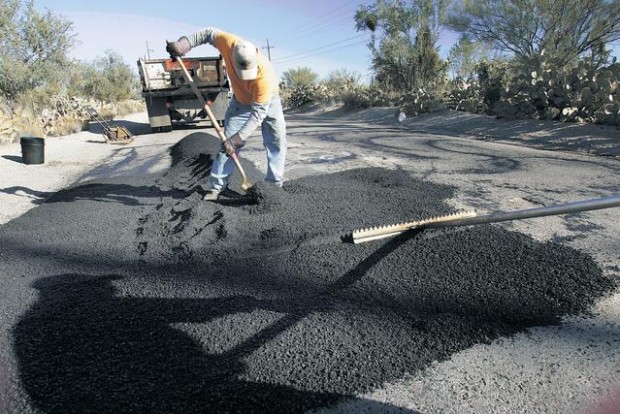
Quick, put the lid on that coffee cup if you're driving westbound on Orange Grove Road from La Cholla.
Both hands on the wheel and mind the bumps and road cracks if you're on Overton Road west of Jagged Rock Road.
There's a stretch of Elkins Road in Catalina that's more pothole than pavement.
But compared with the worst of Tucson's cratered Third World streets, most of Northwest's pavement looks like a Beverly Hills driveway.
Nevertheless, there are a number of forces working against them — including the area's population boom, which has spurred a surge in the number of vehicles traveling area roads, and wear and tear caused by heavy trucks employed by builders to house those new residents.
"Every road, from the day it's built, is falling apart," says Phil Trenary, manager of Oro Valley's operations division.
People are also reading…
Things could get much worse, and in very short order, says Conrad Yrigolla, Pima County's public works supervisor for District 3 West, which includes the Northwest.
Yrigolla says he may be the only person in Southern Arizona not hoping for rain.
"You just don't know how thankful I am that there hasn't been rain," he says. "We need the rain, but we'd be dead in the water."
Rain, especially rain followed by a freeze, is bad for roads. Water, Yrigolla says, leaches the oil out of asphalt. And if water freezes after filling cracks in the road surface, it expands and worsens the cracks.
In the world of road maintenance, you can't win. It's just a matter of how long you can delay the losing.
Drought isn't good, either
As it turns out, extended hot, bone-dry weather isn't great for roads, either, say Yrigolla and Trenary.
"Fines" — powdery particulates — help hold together the subsurface of roads. But when they get too dry, Trenary says, roads crumble.
The long drought has dried out the road surface, says Yrigolla, and now it's brittle. Rainfall now would worsen conditions and make it harder for crews to catch up on maintenance.
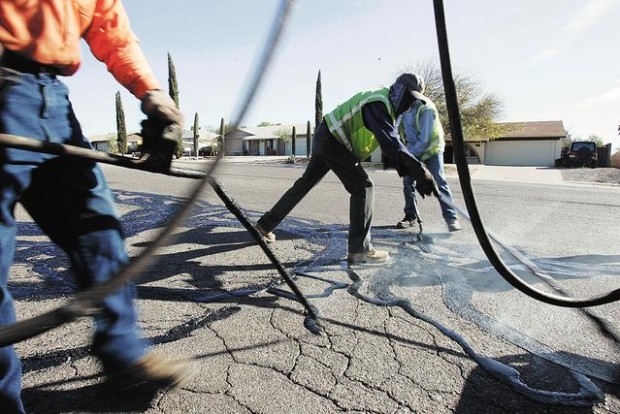
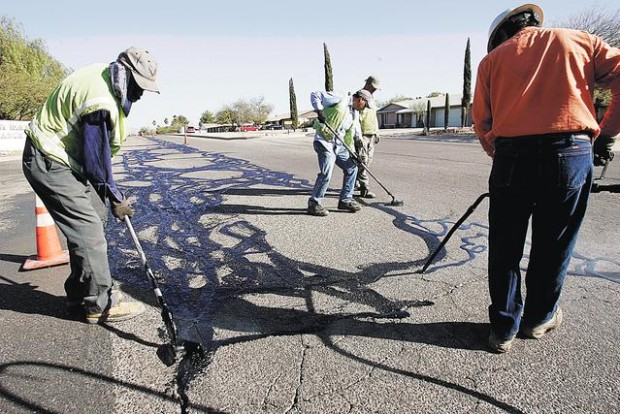
Oro Valley spokesman Bob Kovitz says the town has a policy of filling potholes within 24 hours after they're reported.
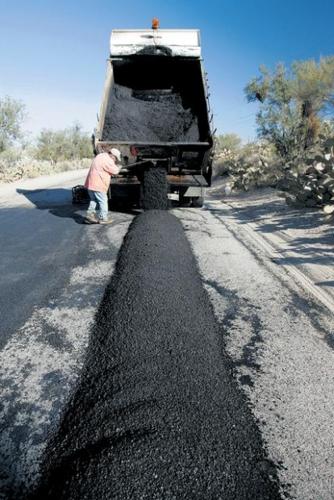
Trenary says Oro Valley's 14-member street crew goes through about a ton of asphalt hot patch a week.
"Every Monday the first thing we do is run our roads," says Trenary.
But, even staying on top of maintenance weekly, he says, "you fix one today and another will be there down the road tomorrow."
There are factors in road deterioration besides rain and drought, says Trenary. He says Northwest roads are also taking a beating because many were designed and built long before the population boom; many haven't been rebuilt from the subsurface on up to handle the higher traffic loads they now get.
Most, he says, started as dirt tracks, then were chip-sealed, and later layered with asphalt.
In that time, he says, they may have gone from a few cars a day to many thousands of cars. But often they never got a stable base adequate to handle the heavier traffic.
First, the foundation
In building a good road, "the first thing, like a house, you need a foundation," Trenary said.
The substrate soil must be tested to see how much weight it will bear, he says. Crews may have to start the road base 2 feet below the eventual road surface.
Many of our roads, particularly in the county area between Oro Valley and Marana, don't even have paved shoulders.
Parts of Silverbell Road south of Cortaro Road have no shoulder where a driver can go to dodge the potholes.
If there's no paved shoulder when traffic backs up behind someone making a left turn and motorists swerve off the pavement onto the gravel and back onto the pavement, tires tear up the pavement edges.
Yrigolla says his district has a contract with Southern Arizona Paving and Construction Co. to fill potholes. The county sends a list of streets that need work to the company; it has two crews working in the Northwest Monday through Thursday trying to keep up with the work orders.
Rocco Bene, the company's vice president, says it's particularly hard for crews to do the work on two-lane roads where there's no place to detour motorists except the shoulder.
Damage from heavy trucks
But there are other underlying factors behind road deterioration, says Trenary.
Heavy trucks cause more damage than passenger cars and light trucks, he says. And the Northwest's building boom is bringing a lot of heavy-truck traffic — concrete trucks and semis loaded with lumber and drywall.
Rising oil prices of the last couple of years make catching up on road maintenance following a few years of tight budgets far more expensive than anticipated.
"It's affected a lot of projects," Trenary says. "Say you had $400,000 to do three jobs. One will have to get cut."
And "it isn't just oil," says Trenary. He says the skyrocketing prices of concrete and steel also tear up road budgets because there's steel-reinforced concrete for curbs and gutters in many roads projects.
And there are other costs of road deterioration, but they're hard to calculate.
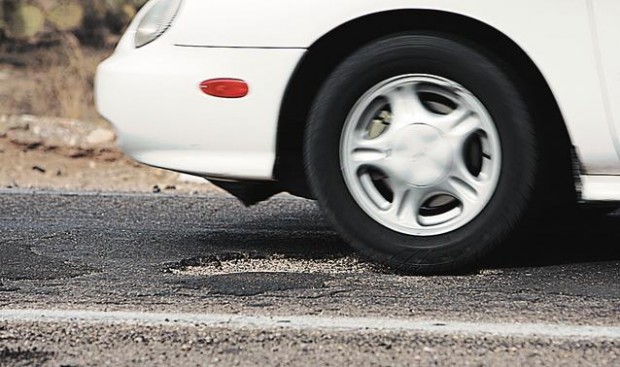
John L. Coker Jr., senior assistant manager of Discount Tire Co.'s store at 3960 W. Ina Road, said rough road surfaces can throw cars' and trucks' front suspension systems out of alignment and cause premature or uneven tire wear. And hitting particularly deep potholes can cause blowouts or even dent wheels and rims.
"A pothole, if you hit it square, something's going to get hurt," says Bruce Hunker, manager of the BrakeMax Car Care Center at 6055 W. Jenna Nicole Lane.
"But an SUV or truck is going to take it much better."
It's hard to find any bright spots in rough roads — except maybe as a reason to drive one of those tough-looking SUVs.


