

When most people call 911, they take for granted that an experienced paramedic will respond to their emergency.
But it takes hundreds of hours of training — both in the classroom and in real-world settings — for paramedics to gain the knowledge they need to make life-and-death decisions in stressful situations.
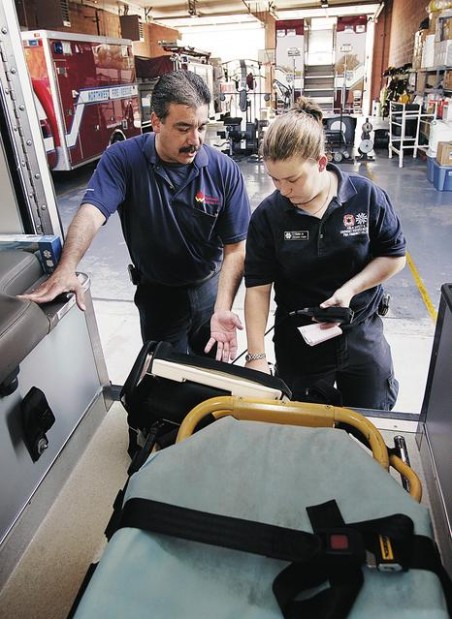
For people going to school at Pima Community College to become paramedics, part of that real-world training involves going on ride-alongs with the Northwest Fire/Rescue District. The fire district has a contract with the Public Safety and Emergency Services Institute — the organization that trains paramedics at the college.
Though they're not required to have four-year degrees, paramedics must learn how to diagnose people, use their medical skills quickly and stay calm — especially if the people they're helping begin to panic, said John Gillis, the advanced program manager for the Public Safety and Emergency Services Institute at Pima Community College.
People are also reading…
Brian Freeman, 24, has been an emergency medical technician for Southwest Ambulance for six years, and the next logical step for him is to become a paramedic, he said.
"It's good to know that you can help out somebody," he said. Most of the time, the people who call are at a low point in their lives and really need the help, he said.
As an emergency medical technician, Freeman stabilizes and transports patients but doesn't engage in more advanced medical procedures. He's taking classes at Pima Community College and goes with firefighters and paramedics from the Northwest Fire/Rescue District to emergencies as part of his training to become a paramedic.
During those ride-alongs, he takes an active role in helping patients through emergencies under the supervision of an experienced paramedic.
The students get hands-on experience, which is required for them to become paramedics, and the Northwest Fire/Rescue District gets extra help during emergencies.
And the paramedics who mentor the students sharpen their own skills, said Adam Goldberg, the Northwest Fire/Rescue District's emergency medical services captain.
"It really gives them a good refresher to be the best they can be and give good care," Goldberg said.
Paramedics and those striving to become paramedics agree that real-life experience in emergency situations is an essential part of the training. It's one thing to learn about dealing with emergencies in a classroom, but quite another to actually see people in stressful, life-threatening situations, Gillis said.
Though still a student, Freeman said he doesn't get too stressed out anymore.
"Sometimes you've got someone dying in front of you and you've got to act quickly to save them," he said. "That's when everybody digs down deep and hopefully the outcome is positive."
While dealing with that stress is woven into a paramedic's training, it takes a certain person to handle that kind of pressure, Gillis said.
Just as important as their technical training is their ability to communicate with people during a time of crisis.
"Most of the time, with the people they encounter, they'll be dealing with that person on the worst day of their life," Gillis said.
If paramedics can't talk to people, they won't be able to get the information they need to know about what's going on and how to treat the patient, Freeman said.
Part of his training has been learning how to talk to different kinds of people. They must deal with children, who might get nervous around adults they're unfamiliar with, or the elderly, who may expect to be treated respectfully by young paramedics.
Freeman said he knew he wanted to become a paramedic at a young age because his family is involved in emergency services. For him, the hardest part is absorbing the enormous amount of information about physiology and anatomy he must learn.
In dire situations, paramedics must do everything they can to help their patients, Freeman said. But inevitably they'll encounter a patient who can't be saved.
Freeman said he's prepared to deal with that.
"It's life. People live. People die," he said. "You can't let that stuff get to you in this job."
Sometimes you've got someone dying in front of you. . . . That's when everybody digs down deep and hopefully the outcome is positive.
Brian Freeman
Emergency medical technician


