

As a kid, you know you did it.
You tried to see how high you could jump, how far you could leap.
For most people, that desire eventually goes away.
The rest join their high school track and field team.
"That's how I grew up, trying to jump far and play in the sand," said Jack Van Riper, a former track and field star at Palo Verde who now serves as an assistant track coach at the school.
Van Riper concentrates on the jumping sports, including high jump, long jump and triple jump. Far less glamorous than the running events that normally dominate the attention of track and field fans, the jumps don't bring out nearly as many people interested in launching themselves into a pit of sand, or flailing their bodies backward over a wobbly bar more than 5 feet off the ground.
People are also reading…
"They're not really considered the cool events, like the 100 (meter dash) or the hurdles, or even the pole vault," said Sabino coach Bill Taylor. "But when you get a kid that's good in something, you get more kids that start to come out for it."
Such is the case at his school with the high jump, which has seen increased numbers during the four-year career of senior Bridgette Gilliland. Same thing for Marana coach Jayme Dozier, who since turning junior Robert Rowe into a state champion triple-jumper has seen other prospective competitors come out of the woodwork.
"It was very difficult getting people to do it until Robert came along," Dozier said. "Now a lot want to try it."
Long jump's popularity
The most popular jumping event is the long jump, which coaches say ties directly back to children's desire to see how far they can leap.
Palo Verde junior Shanell Wilson is the Class 4A-II state champion in long jump, hitting a personal best of 16 feet, 10 inches at last May's state meet at Mesa Community College.
The 16-year-old Wilson, who also runs the 100 and the 200 and is part of Palo Verde's 4x100 relay team, said she took up long jump while in middle school.
She said she takes great joy in perfecting her craft, which includes working to get her hips as high in the air as possible and mastering the steps she takes on her 73-foot approach to the large sand pit jumpers leap into.
"I just love jumping, and the feeling you get, it feels so good doing it," she said. "I try to get as animated as I can. I try to use every muscle in my body."
Van Riper, a 2000 Palo Verde grad, says that in searching for good long jumpers he looks for sprinters who appear to have the technique necessary to jump long.
"I'll just take the natural jumpers and try to form them into long jumpers," he said.
A quick study in triple jump
Robert Rowe tried nearly every event at some point during track practice his freshman year at Marana. He never figured triple jump would be the one in which he'd excel.
"I had never heard of triple jump until I came to Arizona," said Rowe, 17, who moved from Fort Lauderdale just prior to high school. "It looked stupid when I first saw it, but I got really into it, and now every meet I look forward to doing it."
Rowe is also the starting quarterback on Marana's football team. Dozier urged him to focus on the triple jump because he felt Rowe's 6-foot, 1 1/2-inch frame was perfect for the event, which requires participants to jump three times in succession.
"The first two jumps are mostly about (gaining) speed; the last one you're actually jumping," said Dozier, who always starts out new leapers on grass to prepare them for the physical strain to the back and legs.
"The first two, you try to stay really low. If you jump too high you could tear something."
Rowe uses a right-right-left technique that involves making his initial leap off his right foot, bouncing off that right foot to create his second jump and then propelling off his left foot for the final leap into the sand pit. Rowe, whose best is 44 feet, 6 inches, starts his jumps 32 feet from the sand.
"It takes a lot of technique, a lot of form to do it right," Rowe said. "It's not easy at all."
A unique skill
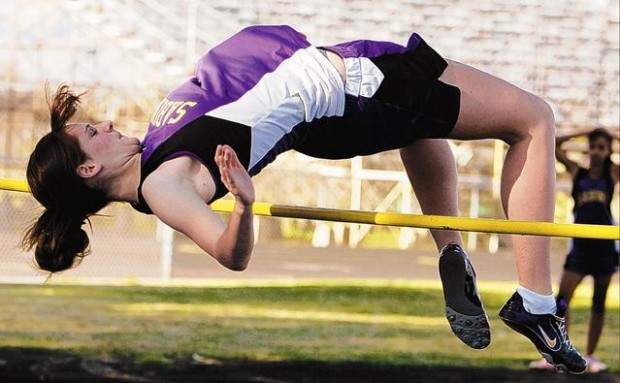
Even more unusual than the triple jump is the high jump, which requires competitors to hurl themselves upward and then backward over a raised bar.
Bridgette Gilliland has been doing that since fifth grade and considers herself addicted to it.
"High jump takes a lot of unique skill, and if you do one thing wrong it's all over," said Gilliland, 18, a senior at Sabino. "But if you do it perfect once, you'll want to do it forever."
Gilliland took second at last year's Class 4A-I state meet, tying Ironwood Ridge's Mallory Drain at 5 feet, 4 inches but then losing a jump-off for the title. That near miss is one of many things that keeps her coming back for more.
"It takes a lot of perseverance," Gilliland said. "I've had pole scars on my back that have lasted for months."
High jumpers must generate speed and momentum as they approach the bar, which hovers in front of a large overstuffed mat. As jumpers get close to the bar they get parallel to it and then thrust themselves into the air to start the leap, which ends up being backward. If the bar, which is not anchored, falls down during a jump it is considered a scratch.
"I drive my center of gravity as high as I can," Gilliland said. "When you get up over the bar, you arch your back and snap your chin forward, and that lifts you over the bar. And if you even barely touch it, you'll knock it down."
Bridgette Gilliland
School: Sabino
Age: 18
Year: Senior
Height: 6 feet
Primary event: High jump
Personal best: 5 feet, 4 inches (at 2006 Class 4A-I state meet)
2006 state finish: Class 4A-I state runner-up
The most important thing to learn about the high jump is: "It's a lot of rhythm. If you don't have a rhythm to your technique, you won't get over the bar. Once you get to the bar, it's a lot about having confidence."


