

Students involved in Amphitheater Middle School's Mathematics, Engineering, Science Achievement program would surely make Isaac Newton proud.
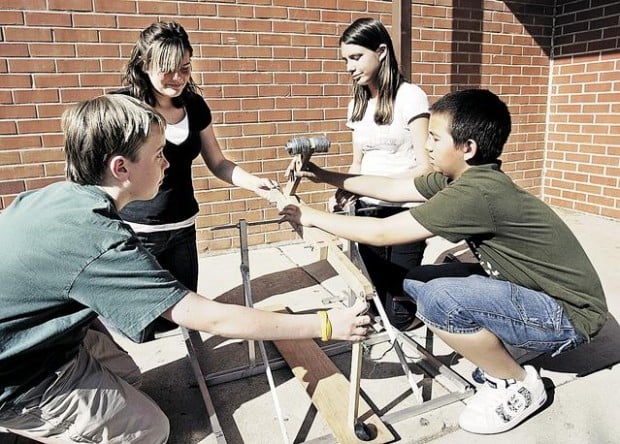
Seventh-grader Dan Cochran, 13, and his MESA teammates — Manny Ahumada, Caitlyn Parsons and Kiara Montoya — can discuss Newton's three laws of motion with ease when talking about how the laws relate to a trebuchet, which is similar to a medieval catapult.
Dan explained that Newton's first law states an object at rest or in motion will stay at rest or in motion until acted on by an unbalanced force.
"It works with the trebuchet because the projectile is at rest on the launch pad, and then we launch the trebuchet and the unbalanced force is the counterweight coming down and flinging the projectile through the air," Dan said.
"When it's going through the air, it's in motion and it encounters another unbalanced force, which is air resistance and friction, and then it's also pulled by gravity until it hits the ground."
People are also reading…
As part of the MESA experience, students compete in engineering activities. In February, Amphi was the overall winner at a regional MESA competition against eight other schools from Southern Arizona. On Saturday, Amphi will compete for the state title at MESA Day on the University of Arizona campus.
Other local teams competing are from Lauffer, Challenger, Booth-Fickett, Roskruge and Safford middle schools.
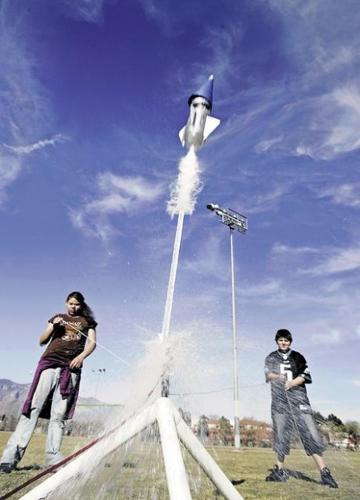
Events at MESA Day will include multitask trebuchet, cargo bottle rocket, on-site engineering design, roller coaster run, toothpick tower and solar water still challenges.
The trebuchet team was responsible for researching, designing, building and testing the device.
At regionals, Amphi's trebuchet slung a small, round projectile — a Hacky Sack — 65 feet, which was good enough for first place.
A trebuchet, which was used during the Middle Ages to hurl missiles, is like a catapult, but the two devices have some differences, seventh-grader Manny said.
"The difference is a catapult uses torsion to get its energy. A trebuchet uses a counterweight to get its energy," Manny, 12, said.
Torsion is when one end of an object is twisted or turned in one direction and the other end is turned in the opposite direction.
Manny was the lead builder, and he and his team used aluminum and wood to construct the device.
He based his design on that of one used last year by Tucson High Magnet School, he said.
It took him around three months to build the trebuchet.
"Ever since January, it has never got out of the 60s. It's only 60 or higher," Manny said in reference to the distance in feet that the device can throw a projectile.
Manny and his teammates hope their trebuchet will perform like it did at regionals. If Amphi can earn a first-place finish Saturday in the event, the team will be invited to the national event in June in Maryland.
The trebuchet challenge is the only event at MESA's National Engineering Design Competition.
In addition to proving to the judges that the trebuchet can perform certain tasks, students had to write a five- to 15-page technical paper, create an academic display and prepare an oral presentation.
It's not surprising that the team chose to write a 15-page paper.
Eighth-grader Kiara, 14, was the lead writer.
The paper details the design, development, experimentation and understanding of the group's trebuchet.
"It didn't sound like a little kid wrote it, and it didn't sound like a professor wrote it," she said. "It's like a college student wrote it."
That's what Amphi's MESA coach likes to hear.
Ron Pierce, who teaches science at the middle school, took over the MESA program last year.
MESA, which operates in eight states, is a college-preparation program geared toward ethnic-minority, low-income and first-generation college-bound students in middle and high schools.
The program's elements include college and career information; development of academic strategies; and math, science and engineering exploration.
"These are a great group of kids," Pierce said. "They work hard. They know they're good, but they just want to compete and show what they can do."
Although the rest of Amphi's team isn't competing for a chance to go to the nationals, those students are still proud of what they have accomplished.
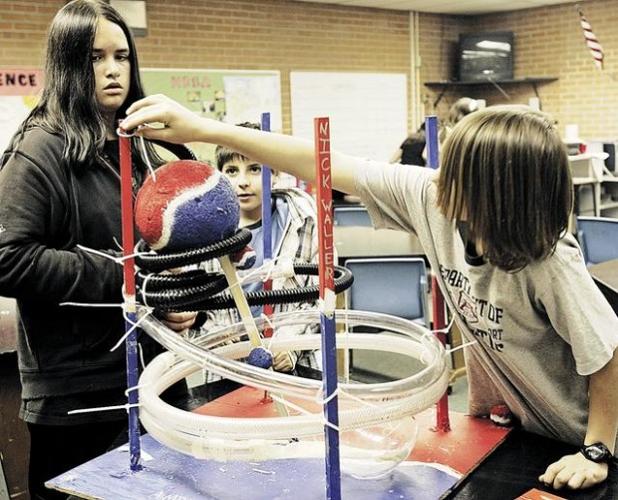
Sixth-graders Louis Montoya, Nicholas Waller, Derric Lopez and Angel Matas will participate in the roller coaster run challenge.
The group used different types of tubing to build a free-standing coaster that incorporates thrill elements, such as directional changes, and a creative theme. A marble is used as the coaster's "vehicle."
The students said designing and building the coaster was difficult, but it taught them about communication and compromise.
"You have to be friendly and not annoy everybody," Nicholas said. "We decided we could all benefit from it and have all of our ideas in it."
Student commentaries
Here's what participants say about Amphi's MESA program:
"I like it because we have fun and learn how to do science projects, like friction, and we learn how to construct. And we learn how to follow specific set goals, and if we don't follow them, we can't compete. It teaches us several lessons about science and life."
Wyatt Jameson, 12
. . .
"I like MESA because it helps you with creativity and involves some things you might need in high school, like physics."
Jordan Gilmore, 11


