

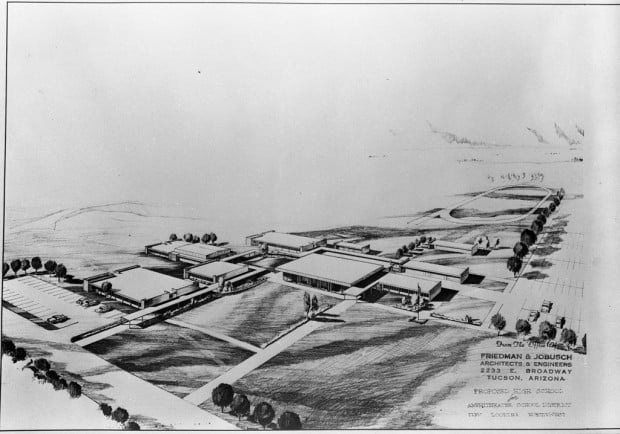
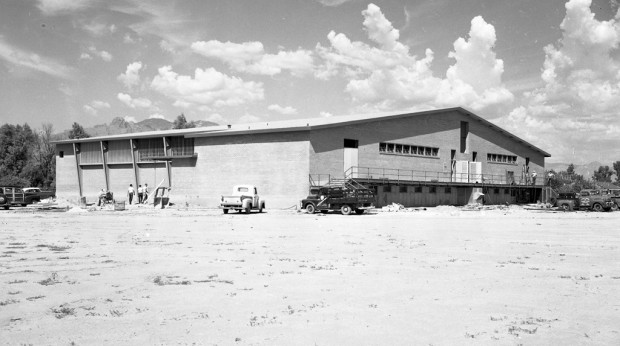
Editor's note: This article was printed Dec. 18, 1938, in The Arizona Daily Star. Today Amphitheater Public Schools has 21 schools and more than 14,000 students.
Late on a Sunday afternoon in September, 1893, little Eddie Wetmore was glad to hear his father say, "That's the last desk, boys. Let's go home and eat."
Eddie was 11, and he was tired. A small group of men and youths had been working since morning at an empty five-room adobe house on Prince road, 200 yards west of First avenue and some four miles north of Tucson. They had cleaned the well, greased the windmill, repaired the corral and outhouses, tidied the premises, and finished the day assembling 20 school desks and fastening them to the floor in a corner room.
School is ready
Amphitheatre school district, organized the preceding July, was scheduled to open for business in the morning. Thanks to community enterprise, everything was ship-shape; Eddie set down at one of the desks and slid to and fro, experiencing the shiny smoothness of the new furniture.
People are also reading…
Wetmore, veteran amusement park operator, lives today in a burgeoning suburb which boasts one of the largest rural elementary schools in the southwest - 800 students in a compact area which extends north from the Tucson city limits to the foothills, bounded by Campbell avenue on the east and running a half mile beyond Oracle road to the west.
Yet it was "the hell of a fight" getting a school at all in the first place, Wetmore recalls.
45 Years Ago
Amphitheatre was in its first phase in 1893. It was ranching country, with a dozen holdings south of Rillito creek and three or four over against the foothills on the north.
Persuading the ranchers they needed a school of their own was touch going. Ft. Lowell offered a thriving nearby institution of 60 or 70 pupils, and Flowing Wells was in easy distance. When County Superintendent J.S. Wood received a petition July 13 to appoint Joseph W. Andrews. G.W. Prince and E.L. Wetmore, sr., trustees of a new Amphitheatre Valley school district, the document was signed only by these three and by four other persons - three of them named Prince. The appointments followed on July 14 - and the enthusiasts set out to finance their venture.
"My dad, Andrews and Old Man Prince fought a long time to raise some money," Wetmore says. "They finally scraped together $128, ordered the furniture, and rented a house for $10. Equipment arrived so late we were barely able to get it ready in time."
That First Day
Eleven pupils were on hand the first day. Mrs. C.E. Wod had been employed as teacher at $70 per month. From her territorial school register she compiled a report in February showing an average daily attendance of 17.
The fact that Amphitheatre long remained a static ranching district is seen by picking up the teacher's annual report 15 years later. Average attendance was 12 in 1908-09, the salary was down to $60, and in the places provided, Schoolmistress Cora Verdenal noted that the library consisted of one volume (its title, unhappily, not recorded); the furniture was unsuitable, the water supply inadequate, and the condition of the single water closet only "passable."
Second Location
It was not Eddie's beloved desk she found "unsuitable," however; the first school had long since been gutted by fire. Trustees successfully rented a small frame house near what was later Pastime park, and a large dwelling close to the site of the Catholic cemetery; built a one-room school at the southeast corner of Prince street and First avenue and finally put up a one-room adobe building, which remains as part of the principal's office and opportunity room in the present elementary plant.
When the first homesteaders, most of them Mexicans, took up land along Rillito creek, they found the loamy lowlands covered with mesquite trees and a heavy carpet of sacaton grass - a wild hay ideal for fattening cattle.
Era of Cattle
It was great while it lasted. Wetmore says when he was a boy in the '90s, the 100-acre Ysidoro Arragon ranch across the road from his father's place used to run (as he calls it) from 500 to nearly twice that many head of cattle. The various Princes, the two Francos, Anisette Rodriguez, L.G. Samaniego and the rest of the major ranchers likewise did a thriving beef business. George Pusch found a site across from the present cemetery on Mammoth (Oracle) road an ideal location for a slaughter house.
In the course of time the range was ruined. Rillito creek no longer carried water most of the year. Ranchers thought it was because "the weather is changing" and turned to digging wells and pumping water. This seems to have ushered in Amphitheatre's second economic phase - when ranching gave way to farming.
Era of Irrigation
The lower Rillito valley changed from range land to irrigated fields. Melons and sorghum cane had flourished on flood water irrigation, but when deep wells were dug and pumps installed, the valley was planted in barley, alfalfa and cotton.
In turn, the old residents say, this period ran out around 1920. Federal Judge William H. Sawtelle's development of a project off Oracle road, in which more than 100 acres were planted and irrigated from a powerful pumping plant, marked the last gasp of the era of extensive cash-crop farming. The day of the three-acre "ranch" and the 50-foot town lot was at hand.
Conversion Comes
Establishment of Pastime park veterans' hospital at the western rim of the community was a factor in converting Amphitheatre from a rural district into city suburb. In the wake of hundreds of sick ex-soldiers came dozens of families. They wanted to be closer to the hospital than town; because they were poor, they needed cheap land and low taxes; on an acre or two of ground a veteran's family could raise a garden, a cow, and enough chickens to sell a few dozen in the city.
Tucson consumers, of course, have always furnished a market for Amphitheatre produce. Andrews, the first school trustee, used to load his wheelbarrow with fruit, eggs and honey and trundle it three miles to town. In the '20s, with Tucson growing by leaps and bounds, catering to city pantries became the community's major business. The poultry industry in particular thrived; in the late '20s, an estimated 35,000 hens cackled along the lowlands of the Rillito, producing virtually all the eggs consumed in Pima county.
Another Phase
Today, in contrast, there is little commercial agriculture in the community. Chicken ranches around the fringes, together with the many small flocks maintained for individual family consumption, are estimated by County Agent C.B. Brown to total not over 20,000 fowls. There is a small amount of dairy farming and some truck gardening in the creek bottoms. The bulk of Amphitheatre's farm produce is grown for home consumption.
The area's population growth, as farms were broken up into lots, is reflected vividly in school statistics: A two-room building in 1920, a $15,000 bond issue in 1923 to provide eight new rooms, and additional bond issues totaling $58,000 in 1928, 1930 and 1938 - not to mention heavy federal expenditures. Ten years ago the September enrollment was 240; five years later it was 400, and this fall the school (which now includes the ninth and tenth grades, and plans for more) had an initial enrollment of 758, with 800 assured at the mid-year peak.
The School Is Everything
The school house has always been a center of community life at Amphitheatre, and what goes on there has reflected in some measure the changes in the character of the population.
Frank Howe recalls fondly that when he moved out on Prince road in 1921, there were only a half a dozen houses in his neighborhood. Semi-monthly dances at the school were a great treat; a two-family committee made plans for each affair and in turn appointed two more families to arrange the next event. They danced the old-time dances, and everybody knew everybody. "But the people changed," Howe says.
Today the heart of Amphitheatre is the area between First and Stone avenues which Prince and Ft. Lowell roads cut through. It is, on the whole, a community of lower middle class families who live on an acre or considerably less of ground, with scattered oleander bushes around a stucco house and a tank of fuel oil elevated on a wooden frame alongside.
It is said that no town-lot home in the school district, apart from business-residence buildings, has an assessed valuation of $5,000.
Area of Modest Homes
There also are beautifully landscaped and tended yards around modest homes, and a number of small ranches calculated to stir yearnings for the soil in any city breast capable of being stirred along those lines.
Chief influence of the school as a community center now is in providing healthful and mischief-preventing playground activities, in encouraging citizens to improve sanitation and the water supply, and in teaching youths that planting a garden eases the pinch of living costs, while raising blooded stock or a flock of turkeys will enable an industrious boy to put himself through high school and even college.
Ultimate Statistics
One last statistic, if you're entertaining any doubt that Amphitheatre is growing like a mushroom and is fully entitled to the title of No. 1 Suburb: The district's total assessed valuation 15 years ago was $399,000; five years ago it was $711,000 (a depression-time reduction, at that); in the current year it is $1,345,000.


