PHOENIX — A state lawmaker wants to give voters a new chance to decide if he and his colleagues are worth more than the $24,000 annual salary they now get for what are supposed to be part-time jobs.
Sen. John Kavanagh, a Fountain Hills Republican, is proposing a measure for the 2026 ballot to add an automatic inflation adjustment. If voters approved, lawmakers would get an annual boost every year tied to the Consumer Price Index.

Sen. John Kavanagh
Unlike the current system, lawmakers would never again have to seek voter approval for future pay hikes.
Kavanagh, the longest continually serving legislator, acknowledged that voters have had multiple chances in the past to decide the $24,000 figure, approved in 1998, is too low.
But they turned down each effort, most recently a 2014 proposal to set the figure at $35,000.
People are also reading…
He said this is different because it would use the current salary as a base and then just make annual adjustments.
So, had his proposal been in effect now, the lawmakers being sworn in next week would get a $648 raise based on the most recent CPI report, which pegged annual inflation at 2.7%.
Even though being a lawmaker is considered a half-time gig, Kavanagh said lawmakers have been meeting most years from January into at least May despite a 100-day deadline to get their work done each year. Plus there are hearings and other meetings throughout the year.
That precludes many legislators from having outside jobs. “There aren’t many people looking around for half-time workers,’’ he said.
Kavanagh said he really thinks the salary should be $48,000, based on inflation since their last raise. He said that would not be unreasonable, even if it is higher than the median income for Arizonans, because it’s based on the responsibilities lawmakers have.
“I mean, we’re not digging ditches, we’re not working a fast-food restaurant line,’’ Kavanagh said.
He also thinks it’s justified to take voters out of the equation for the future if they approve this plan. “Very often, the mood of the public, based on other events the Legislature’s associated with, sometimes determines whether they’re for us or against us,’’ he said.
Put another way, his plan would make irrelevant whether voters like or hate what lawmakers are doing at the moment.
No raise since 1998
Under the Arizona Constitution, voters get the last word on legislative salaries.
The Commission on Salaries for Elective State Officers is supposed to meet on a biennial basis. Among its tasks is to make recommendations for legislative salaries and ask voters to approve them.
The panel did make such recommendations in 2000, 2002, 2004, 2006 and 2008 — all rejected by voters.

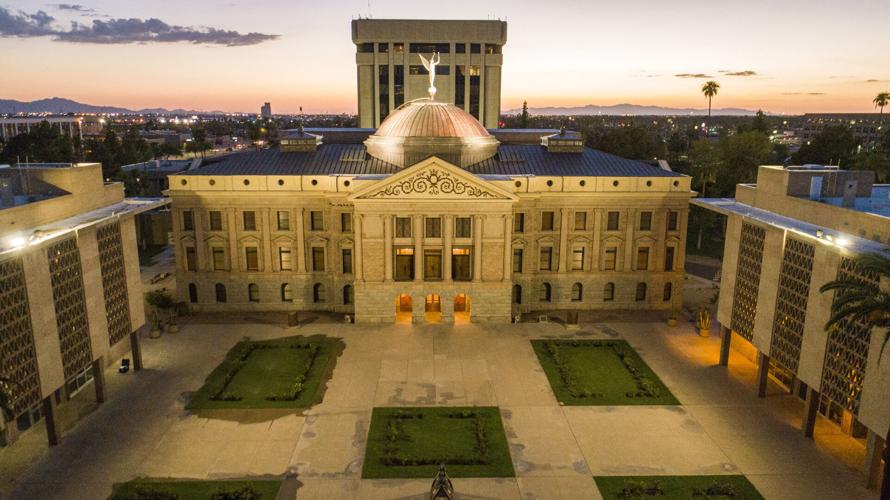
The Arizona State Capitol in Phoenix.
When Republican Jan Brewer was governor during the Great Recession, she refused to name members to the panel for four years, saying it was inappropriate to consider pay hikes for elected officials during “difficult times.’’ She did make selections in time for 2014 — though she openly opposed that proposal to boost pay to $35,000. It fared even worse than the others, with just 32% of voters favoring the plan.
Since then, however, the commission has made no recommendations.
In fact, the commission exists only on paper as Republican Doug Ducey, governor from 2015 through 2022, who succeeded Brewer, did not fill two vacancies when they developed on the five-member board, one of whom is supposed to chair the panel. Kirk Adams, who was his chief of staff, said Ducey shared the concerns about asking voters to raise pay for elected officials during difficult economic times.
Current Gov. Katie Hobbs, a Democrat, has not resurrected the panel, though there was no immediate response from her office about why.
So, absent what Kavanagh wants, there is currently no way for lawmakers to get voters to consider a pay hike.
Inflation factor
The senator said his plan is a better alternative — and not just because it doesn’t rely on a governor to set the process in motion. If approved, the annual adjustments would be automatic and not dependent on the commission.
Kavanagh thinks his Senate Concurrent Resolution 1003 should be an easier sell than the bigger increases that voters have turned down in the past.
“I do not believe that the voters in 1998 when they said ‘You should get $24,000’ intended for that amount to be eroded nearly in half due to inflation,’’ Kavanagh said.
In fact, an inflation calculator from the U.S. Bureau of Labor Statistics figures you’d need $46,085 in current dollars to buy as much as you could for $24,000 in 1998.
Anyway, Kavanagh said, there is precedent for what he is proposing.
In 2006 voters approved creation of the state’s first-ever minimum wage. That set the floor for workers in Arizona at $6.75 an hour, versus the federal minimum of $5.15.
More to the point, that law requires annual inflation adjustments.
That measure, along with an update in 2016, has boosted the state minimum wage to $14.70; the federal minimum remains at $7.25, a figure Congress hasn’t adjusted since 2009.
“If the voters said inflation’s OK for the minimum wage, I don’t think voters would be opposed to this,’’ Kavanagh said.
The senator did not mention, however, that he opposed the ballot measure raising the minimum wage. But he did argue that an inflation adjustment is more justified for lawmakers than for those at the bottom of the pay scale.
“Most people only work in a minimum wage slot for a short period of time before they either get a promotion or a longevity raise,’’ he said. “There is no promotion or longevity raises for legislators.’’
Other legislator perks
While the salary is just $24,000, there are other perks.
The minimum per diem allowance for expenses is $35 a day for those living in Maricopa County for what is supposed to be a 100-day session. In essence, that’s a payment for going to the Capitol in Phoenix, though they also get the allowance for weekends and other days the Legislature is not in session. That figure gets cut to $10 a day after 120 days.
Out-county lawmakers get a figure equal to the federal General Services Administration rate, the number used by the federal government to reimburse employees on the road. That is currently about $250 a day, covering both lodging and an allowance for meals.
Then there’s a pension. For those first elected to any office before 2012, it can hit 80% of what they were earning after 20 years; there are lower benefits for newer elected officials.
There’s also a sweetener for those who move from the Legislature to another elective office: Their benefits are calculated on the highest five years of their earnings.
So a lawmaker who served 16 years at the Capitol at $24,000 but then became the state treasurer at $70,000 would be entitled to a pension of $52,500 after five years on the new job, plus annual cost-of-living adjustments.
Howard Fischer is a veteran journalist who has been reporting since 1970 and covering state politics and the Legislature since 1982. Follow him on X, formerly known as Twitter, Bluesky, and Threads at @azcapmedia or email azcapmedia@gmail.com.


 Want to see AZ's governor grilled like a prime minister? This lawmaker does.