
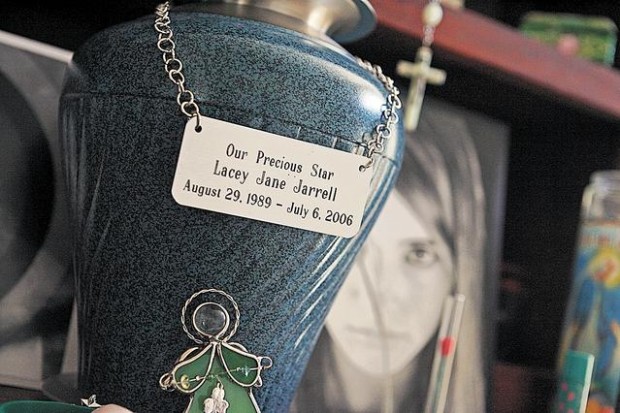

Here is what hope looks like to Nancy Jarrell after the loss of her 16-year-old daughter, Lacey:
"You don't want to imagine my life now. It is simply one of putting together days, hour by hour, to somehow get further away from July sixth and closer to seeing her again in a place far away."
She writes this on Dec. 9, five months after Lacey was killed when she rolled her car on River Road.
Nancy says she recognizes this new orientation of her life as a death wish. She is trained in counseling and psychotherapy. She has read all the books, and she knows about grief from personal experience.
Her best friend, Harriet, died when they were both 18.
Her brother Tom fell from a bicycle, hit his head and died when he was 40, shortly before Lacey was born.
People are also reading…
Her father died in April 2005, her mother a week later.
"All these grief experiences, in some way, gave me preparation for what I call my ultimate loss. At least I hope it's my ultimate loss."
She will do nothing to hasten the day of her death, and she will not give up on living the days between now and then.
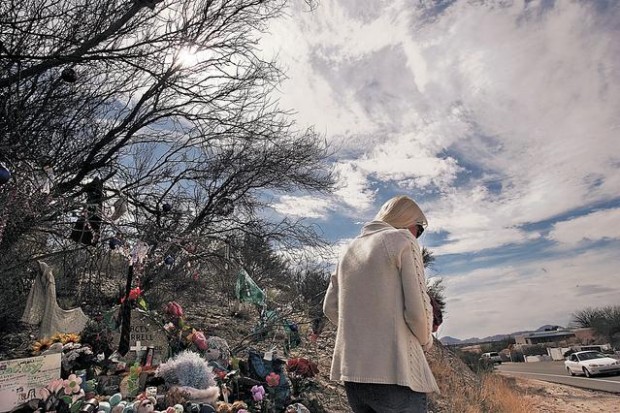
She will work to make sure her daughter is not forgotten, keeping up her shrine on River Road and moderating her MySpace site on the Internet. She created bracelets in Lacey's favorite color, green, decorated with the stars she loved and bearing the message "Lacey: Buckle for Me," to pass out to her classmates and friends.
She is forming a nonprofit group, the Lacey Jarrell Foundation, to create venues for teens to express their artistic sides, and she dreams of opening a gallery that would promote young artists — the Green Star Gallery.
She is recording the events and thoughts of each day, writing a book on grieving a child.
She works more than ever, and she meets with her daughter's friends frequently to keep Lacey's memory alive and to help them deal with their pain and sorrow.
She has had powerful, honest discussions with Ernesto Chavez, now 19, who escaped nearly unharmed from the crash that day.
Lacey and Ernesto's relationship had been stormy before and after they broke up in March. Nancy at first wondered why Ernesto was even with her daughter when she died. She has come to accept that God wanted Lacey that day, at that time, for a reason.
"I have told him, 'I don't blame you, Ernie, for her death, and I want you to stop blaming yourself.' "
***
Ernesto JUST WANTS 10 seconds of his life back.
He and Lacey used to play a computer game called "Prince of Persia: The Sands of Time," in which one of the weapons players can wield is a "dagger of time."
"If you fell or you died, you could rewind up to 10 seconds back. I would do anything for something like that — to be able to rewind time. I'd give up everything, give up my car, all my money, all my possessions if I could just do that and bring her back."
If there is a lesson in Lacey's death other than the obvious "Wear your seat belt," it is this, Ernesto says: "You are not promised another day."
He learned that lesson from a song called "Problems" by Rappin' 4-Tay.
"You ain't gotta listen, but take it from your boy 4-Tay, fool, you think you promised another day?"
Ernesto knows and he has been told by others that he owes it to Lacey's memory to go on living, to make something of his life. "Lacey would want me to not just do nothing. She would definitely want me to follow my dreams."
What those might be he hasn't figured out. "I just live one day at a time right now."
He is working six days a week in customer service for a prepaid-credit-card company. On Sundays he plays paint ball, getting out some aggression and anger, and just doing something he enjoys.
"I can talk to friends a little bit about it, but no one understands. A lot of times I end up talking to myself. ...
"There is nothing I can do to stop the pain. I think about her every day."
Lacey was in junior high when Ernesto first saw her. His friend Daniel had a crush on Lacey's friend, so they both went to a basketball game where the two girls were playing. He had eyes only for Lacey.
They began dating soon after. On April 12, 2003, to be exact. They went to Spring Fling. Ernesto was 16, Lacey 14.
The mothers thought the age difference was inappropriate. "We were both horrified," said Ernesto's mom, Mel McBeath.
"We made sure we knew each other and tried to keep tabs on what was going on. We thought it was just a crush."
"At first, you think it's a crush," said Ernesto. "Then comes a month, then a year, then two years. For both of us, it was our first serious relationship.
"She was wonderful. She was a beautiful girl who didn't deserve to die, and I'm going to miss her for the rest of my life."
He bought a car after Lacey died — a newer model of her Subaru Impreza. His isn't a turbocharged WRX like Lacey's was, but he's added parts to boost its horsepower. He drives fast sometimes. "I lost the love of my life. I lost the reason to live. That's why I drive really fast sometimes, because if I did die, that's OK, I'm not afraid of dying anymore."
He often drives by the site of the accident, to stand by the memorial, to bring roses. "Every time I go by that turn, I just look at it and I get angry because it's really not that bad of a turn. It's really not that sharp a turn. We were just going so fast."
***
Nancy Jarrell drove those curves repeatedly after her daughter's death. She drove them at varying speeds, trying to determine at what point, and at what speed, a car would leave the pavement.
She needed to know the details. She read the police reports, asked for all the photographs from the scene. She fixated on a witness's claim that she had felt a pulse in Lacey's foot.
Talking with Paul Smith and Alan DeKalb, the paramedics, helped settle that point, she said. They assured her Lacey died instantly.
Nancy's friend Jack O'Donnell also helped, though the two had stopped dating months before.
He looked at the crash photographs, editing out the ones Nancy did not need to see. He had planned a monthlong getaway to Aspen, Colo. — "just me and my dog" — and persuaded Nancy to come along. He wanted to get her away from the scene of her daughter's death and from a house in which she woke each morning and asked "What do I do today?"
It was up and down. Some days, she was able to go out for hikes and meals. She even parasailed off a mountain. On other days, she simply curled up in a ball and cried.
When she returned to Tucson, she threw herself into her work at Sierra Tucson.
"Work helps me. For one thing, I work with all these phenomenal people who happen to be doctors and nurses, psychologists and therapists."
She doesn't have to ask for hugs. When her co-workers ask how she's doing, they don't expect an easy answer. They are professional listeners.
The job itself became easier. "The prefrontal cortex, the executive-decision-making place, is functioning very well at work. Emotionally, I still feel I'm quite a mess, but I get up in the morning; I go to work. I'm working more, working better."
At home, it is different. There she is often "a puddle on the floor." Each spot holds a memory, she says, as she sits at her kitchen table. "It was right there (by the refrigerator) where she told me I was the best mom and that she loved me. It was there (by the garage entryway) we had a discussion about being old souls. We decided Lacey was the oldest."
Her salvation at home has been her friends, the strangers who have entered her life because of Lacey's death and her daughter's wide-ranging circle.
"The kids have been the biggest support to me. They maintain contact. They keep her memorial going, check on me. They pushed for a second tribute at the school when they decided the first one didn't do it.
"One left a note at the roadside memorial — 'I'm going to take care of your mom.' "
***
The note was from Christina McAlpin, whose nails Lacey painted the evening before she died.
Christina's nails ended up looking a bit lumpy, "a white background with rainbow sparkles." In other circumstances, she would have reached for the nail-polish remover. She didn't touch them until her nails grew out.
Christina, 21, is one of a trio of young women who visit Nancy routinely.
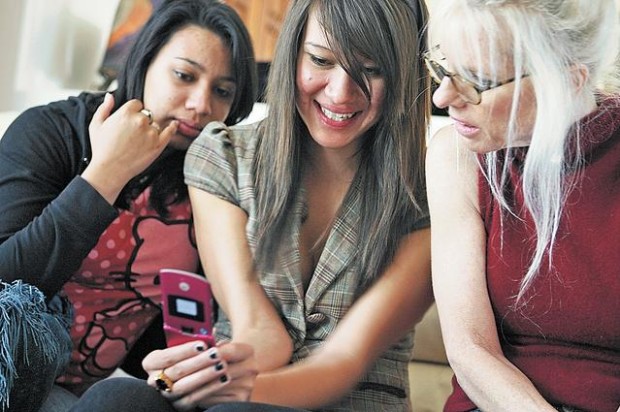
Emily Heintz, 19, had been a sleepover buddy and "big sister" since meeting Lacey in middle school at St. Gregory College Preparatory School. Her cell phone, programmed by Lacey, lists Nancy Jarrell's number under "Mommy No. 2."
Megan Shaw, 18, was befriended by Lacey when she moved to Tucson from Connecticut in 2005 and starting attending St. Gregory. She said Lacey made the transition bearable.
All three learned of Lacey's death by cell phone on the day she died. Emily was at a friend's house watching "Charmed" on TV when her mother called and told her to turn on the news.
Megan was back in Connecticut for the summer, in a car with her boyfriend who was driving on a winding country road when a friend called her.
Christina was driving in Tucson. She had been trying to reach Lacey all day and finally got through on Nancy's cell phone, was surprised when O'Donnell answered. "Pull over," he told her.
They each had similar reactions — screaming profanely at the bearers of the news: "No, you're lying!"
The friends all wear stars in Lacey's memory, on bracelets and necklaces. Megan Shaw keeps one of the green-star bracelets Nancy Jarrell had made on the stick shift of her car — "Lacey: Buckle for me."
Emily had a star tattooed behind her ear because, she said, Lacey is always talking to her.
It took several sessions for Lacey's brother, Will, to complete his tattoo — a tree whose branches wrap around a green star. The roots spell out "Lacey" in cursive script.
It's on the back of his left shoulder.
"She's got my back, like she always used to," said Will. "Every night before bed, I give it a little pat."
"I talk to her sometimes," said Will. "I know my mom is really into like taking little things and turning them into big signs of Lacey phenomena. I'm not sure I'm picking up on that as much," he said by phone from Boulder, Colo. "Maybe it's because I'm not there."
Nancy and Lacey's girlfriends all talk to her and, they say, they receive signs she is listening.
Emily loves the rain. It rained on her birthday this year. Lacey brought the rain, she believes.
Emily and Lacey spent many evenings together on the swing sets at Fort Lowell Park. She goes there now, alone. "One time I went there, one of the two swings was broken."
Lacey's MySpace site buzzed when it snowed last winter, covering the cacti and trees surrounding Lacey's memorial. Lacey brought the snow, wrote Megan.
On Valentine's Day, Emily went to St. Greg's and persuaded her mother, who is head of the upper division there, to pull Megan from class so she could give her a hug. It was the kind of thing Lacey would have done, Emily said.
Megan, since Lacey's death, has begun asking herself, "What would Lacey do?"
She has healed rifts with friends and family. "There is kind of always going to be a void there, but it's more positive than I would have expected, because she told me you need to start appreciating people more."
A boyfriend came back, courtesy of Lacey. Before Lacey died, she had called him, told him he had to forgive Megan and reconcile: "She's really going to need you," Lacey had told him.
The young women talk comfortably with Nancy and with one another, though they didn't know one another well before Lacey's death, being parts of different groups of friends Lacey maintained. It's difficult to say who is helping whom.
"They say, 'Who do I talk to now that Lacey's gone?' I tell them 'Talk to each other,' " Nancy said. "The kids want to spend time with me. I have to take care of myself. But I'm a mom. I'm a therapist. I came home one night from work, there were six of them waiting for me at the door."
Recently, Nancy spent a long weekend with a group of therapists training in psychodrama. She acted out the many roles she's playing now in other people's lives.
"Who takes care of Nancy?" they asked her. "I think I said 'I do, and that really wasn't working very well.' "
***
In the weeks and months after she witnessed the crash, Michelle St. Rose began seeing groups of teenagers, obviously distraught, gathering at the memorial. She went down the hill from her home to meet them, to learn about this young woman who had died.
They told her about Lacey Jane Jarrell. Said she was special. She wasn't the type to shake hands. The first time she met you, she would leave you with a hug and an "I love you."
St. Rose, who had failed to tell her daughter she loved her on the day before Lacey died, vowed that would never happen again. Now she leaves nobody in her life without saying those words. She still calls her son daily with that message.
"This has been a life-changing experience for me," she said.
St. Rose would often see Nancy at the roadside memorial but felt reluctant to intrude.
By then, she had sought counseling for what was diagnosed as post-traumatic stress disorder. She couldn't sleep, couldn't walk onto her balcony without reliving that day. Stay off the balcony, her therapist advised, and leave Nancy a note at the memorial.
And so she did, and Nancy phoned her, told her to feel free to come down. They have since shared hugs, shared tips for dealing with trauma and grief.
"Now she calls me to see how I'm doing," St. Rose said.
They had lived for years above River Road, one woman on the mountain side, the other on the river side. They were both divorced and raising their girls but had never met. Now they call each other friend.
***
It is, perhaps, a glimpse of life not overwhelmed by loss.
Lacey's seventh-grade English teacher, Cheryl Pickrell, made the transition after her 26-year-old son, Chris, died six years ago.
For four years, she said, she tried to go around her grief. Then she confronted it, becoming, she believes, "a better teacher, a better wife, a better mother."
"Suffering can make us wise," she discovered.
"When you experience the worst that you can imagine, it has the capability of destroying you, crushing you, but if you open your heart to it, amazing things can happen."
No one would willingly endure such grief in return for wisdom, but for Lacey's friends and family, there is some solace in hoping her example — her gifts — might prevent a death or enrich a life.
Buckle up.
Drive safely.
I love you.
You are not promised another day.