NUSEIRAT, Gaza Strip — Rockets streaked through the morning sky in Gaza on Oct. 7 as Amal Al-Taweel hurried to the hospital in the nearby Nuseirat refugee camp, already in labor. After a difficult birth, she and her husband, Mustafa, finally got to hold Ali, the child they spent three years trying to have.
Rola Saqer’s water broke that day as she sheltered from Israeli airstrikes in Beit Lahia, a Gaza town near where Hamas militants streamed across the border hours earlier in the attack that kicked off the war. She and her husband, Mohammed Zaqout, had been trying to have a child for five years, and not even the terrifying explosions all around would stop them from going to the hospital to have their baby that night. Saqer gave birth to Masa, a name that means diamond in Arabic.

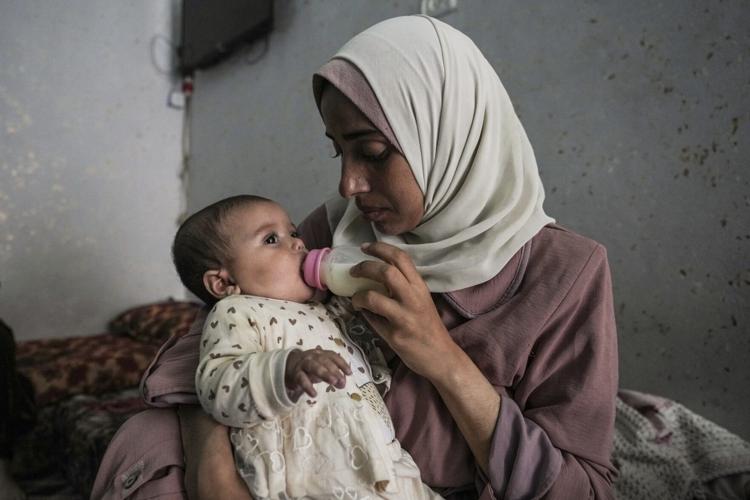
Rola Saqer feeds her baby Masa Mohammad Zaqout at her parents' home April 4 in the neighborhood of Zawaida, central Gaza. Zaqout was born Oct. 7, the day the Israel-Hamas war erupted. Mothers who gave birth that day fret that their 6-month-old babies have known nothing but brutal war, characterized by a lack of baby food, unsanitary shelter conditions and the crashing of airstrikes.
The families emerged from the hospitals to a changed world. On the babies' second day of life, Israel declared war on Hamas and its fighter jets swooped over the neighborhoods where Ali and Masa were supposed to grow up. In the six months since the children were born, the couples have experienced the trials of early parenthood against the backdrop of a brutal conflict.
People are also reading…
The families' homes were leveled by airstrikes, and they've had no reliable shelter and scant access to medical treatment and baby supplies. The infants are hungry, and despite all of the plans the couples made before the war, they fear the lives they had hoped to give their children is gone.
“I was preparing him for another life, a beautiful one, but war changed all of these features,” Amal Al-Taweel said Wednesday. “We barely live day by day, and we don't know what will happen. There is no planning."

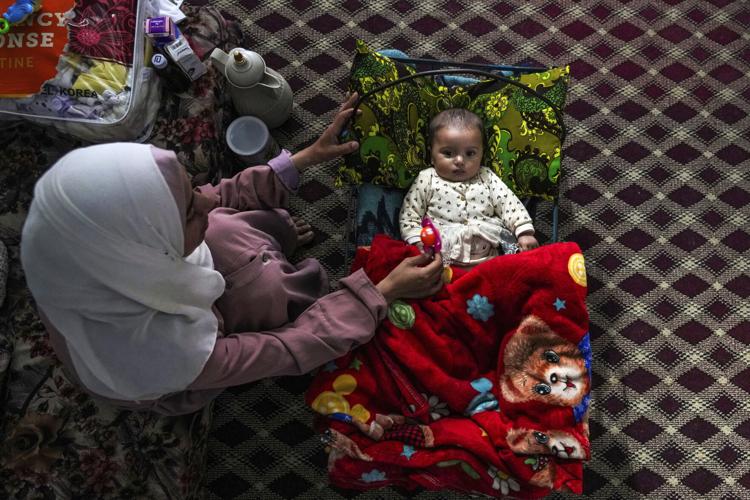
Rola Saqer sits beside her baby Masa Mohammad Zaqout on April 4 at her parents' home in the neighborhood of Zawaida, central Gaza.
Saqer recalled the hope she had before the war.
“This is my only daughter," she said, rocking Masa gently in a cradle. "I prepared many things and clothes for her. I bought her a closet a week before the war. I was also planning her birthdays and everything. The war came and destroyed everything.”
The Al-Taweel family spent the first days of Ali's life going between their home and relatives' houses in search of safety. Nearby buildings kept being struck — first one next to Amal's sister's home, and then one next to her parents' place.
As the family sheltered at home on Oct. 20, Israeli authorities issued an evacuation order warning that a strike was imminent and residents had 10 minutes to leave.
“I had to evacuate. I couldn’t take anything; no IDs, no university certificates, no clothes for my child — nothing,” Amal Al-Taweel said. “Even milk, diapers, and toys that I bought for my child.”

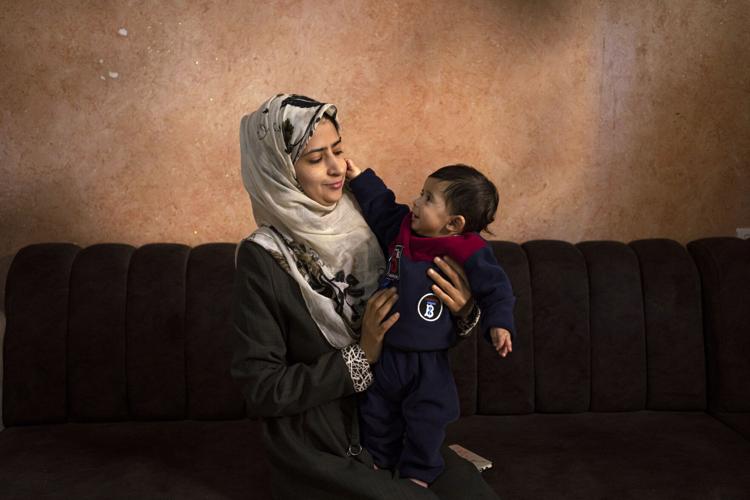
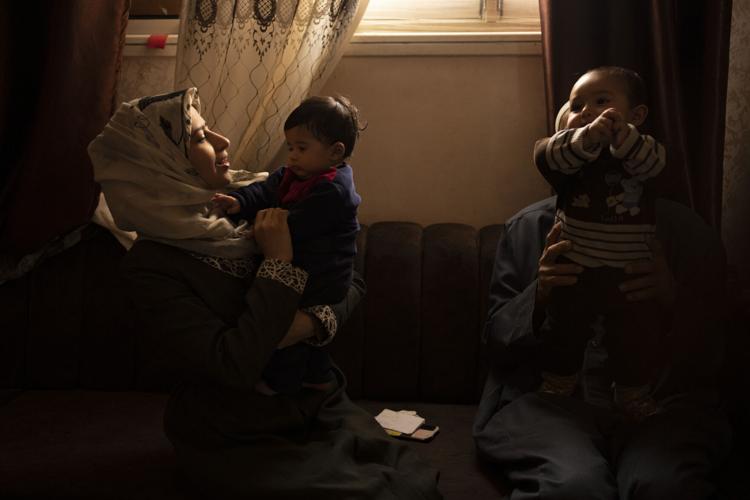
Amal Al-Taweel plays with her baby Ali on April 5 at her family home in Nuseirat, central Gaza Strip. Ali was born Oct. 7, the day the Israel-Hamas war erupted.
The family found temporary refuge at Amal's parents' house in central Gaza, where 15 family members took shelter.
Not far away, Saqer, her husband and daughter crammed into a relative’s two-bedroom house where more than 80 members of her extended family were staying. It became so crowded, she said, that her male relatives built a tent outside so that the women and children could sleep more comfortably indoors.
As Israeli ground troops advanced on central Gaza in December, both young families headed to Gaza’s southernmost city, Rafah, which is now home to hundreds of thousands of displaced Palestinians.
“It was the worst experience of my life; the worst conditions I have ever lived in,” Amal Al-Taweel said.
Israel has severely restricted aid deliveries of food, water, medicine and other supplies into Gaza during the war, which began with Hamas' Oct. 7 attack on southern Israel in which militants killed about 1,200 people and took roughly 250 hostages.
Israel has exacted a terrible toll: More than 33,000 Palestinians have been killed, around two-thirds of them women and children, according to Palestinian health officials whose death count doesn’t distinguish between civilians and fighters. Israel's offensive has pushed Gaza into a humanitarian crisis, displacing over 80% of the population and leaving more than 1 million people on the brink of starvation.
Ali, who was diagnosed with gastroenteritis before the family fled to Rafah, had chronic vomiting and diarrhea — signs of malnutrition that the U.N.'s main health agency says are now common in one of every six young Gazan children. He is underweight, at just 11 pounds.
Not far from where the Al-Taweels lived in Rafah, Masa and her parents found a spot in the Shaboura refugee camp. They lived in a small tent the couple made by stitching together flour bags, Saqer said.
Masa grew sick. Her skin turned yellowish and she seemed to have a perpetual fever, with sweat beading on her small forehead. Saqer tried to breastfeed but couldn't produce milk because she, too, was malnourished. Eventually, she decided to go back to central Gaza to seek medical treatment for her daughter, leaving her husband behind to mind their tent and setting off in a donkey-pulled cart.

Amal Al-Taweel plays with her baby Ali on April 5 at her family home in Nuseirat, central Gaza Strip. “I was preparing him for another life, a beautiful one, but war changed all of these features,” she said.
Both mothers tried their luck at the Al-Aqsa hospital once they arrived in central Gaza. Saqer was lucky — doctors there told her that Masa had a virus and gave the baby medicine.
But they told Amal that Ali needed surgery for a hernia that they couldn't perform.
As the families ponder the future, they can't imagine that their babies' lives will be close to what they had envisioned. Saqer said that even if her family were able to return to their home in northern Gaza, they would find only rubble where their house once stood.
"The same I suffered in Rafah; I will suffer in the north," she said. "All of our lives will be spent in a tent. It will certainly be a hard life.”
Israel-Hamas war at 100 days

Police officers evacuate a woman and a child Oct. 7 from a site hit by a rocket fired from the Gaza Strip in Ashkelon, southern Israel.

Palestinians wave their national flag Oct. 7 and celebrate by a destroyed Israeli tank at the southern Gaza Strip fence east of Khan Younis.

Fire and smoke rise Oct. 8 following an Israeli airstrike in Gaza City.

Israelis evacuate a site struck by a rocket fired Oct. 9 from the Gaza Strip in Ashkelon, southern Israel.

An Israeli firefighter kneels to compose himself Oct. 9 after he and his colleagues extinguished cars set on fire by a rocket fired from the Gaza Strip in Ashkelon, Israel.

Palestinians inspect the rubble of the Yassin Mosque on Oct. 9 after it was hit by an Israeli airstrike at Shati refugee camp in Gaza City.

An Israeli soldier walks Oct. 11 by a house destroyed in fighting with Hamas militants in kibbutz Be'eri.

Antonio Macías' mother cries over her son's body covered with the Israeli flag Oct. 15 at Pardes Haim cemetery in Kfar Saba, near Tel Aviv, Israel. Macias was killed by Hamas militants Oct. 7 while attending a music festival in southern Israel.

Mourners gather around the five coffins of the Kotz family during their funeral Oct. 17 in Gan Yavne, Israel. The family was killed by Hamas militants on Oct. 7 at their house in Kibbutz Kfar Azza near the border with the Gaza Strip.

Rockets are fired from the Gaza Strip toward Israel over destroyed buildings Oct. 19 following Israeli airstrikes on Gaza City, central Gaza Strip.

An Israeli soldier hugs his partner Oct. 20 near the border with the Gaza Strip, southern Israel.

Palestinians walk Oct. 20 by buildings destroyed in an Israeli bombardment on al-Zahra, on the outskirts of Gaza City.

Palestinians evacuate a building hit Oct. 22 in an Israeli bombardment of the Gaza Strip in Rafah.

Palestinians inspect the rubble of destroyed buildings Oct. 26 following Israeli airstrikes on the town of Khan Younis, southern Gaza Strip.

Israeli security forces on Nov. 1 inspect charred vehicles burned in the Oct. 7 cross-border attack by Hamas militants outside the town of Netivot, southern Israel.

Kenzi al Madhoun, a 4-year-old wounded in an Israeli bombardment, lies Nov. 1 at Al Aqsa Hospital in Deir al Balah City, Gaza Strip.

An Israeli soldier stands in an apartment Nov. 8 during a ground operation in the Gaza Strip.

Palestinians flee Nov. 11 to the southern Gaza Strip on Salah al-Din Street in Bureij, Gaza Strip.

Palestinians wounded in an Israeli bombardment of the Gaza Strip wait for treatment Nov. 15 at a hospital in Khan Younis.

Palestinians displaced by the Israeli bombardment of the Gaza Strip seek cover from a winter rainfall Nov. 19 at a U.N. tent camp in the southern town of Khan Younis, Gaza Strip. Hundreds of thousands of Palestinians fled their homes in northern Gaza as Israel moved ahead with a ground offensive against the ruling Hamas militant group.

Palestinians flee to northern Gaza as Israeli tanks block the Salah al-Din road Nov. 24 in the central Gaza Strip, as a temporary cease-fire begins.

A Red Cross vehicle carrying Israeli hostages drives by Nov. 25 at the Gaza Strip crossing into Egypt in Rafah.

An Israeli soldier looks at Palestinians fleeing south Nov. 26, the third day of a temporary cease-fire between Hamas and Israel, at Salah al-Din road in central Gaza Strip.

Israelis embrace Nov. 28 next to photos of people killed and taken captive by Hamas during militants' Oct. 7 rampage through the Nova music festival in southern Israel, at the site of the event near kibbutz Re'im.

A Palestinian woman gestures Dec. 7 following Israeli airstrikes in Khan Younis refugee camp, southern Gaza Strip.

Israeli soldiers on Dec. 8 stand by a truck packed with bound and blindfolded Palestinian detainees rounded up for interrogation in northern Gaza during a search for Hamas fighters.

Palestinians mourn Dec. 20 outside a morgue in Khan Younis for relatives killed in the Israeli bombardment of the Gaza Strip.

Palestinians line up for a free meal Dec. 21 in Rafah, Gaza Strip. International aid agencies say Gaza is suffering from shortages of food, medicine and other essential supplies as a result of the war.

A makeshift tent camp Jan. 1 where Palestinians displaced by the Israeli bombardment of the Gaza Strip are staying in the Muwasi area.

With the U.S Capitol in the background, demonstrators rally Jan. 13 during the March on Washington for Gaza at Freedom Plaza in Washington. The protest was part of a global day of action ahead of the Israel-Hamas war's 100-day mark.