UNITED NATIONS — The United States vetoed a United Nations resolution Friday backed by the vast majority of Security Council members and many other nations demanding an immediate humanitarian cease-fire in Gaza.
The vote in the 15-member council was 13-1 with the United Kingdom abstaining.
U.S. deputy ambassador Robert Wood criticized the council after the vote for its failure to condemn Hamas' attacks in Israel and to acknowledge Israel's right to defend itself. He declared that halting military action would allow Hamas to continue to rule and "only plant the seeds for the next war.”
The United Nations chief and many Security Council members had demanded an immediate humanitarian cease-fire Friday, but United States opposition virtually doomed any action by the U.N.’s most powerful body.

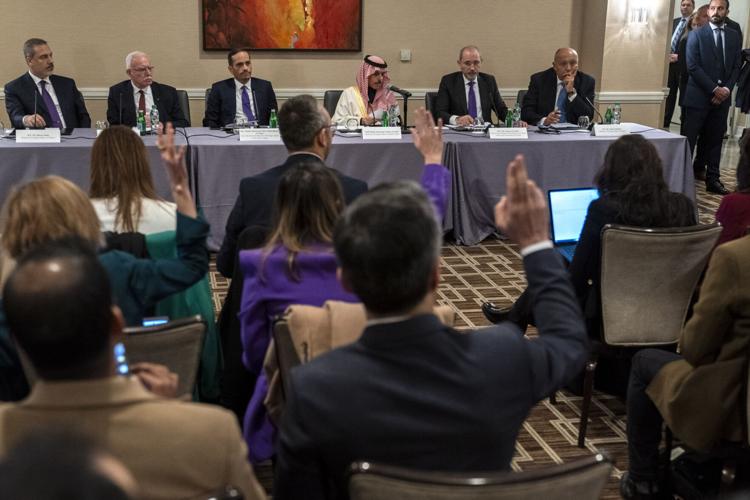
Reporters raise their hands to ask questions as Foreign Ministers, from left, Turkish Foreign Minister Hakan Fidan, Palestinian Minister of Foreign Affairs Riyad al-Maliki, Qatari Prime Minister and Minister of Foreign Affairs Sheikh Mohammed bin Abdulrahman bin Jassim Al-Thani, Saudi Foreign Minister Prince Faisal bin Farhan, Jordan's Minister of Foreign Affairs Ayman Safadi, and Egyptian Foreign Affairs Minister Sameh Shoukry, attend a news conference about the Israel-Hamas war, and pressure to reduce civilian casualties, Friday in Washington.
The foreign ministers of Saudi Arabia and other leading Arab nations and Turkey were in Washington on Friday on a rare joint mission to press the Biden administration to drop its opposition to a cease-fire given the soaring death tolls. They were scheduled to meet with Secretary of State Antony Blinken on Friday afternoon.
People are also reading…
One, the top diplomat of Jordan, told reporters in Washington that the killings of Palestinian civilians in Israel’s bombardment and siege of Gaza were war crimes and threatened to destabilize the region, the U.S. and the world for years to come
“If people are not seeing it here, we are seeing it," Safadi said, adding: “We’re seeing the challenges that we are are facing talking to our people. They are all saying we’re doing nothing. Because despite all our efforts, Israel is continuing these massacres.”

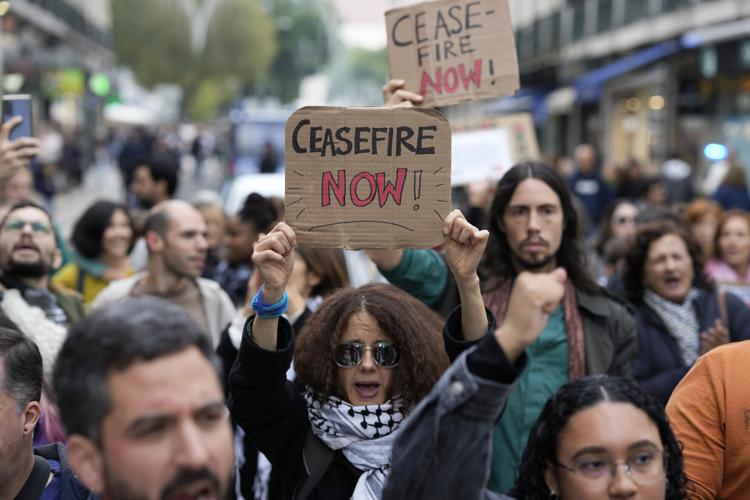
People hold up signs and shout slogans Friday during a demonstration in support of the Palestinian people and demanding a cease fire, in Lisbon.
Israel’s more than two-month military campaign has killed more than 17,400 people in Gaza — 70% of them women and children — and wounded more than 46,000, according to the Palestinian territory’s Health Ministry, which says many others are trapped under rubble. The ministry does not differentiate between civilian and combatant deaths.
The Security Council was scheduled to vote Friday afternoon on a resolution by the United Arab Emirates, the Arab representative on the 15-member body, demanding an immediate humanitarian cease-fire. U.S. Deputy Ambassador Robert Wood’s statement to the council Friday, however, signaled the United States will veto the resolution.
Wood criticized the council for not condemning Hamas’ surprise attack on Israel on Oct. 7 in which the militants killed about 1,200 people, mostly civilians, and took more than 240 hostages.
He said a cease-fire would leave Hamas in charge of Gaza, still holding more than 100 Israeli hostages.

A person lights a candle Friday on a table set for hostages being held in the Gaza Strip by the Hamas militant group during the Jewish holiday of Hanukkah in the Hostages Square at the Museum of Art, in Tel Aviv, Israel.
No government would allow such a threat after the worst attack on its peoples in decades, Wood said, stressing that a halt to military action would only “plant the seeds for the next war, because Hamas has no desire to see a durable peace, to see a two-state solution.”
“For that reason, while the United States strongly supports a durable peace, in which both Israelis and Palestinians can live in peace and security, we do not support calls for an immediate cease-fire,” Wood said.
The council called the emergency meeting to hear from Secretary-General Antonio Guterres, who for the first time invoked Article 99 of the U.N. Charter, which enables a U.N. chief to raise threats he sees to international peace and security. He warned of an “humanitarian catastrophe” in Gaza and urged the council to demand a humanitarian cease-fire.
Guterres said he raised Article 99 — which hadn’t been used at the U.N. since 1971 — because “there is a high risk of the total collapse of the humanitarian support system in Gaza.” The U.N. anticipates this would result in “a complete breakdown of public order and increased pressure for mass displacement into Egypt,” he warned.
Gaza is at “a breaking point,” he said, and desperate people are at serious risk of starvation.
Guterres said Hamas’ brutality against Israelis on Oct. 7 “can never justify the collective punishment of the Palestinian people.”
“While indiscriminate rocket fire by Hamas into Israel, and the use of civilians as human shields, are in contravention of the laws of war, such conduct does not absolve Israel of its own violations,” he stressed.
The U.N. chief detailed the “humanitarian nightmare” Gaza is facing, citing intense, widespread and ongoing Israeli attacks from air, land and sea that reportedly have hit 339 education facilities, 26 hospitals, 56 health care facilities, 88 mosques and three churches.
Over 60% of Gaza’s housing has reportedly been destroyed or damaged, some 85% of the population has been forced from their homes, the health system is collapsing, and “nowhere in Gaza is safe,” Guterres said.
Riyad Mansour, the Palestinian U.N. ambassador, told the council that Israel’s objective is “the ethnic cleansing of the Gaza Strip” and “the dispossession and forcible displacement of the Palestinian people.”
“If you are against the destruction and displacement of the Palestinian people, you have to be in favor of an immediate cease-fire,” Mansour said. "When you refuse to call for a cease-fire, you are refusing to call for the only thing that can put an end to war crimes, crimes against humanity and genocide.”
Read more:
New bill in Congress would help protect postal workers, and more of today's top videos
A new bill in Congress is hoping to protect postal workers from robberies, the humanitarian crisis is spiraling in Gaza as fighting restricts access to food and water, and more of today's top videos.