LONDON — What did you do in the war, Granny?
For British women who came of age during World War II, the answer to that question is often: quite a lot.
The history of D-Day is often told through the stories of the men who fought and died when the Allies stormed the beaches of northern France on June 6, 1944.
But behind the scenes were hundreds of thousands of military women who worked in crucial non-combat roles such as codebreakers, ship plotters, radar operators and cartographers. Often overlooked, their contributions have come into sharper focus as the number of living D-Day veterans dwindles and the world prepares for the 80th anniversary of the landings.
People are also reading…
One of those women was Marie Scott, who was a 17-year-old radio operator when she heard the chaos of battle through her headset as she relayed messages between Allied commanders in England and men on the Normandy beaches.

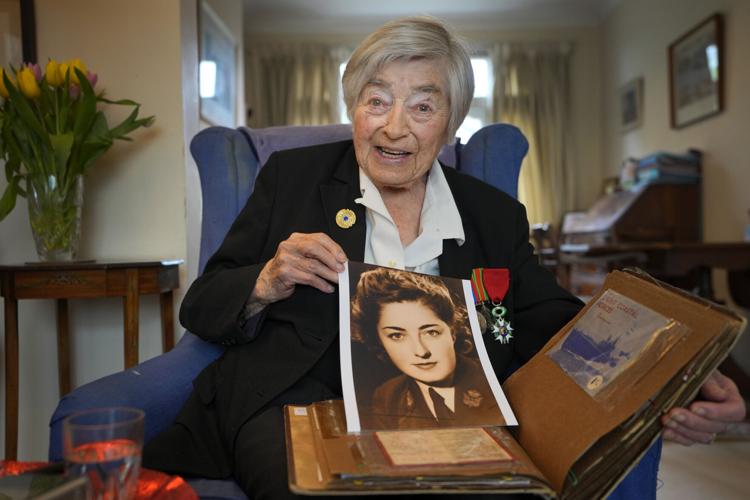
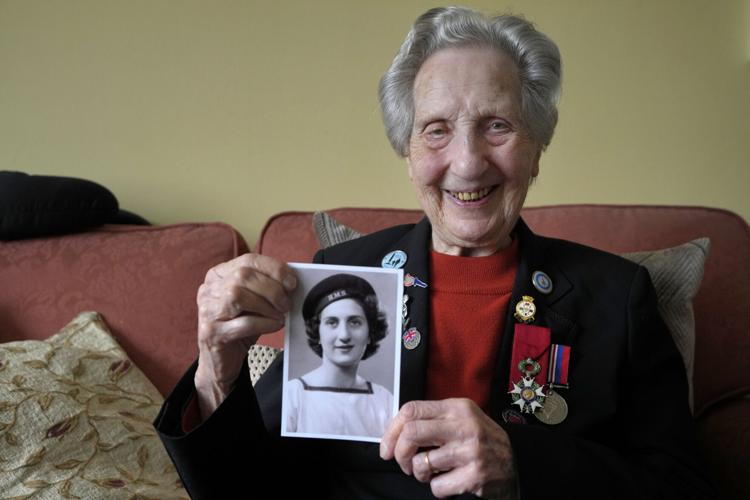
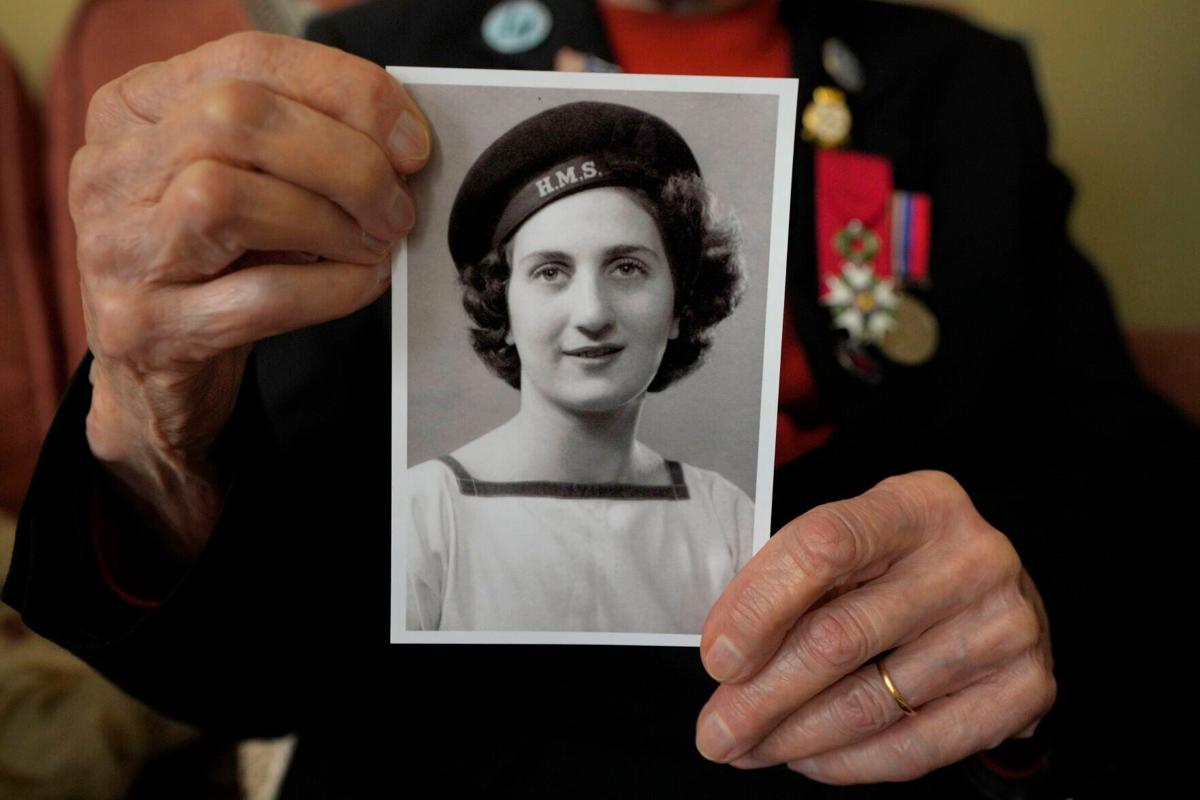
Marie Scott, who was a serving Wren and switchboard operator at the time of D-Day, holds up a 1944 photograph of herself April 25 at her home in London.

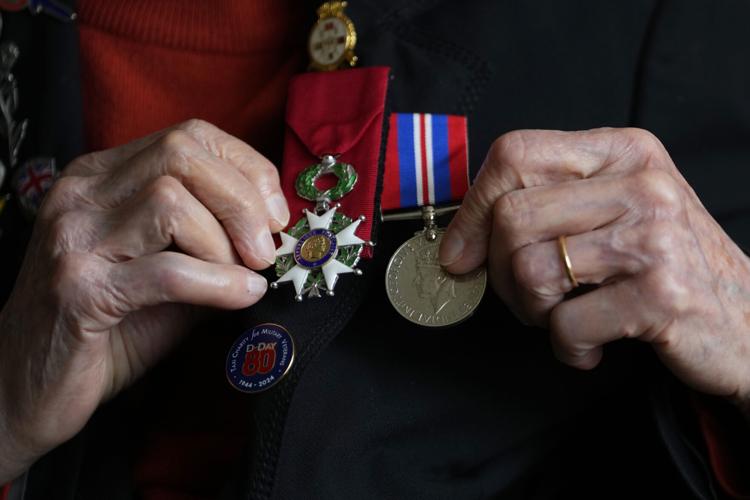
Marie Scott holds the medals she received for her military service.
“You realize the reality of war, what it really entails. It’s not a word. It’s an action that affects thousands, millions,” Scott said recently, discussing her time in the Women’s Royal Naval Service, commonly known as the Wrens. “I think I grew up that day from being a stupid 17-year-old. I think I honestly grew up on D-Day.”
Almost 160,000 Allied troops landed at Normandy on D-Day in a massive amphibious operation designed to break through heavily fortified German defenses and begin the liberation of Western Europe.
Throughout the war, more than 1.1 million women served in the armed forces of the Western Allies, including 640,000 in Britain, where there was a real threat of invasion after Nazi troops drove to the shores of the English Channel.
Even Princess Elizabeth, the future queen, did her bit, training to be a driver and mechanic in the Auxiliary Territorial Service, the women’s branch of the British Army.

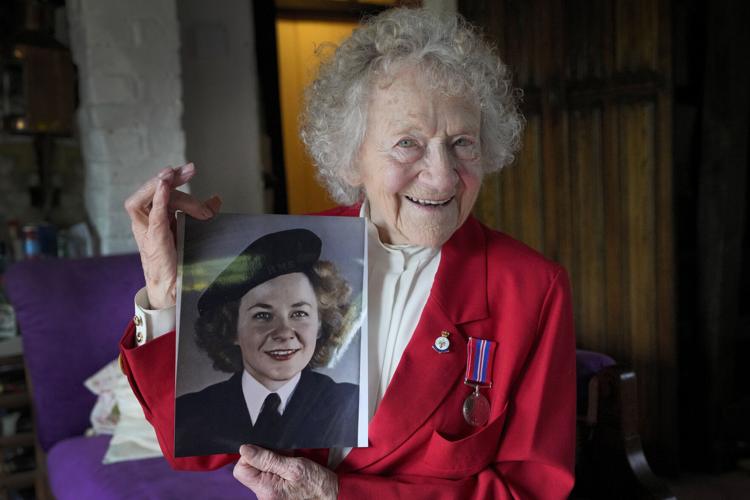
Dorothea Barron, who was a serving Wren at the time of D-Day, holds up a photograph of herself in uniform during WWII on May 7 at her home near Sawbridgeworth, in England. Barron was part of the team that developed the Mulberry harbors — the system of breakwaters, pontoons and floating roadways that were built on the coast of Normandy.
The pitch on recruiting posters was simple: By joining the military and taking over support roles, women could free men for front-line service. Although technically barred from combat, more than 800 British women were killed in military service during the war.
“People forget they were 17, 18 doing these jobs," said Dick Goodwin, the honorary secretary of the Taxi Charity for Military Veterans, which helps veterans travel to Normandy each year. “I mean, it’s just amazing, really. Talk about thrown in at the deep end!”
Those who did not join the military had other opportunities to serve. Millions of women worked in defense factories, grew crops and rode motorcycles through the blacked out streets of London to keep firefighters updated on the latest bomb damage as the British government asked them to keep the economy going after men went off to fight.
The Allied nations’ decision to mobilize women was an important strategic choice that contrasted with Nazi Germany, where the authorities relied on forced labor, according to Ian Johnson, a historian at the University of Notre Dame in South Bend, Indiana.

Patricia Owtram, who was a serving Wren at the time of D-Day, shows a photograph of herself in wartime uniform April 10, at her home in London. Owtram used her language skills to listen in on German U-boats during WWII.
“Part of the intent was to take it — use the economic and material advantages of the Allies and really … put that to greatest use compared to the way the Germans structured their military,” he said. “So those support roles were crucial in providing the logistical advantages that help the Allies win.”

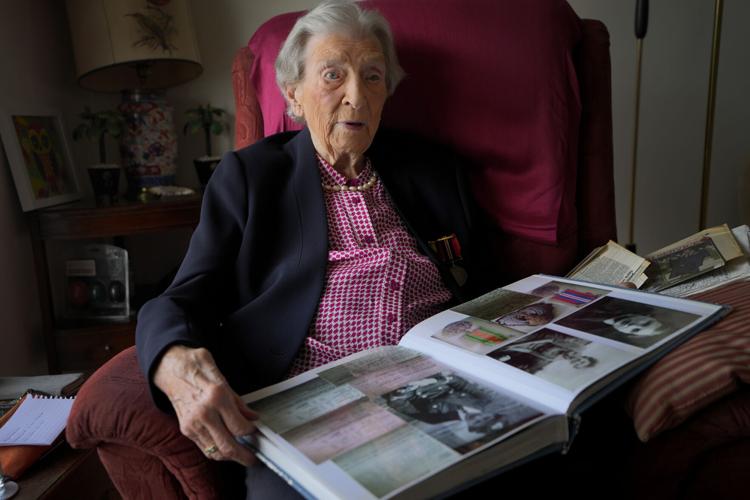
Christian Lamb, who was a serving Wren at the time of D-Day, looks through a photograph album April 11 at her home in London. Lamb made maps to guide the crews landing crafts at Normandy on D-Day.
Altogether, some 7 million British women served their country in some capacity during World War II.
Their sacrifices are honored with a sculpture in central London, near the Cenotaph, the national war memorial.
The bronze monolith is decorated with 17 different uniforms hung on pegs to represent the jobs women took on during the war, then gave up when the men returned.
They include the uniforms of the Auxiliary Territorial Service, the Women’s Auxiliary Air Force and the Women’s Royal Naval Service. But there are also police overalls, a nursing cape and a welder’s mask.
“I get a certain satisfaction from my wartime experience,” Scott said. “And I do allow myself, occasionally, just a tinge of pride in my younger self."
10 things you might not know about D-Day
1. Many photos were taken, but then lost.
War photographer Robert Capa, who said, “If your pictures aren’t good enough, you aren’t close enough,” landed at Omaha Beach on D-Day. He took more than 100 pictures, but when the film was sent to London, a darkroom technician dried it too quickly and melted the emulsion, leaving fewer than a dozen pictures usable. Even so, those shaky and chaotic photos tell the story of Omaha Beach.

A member of staff poses for photographs next to Hungarian-born photographer Robert Capa's 'American Soldier Landing on Omaha Beach, D-Day' during a press preview for the photo exhibition 'Eyewitness: Hungarian Photography in the 20th Century' at the Royal Academy of Arts in London, Tuesday, June 28, 2011. (AP Photo/Akira Suemori)
2. Crossword puzzles were a concern.
In the weeks before D-Day, British intelligence was concerned about crossword puzzles. The London Daily Telegraph’s recent puzzle answers had included Overlord and Neptune (the code names for the overall operation and the landing operation) and Utah and Omaha (the two American invasion beaches).
Agents interrogated the puzzle-maker, Leonard Dawe. Turned out, it was just a coincidence.

Members of an American landing unit help their exhausted comrades ashore during the Normandy invasion, June 6, 1944. The men reached the zone code-named Utah Beach, near Sainte Mere Eglise, on a life raft after their landing craft was hit and sunk by German coastal defenses. (AP Photo/INP Pool/Louis Weintraub)
3. The people who planned D-Day were bigots.
That was the code word — bigot — for anyone who knew the time and place of the invasion. It was a reversal of a designation — “to Gib” — that was used on the papers of those traveling to Gibraltar for the invasion of North Africa in 1942.

A company commander briefs his men, using a model of the French invasion coast, prior to the June 6 landings in northern France. Note tense expressions on faces of these men, who study details of terrain during his huddle somewhere in England, June 1944. (AP Photo)
4. A few notable names
Among those who landed at Normandy on D-Day were J.D. Salinger (who went on to write “Catcher in the Rye”), Theodore Roosevelt Jr. (the president’s son, who died of a heart attack a month later) and Elliot Richardson (attorney general under President Richard Nixon).

FILE - This Thursday, Jan. 28, 2010 picture shows copies of J.D. Salinger's classic novel "The Catcher in the Rye" as well as his volume of short stories called "Nine Stories" at the Orange Public Library in Orange Village, Ohio. (AP Photo/Amy Sancetta, File)
5. Code name 'Fortitude'
The Allied effort to hoodwink Adolf Hitler about the invasion was code-named Fortitude, and it was nearly as elaborate and detailed as the invasion itself. The Allies went so far as to parachute dummies — outfitted with firecrackers that exploded on impact — behind enemy lines as a diversion.

U.S. paratroopers prepare to jump June 6, 1944, over Normandy in France.
6. D-Day secrets were almost exposed in Chicago.
A package from Supreme Headquarters in London arrived at a Chicago mail-sorting office a few months before D-Day and was accidentally opened. Its contents may have been seen by more than a dozen unauthorized people. The FBI found that a U.S. general’s aide of German descent had sent the package to “The Ordnance Division, G-4” but had added the address of his sister in Chicago. The FBI concluded that the aide was overtired and had been thinking about his sister, who was ill.

Pair of landing craft hit Utah Beach in Normandy, France, June 1944. (AP Photo)
7. Not an 'invasion of Norway'
Woe be unto a politician who commits a gaffe during a D-Day remembrance. In 2004, Canadian Prime Minister Paul Martin referred to the “invasion of Norway” when he meant Normandy. Years later, at an event with President Barack Obama, British Prime Minister Gordon Brown cited “Obama Beach” when he meant “Omaha Beach.”

From left, U.S. President Barack Obama, Britain's Prince Charles, British Prime Minister Gordon Brown, Canadian Prime Minister Stephen Harper, and French President Nicolas Sarkozy arrive at the American Cemetery at Colleville-Sur -Mer, near Caen, Western France, Saturday, June 6, 2009 to attend the 65th Anniversary of the D-day landings in Normandy. (AP Photo/Francois Mori)
8. Andrew Higgins 'won the war for us.'
In a 1964 interview, Dwight Eisenhower said a single person “won the war for us.” He was referring to Andrew Higgins, who designed and built the amphibious assault crafts that allowed the Allies to storm the beaches of Normandy. The eccentric boat builder foresaw not only the Navy’s acute need for small military crafts early on, but also the shortage of steel, so he gambled and bought the entire 1939 crop of mahogany from the Philippines. His New Orleans company produced thousands of boats for the war effort.

Andrew Higgins’ wooden boat factory in New Orleans produced thousands of boats for the Allied efforts in World War II.
9. Training exercises gone wrong
While U.S. forces were conducting a training exercise off the southwestern English coast to prepare for the landing on Utah Beach, German torpedo boats ambushed them. More than 700 Americans were killed — a toll far worse than when U.S. forces actually took Utah Beach a few months later.

With a U.S. tank unit in England getting ready for D-Day in 1944, left to right are: Captain Leonard Brusky, Milwaukee, Wisconsin, Sergeant Wilfred F. Thomas, Wisconsin, Sergeant Frank L. Niner, Louisville, Kentucky, Pfc Harry H. Smith, Louisville, Kentucky, and Private Louis W. Louisville Kentucky. (AP Photo)
10. Breaking the Enigma code
On June 4, 1944, U.S. forces were able to capture a German submarine off the African coast because they had broken the Enigma code and learned a sub was in the vicinity. On the eve of D-Day, the U.S. couldn’t risk that the Germans would realize the code was cracked. So they hid away the sub and its captured crew until the end of the war, and the Germans assumed the vessel was lost at sea.

In this image provided by the U.S. Navy, the American flag flies from the conning tower of a captured German submarine U-505 near Cape Blanco in French West Africa on June 4, 1944 during World War II. (AP Photo/U.S. Navy)
A closer look at the attack

Gen. Dwight D. Eisenhower is shown in March, 1944 when as Commander of invasion of Europe. Standing beside Ike was British air Chief Marshal Sir Arthur W. Tedder. In left background was british field marshal Montgomery. (AP-Photo)
Operation Overlord begins
June 5, 1944: On the morning of June 5, amid bad weather fears, U.S. Gen. Dwight D. Eisenhower, the supreme commander of Allied forces in Europe, gave the approval for Operation Overlord. About 6,000 landing craft, ships and other vessels carrying more than 150,000 troops left England for France.
That night, about 1,000 aircraft filled with more than 15,000 paratroopers landed in drop zones in Normandy to begin missions behind enemy lines. About 12,000 aircraft were mobilized to provide air cover and support for the invasion.

Operation Neptune begins
June 6, 1944: Early in the morning, Allied bombers took off to attack targets around the beachhead. The amphibious landings, called Operation Neptune, also were preceded by extensive naval bombardment.
The seaborne units began to land about 6:30 a.m. France time. Many Americans were packed into flat-bottomed Higgins boats launched from troop transports.

After landing at the shore, these British troops wait for the signal to move forward June 6, 1944, during the initial Allied landing operations in Normandy, France.
At 3 a.m. ET on June 6, President Franklin Roosevelt received the call that the invasion had commenced. He later notified the nation by radio, saying that “at this poignant hour, I ask you to join with me in a prayer.”
On the coast of Normandy, the British and Canadians landing on Gold, Juno and Sword beaches overcame light opposition. The Americans at Utah did as well.
The U.S. 1st Division at Omaha Beach, however, confronted the best of the German coast divisions, the 352nd, and was torn up by machine gunners as the troops waded ashore.
Eventually the Allied troops fought their way inland, at a heavy cost of life. More than 4,000 died that day. By the end of D-Day, more than 150,000 troops had landed in Normandy. They pushed their way inland, allowing more troops to land over the next several days.