

TOKYO (AP) — Toshihiro Mutsuda was only 5 years old when he last saw his father, who was drafted by Japan's Imperial Army in 1943 and killed in action. For him, his father was a bespectacled man in an old family photo standing by a signed good-luck flag that he carried to war.
On Saturday, when the flag was returned to him from a U.S. war museum where it had been on display for 29 years, Mutsuda, now 83, said: “It's a miracle."
The flag, known as “Yosegaki Hinomaru,” or Good Luck Flag, carries the soldier's name, Shigeyoshi Mutsuda, and the signatures of his relatives, friends and neighbors wishing him luck. It was given to him before he was drafted by the Army. His family was later told he died in Saipan, but his remains were never returned.
The flag was donated in 1994 and displayed at the museum aboard the USS Lexington, a WWII aircraft carrier, in Corpus Christi, Texas. Its meaning was not known until it was identified by the family earlier this year, said museum director Steve Banta, who brought the flag to Tokyo.
People are also reading…
Banta said he learned the story behind the flag earlier this year when he was contacted by the Obon Society, a nonprofit organization that has returned about 500 similar flags as non-biological remains, to the descendants of Japanese servicemembers killed in the war.
The search for the flag's original owner started in April when a museum visitor took a photo and asked an expert about the description that it had belonged to a “kamikaze” suicide pilot. When Shigeyoshi Mutsuda's grandson saw the photo, he sought help from the Obon Society, group co-founder Keiko Ziak said.
“When we learned all of this, and that the family would like to have the flag, we knew immediately that the flag did not belong to us,” Banta said at the handover ceremony. “We knew that the right thing to do would be to send the flag home, to be in Japan and to the family.”
The soldier's eldest son, Toshihiro Mutsuda, was speechless for a few seconds when Banta, wearing white gloves, gently placed the neatly folded flag into his hands. Two of his younger siblings, both in their 80s, stood by and looked on silently. The three children, all wearing cotton gloves so they wouldn't damage the decades-old flag, carefully unfolded it to show to the audience.
“After receiving the flag today, I earnestly felt that the war like that should never be fought again and that I do not wish anyone else to go through this sadness (of separation),” Toshihiro Mutsuda said.
The soldier's daughter, Misako Matsukuchi, touched the flag with both hands and prayed. “After nearly 80 years, the spirit of our father returned to us. I hope he can finally rest in peace," Matsukuchi said later.
Toshihiro Mutsuda said his memory of his father was foggy. However, he clearly remembers his mother, Masae Mutsuda, who died five years ago at age 102, used to make the long-distance bus trip almost every year from the farming town in Gifu, central Japan, to Tokyo's Yasukuni Shrine, where the 2.5 million war dead are enshrined, to pay tribute to her husband's spirit.
The shrine is controversial, as it includes convicted war criminals among those commemorated. Victims of Japanese aggression during the first half of the 20th century, especially China and the Koreas, see Yasukuni as a symbol of Japanese militarism. However, for the Mutsuda family, it's a place to remember the loss of a father and husband.
“It’s like an old love story across the ages coming together ... It doesn’t matter where,” Banta said, referring to the Yasukuni controversy. “The important thing is this flag goes to the family.”
That’s why Toshihiro Mutsuda and his siblings chose to receive the flag at Yasukuni and brought the framed photos of their parents.
“My mother missed him and wanted to see him so much and that's why she used to pray here," he said. “Today her wish finally came true, and she was able to be reunited.”
Keeping the flag on his lap, he said, “I feel the weight of the flag."
32 historical photos of the attack on Pearl Harbor
WWII PEARL HARBOR
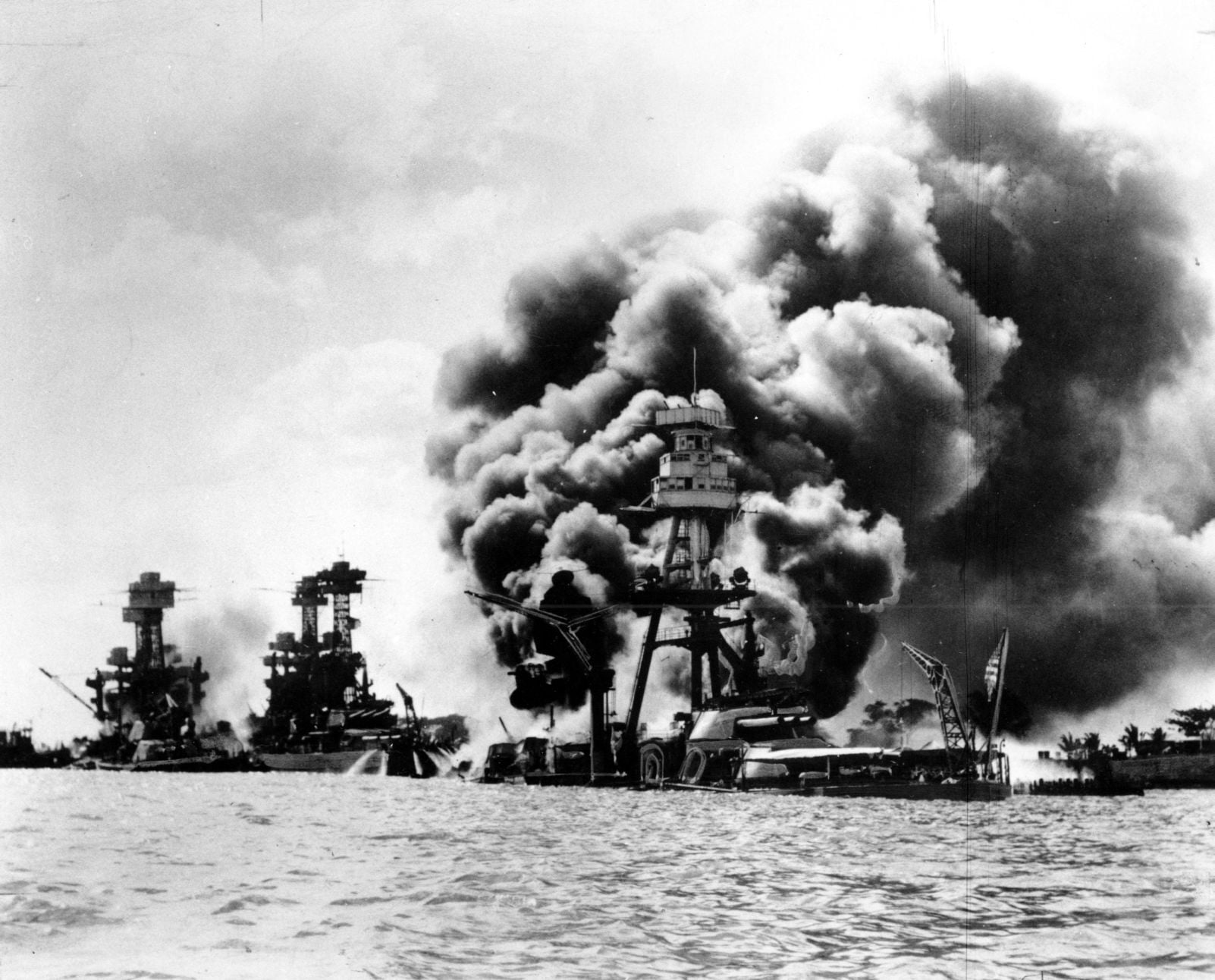
Three U.S. battleships are hit from the air during the Japanese attack on Pearl Harbor on Dec. 7, 1941. Japan's bombing of U.S. military bases at Pearl Harbor brings the U.S. into World War II. From left are: USS West Virginia, severely damaged; USS Tennessee, damaged; and USS Arizona, sunk. (AP Photo)
WWII USS CRUISER PEARL HARBOR

An undamaged light cruiser steams out past the burning USS Arizona and takes to sea with the rest of the fleet during the Japanese aerial attack on Pearl Harbor, Hawaii, on Dec. 7, 1941 during World War II. (AP Photo/U.S. Navy)
Roosevelt
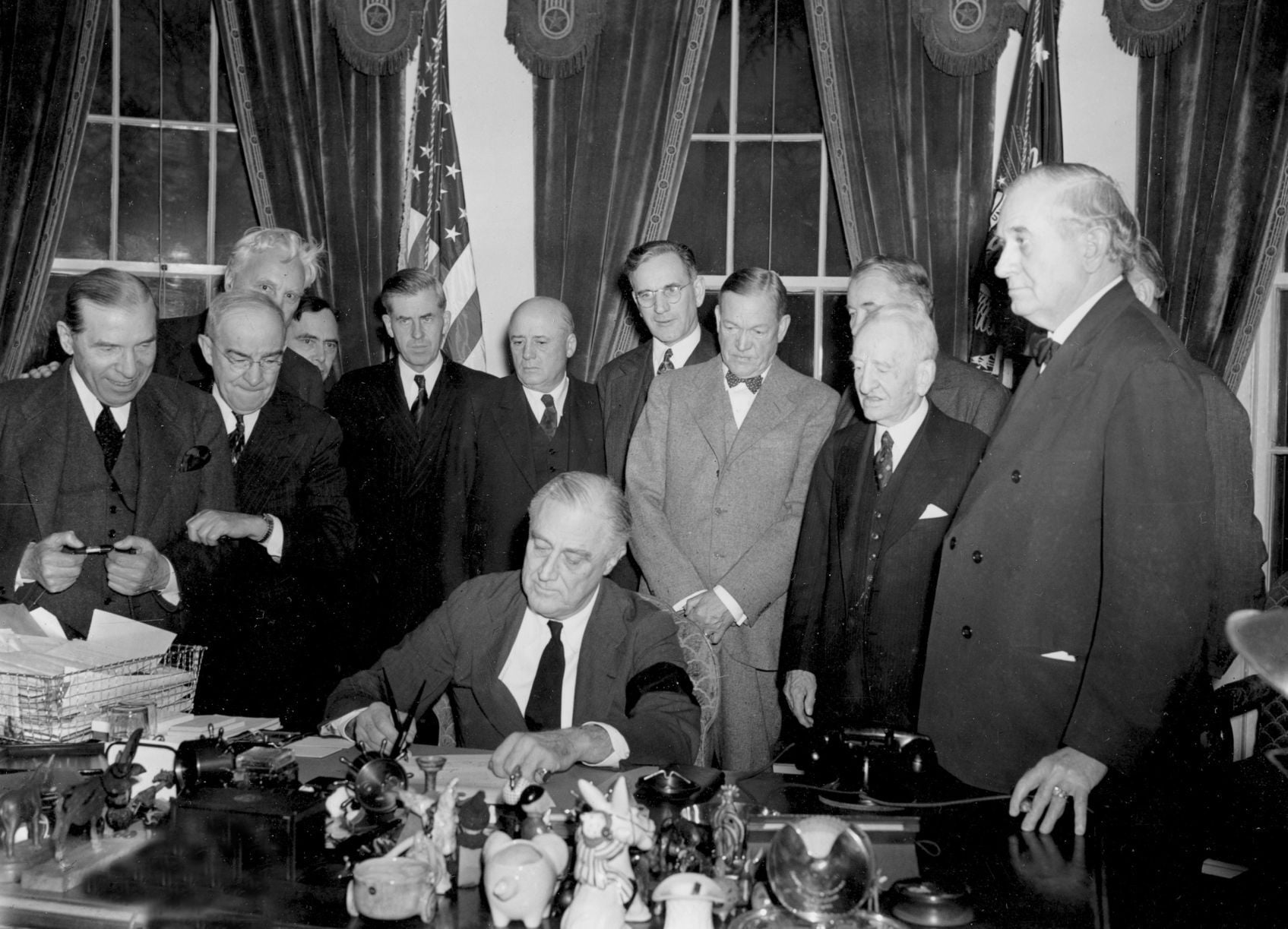
U.S. President Franklin D. Roosevelt signs the declaration of war following the Japanese bombing of Pearl Harbor, Dec. 7, at the White House in Washington, D.C., Dec. 8, 1941 at 3:08 p.m. EST. Watching from left to right are, Rep. Sol Bloom, D-N.Y.; Rep. Luther Johnson, D-Texas; Rep. Charles A. Eaton, R-N.J.; Rep. Joseph Martin, R-Mass.; Vice President Henry A. Wallace; House Speaker Sam Rayburn, D-Texas; Rep. John McCormack, D-Mass.; Sen. Charles L. McNary, R-Ore.; Sen. Alben W. Barkley, D-Ky.; Sen. Carter Glass, D-Va.; and Sen. Tom Connally, D-Texas. (AP Photo)
JAPANESE ATTACK PEARL HARBOR

American ships burn during the Japanese attack on Pearl Harbor, Hawaii, on Dec. 7, 1942. (AP Photo)
PEARL HARBOR

A small boat rescues a USS West Virginia crew member from the water after the Japanese bombing of Pearl Harbor, Hawaii on Dec. 7, 1941 during World War II. Two men can be seen on the superstructure, upper center. The mast of the USS Tennessee is beyond the burning West Virginia. (AP Photo)
WWII ATTACK ON PEARL HARBOR

The battleship USS West Virginia is seen afire after the Japanese surprise attack on Pearl Harbor, Hawaii, on December 7, 1941. (AP Photo)
WWII PEARL HARBOR ATTACK

Black smoke rises from the burning wrecks of several U.S. Navy battleships after they had been bombed during the Japanese surprise attack on Pearl Harbor, Hawaii, on December 7, 1941. (AP Photo)
WWII EXPLOSION USS SHAW
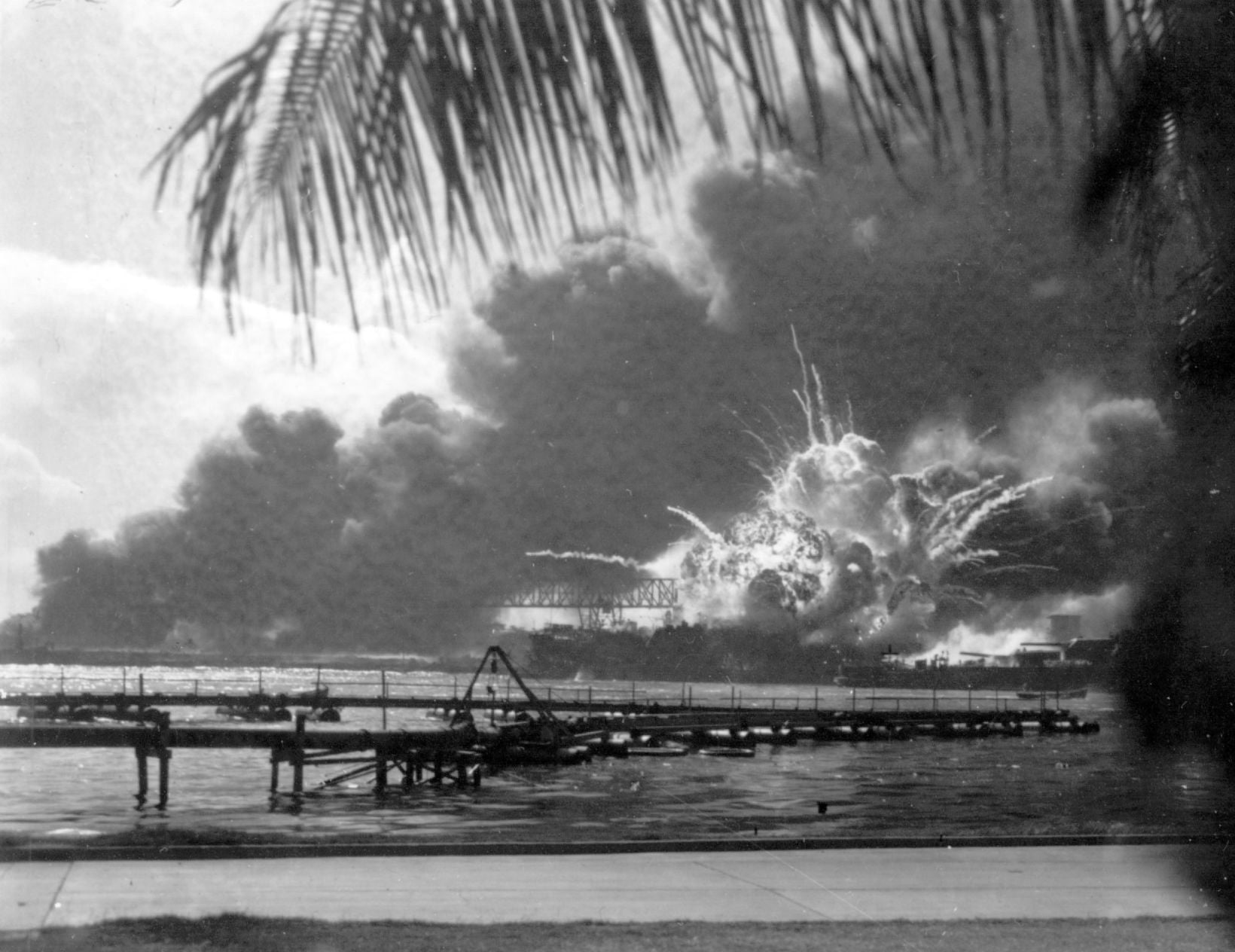
The destroyer USS Shaw explodes after being hit by bombs during the Japanese surprise attack on Pearl Harbor, Hawaii, on December 7, 1941. (AP Photo)
WWII Attack on Pearl Harbor
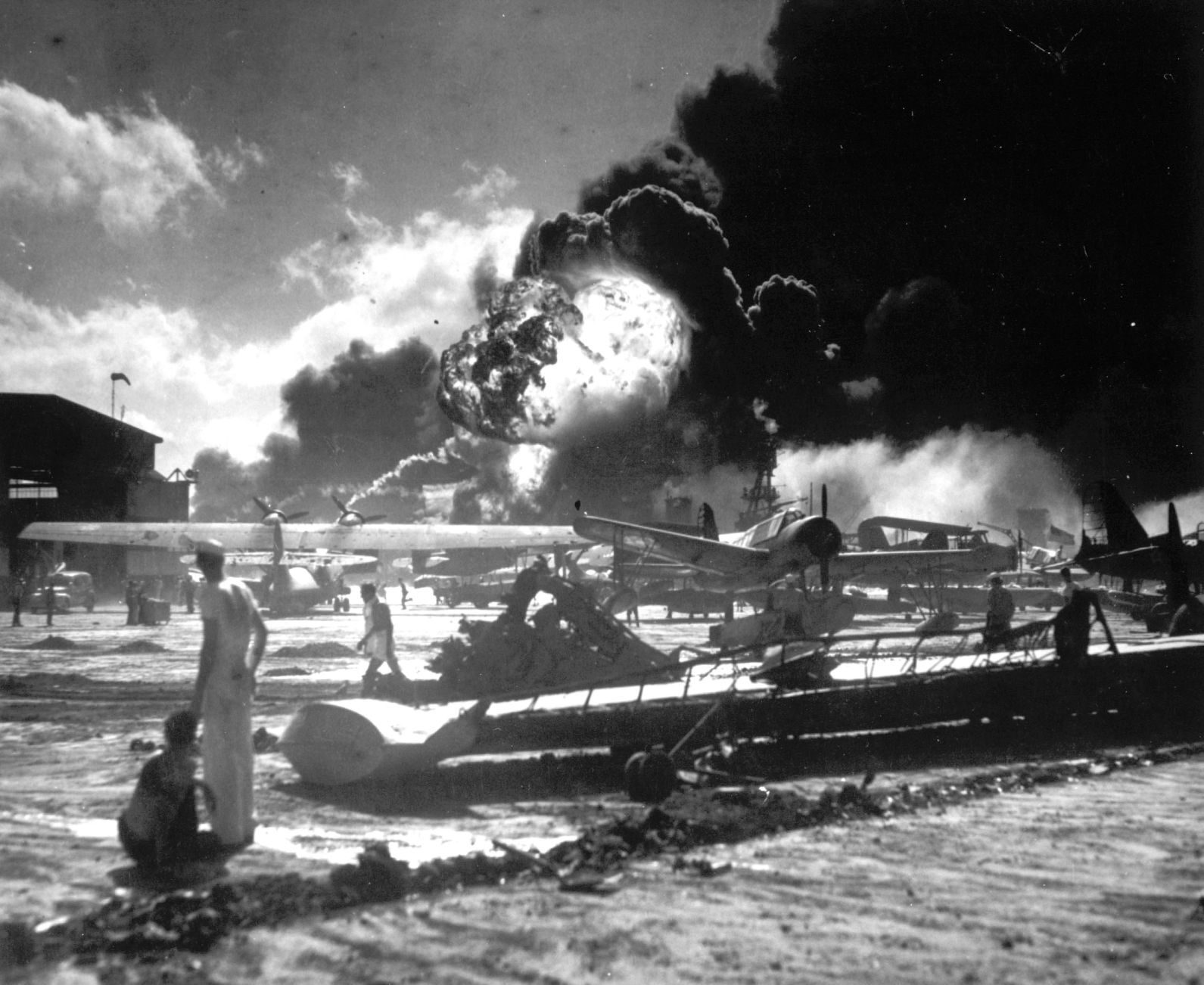
In this image provided by the U.S. Navy, sailors stand among wrecked airplanes at Ford Island Naval Air Station as they watch the explosion of the USS Shaw in the background, during the Japanese surprise attack on Pearl Harbor, Hawaii, on December 7, 1941. (AP Photo/U.S. Navy)
WWII ATTACK ON PEARL HARBOR

This photograph, from a Japanese film later captured by American forces, is taken aboard the Japanese aircraft carrier Zuikaku, just as a Nakajima "Kate" B-5N bomber is launching off deck for the second wave of the attack on Pearl Harbor, Hawaii, on December 7, 1941. (AP Photo)
WWII PEARL HARBOR SCHOOL BOMBING

Rescue workers help evacuate the Lunalilo High School in Honolulu after the roof of the main building was hit by a bomb during the Japanese attack at Pearl Harbor, Hawaii on Dec. 7, 1941. (AP Photo)
PEARL HARBOR ATTACK 1941

A Japanese dive bomber goes into its last dive as it heads toward the ground in flames after it was hit by Naval anti-aircraft fire during surprise attack on Pearl Harbor, Dec. 7, 1941. (AP Photo)
PEARL HARBOR 1941

An American Seaman looks at the charred corpse of a Japanese flier brought up from the bottom of Pearl Harbor where he crashed with his burning plane during the Japanese attack on Dec. 7, 1941 in Hawaii. (AP Photo)
Pearl Harbor Reactions 1941

Declaring Japan guilty of a dastardly unprovoked attack, President Franklin D. Roosevelt asked Congress to declare war, Dec. 8, 1941. Listening are Vice President Henry Wallace, left, and House Speaker Sam Rayburn. (AP Photo)
Pearl Harbor Anniversary

Rescue workers help evacuate the Lunalilo High School in Honolulu after the roof of the main building was hit by a bomb during the Japanese attack at Pearl Harbor, Hawaii in this Dec. 7, 1941 file photo. (AP Photo/File)
WWII Pearl Harbor Reactions 1941

Unidentified Japanese men, taken into custody under an order issued by Pres. Franklin Roosevelt, enter the Federal Building in New York, Dec. 7, 1941, accompanied by agents of the Federal Bureau of Investigation. (AP Photo/Matty Zimmerman)
WWII Pearl Harbor Reactions 1941

"Japanese cabinet meets in emergency session," is the bulletin shown in Times Square's news zipper in lights on the New York Times building, New York, Dec. 7, 1941. (AP Photo/Robert Kradin)
WWII Pearl Harbor Reactions 1941

Unidentified attaches of the Japanese consulate began burning papers, ledgers and other records shortly after Japan went to war against the U.S., Dec. 7, 1941, in New Orleans. Police later stopped the fire after most of the papers had been destroyed. (AP Photo/Horace Cort)
War Against Japan

Believed to be the first bomb dropped on Pearl Harbor, Hawaii in the sneak-attack on Dec. 7, 1941, this picture was found torn to pieces at Yokusuka Base by photographer's mate 2/C Martin J. Shemanski of Plymouth, Pa. One Japanese plane is shown pulling out of a dive near bomb eruption (center) and another the air at upper right. (AP Photo)
Pearl Harbor Attack

The wreckage of a drug store smolders at Waikiki after attack by Japanese planes, Dec. 7 1941. (AP Photo)
Pearl Harbor Attack

A Japanese plane, braving American anti-aircraft fire, proceeds toward “battleship row,” Pearl Harbor, after other bombers had hit USS. Arizona, from which smoke billows, Dec. 7, 1941. (AP Photo)
WWII Pearl Harbor Attack

Officers' wives, investigating explosion and seeing smoke pall in distance on Dec. 7, 1941, heard neighbor Mary Naiden, then an Army hostess who took this picture, exclaim "There are red circles on those planes overhead. They are Japanese!" Realizing war had come, the two women, stunned, start toward quarters. (AP Photo/Mary Naiden)
Battleship Arizona

Battle ship Arizona at pearl Harbor, December 1941. The photo was taken shortley after the battleship was bombed and destroyed during the surprise attack by Japanese forces, December 7, 1941. The vessel at right is a rescue tug. Flag still flying the ship is resting on the bottom of the ocean with decks flooded. (AP Photo)
WWII Pearl Harbor Reactions 1941

Young Japanese Americans, including several Army selectees, gather around a reporter's car in the Japanese section of San Francisco, Dec. 8, 1941. (AP Photo)
Pearl Harbor Anniversary

FILE - In this Dec. 7, 1941 file photo, people buy newspapers reporting the Japanese attack on U.S. bases in the Pacific Ocean, at Times Square in New York. (AP Photo/Robert Kradin)


