JERUSALEM — Every year, Alon Gat’s mother led the family’s Passover celebration of the liberation of the ancient Israelites from Egypt thousands of years ago. But this year, Gat is struggling with how to reconcile a holiday commemorating freedom after his mother was slain and other family members abducted when Hamas attacked Israel.
Gat’s sister, Carmel, and wife, Yarden Roman-Gat, were taken hostage in the Oct. 7 attack. His wife was freed in November but his sister remains captive.
“We can’t celebrate our freedom because we don’t have this freedom. Our brothers and sisters and mothers and fathers are still in captivity and we need to release them,” Gat said.
People are also reading…
On Monday, Jews around the world will begin celebrating the weeklong Passover holiday, recounting the biblical story of their exodus from Egypt after hundreds of years of slavery. But for many Israelis, it’s hard to fathom a celebration of freedom when friends and family are not free.
The Hamas attack killed some 1,200 people, while about 250 others were taken hostage. About half were released in a weeklong cease-fire in November, while the rest remain in Gaza, more than 30 of them believed to be dead.

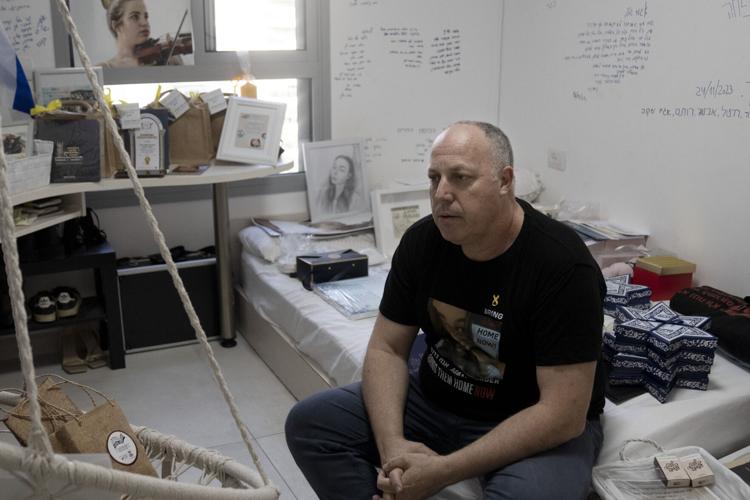
Shlomi Berger sits in his daughter’s bedroom April 17 in Holon, Israel. Agam, 19, was abducted two days after the start of her army service along the border with Gaza during a cross-border attack by Hamas on Oct. 7, 2023. “The Passover story says we come from slaves to free people, so this is a parallel story,” Berger said. “This is the only thing I believe that will happen. That Agam will get out from darkness to light. She and all of the other hostages.”

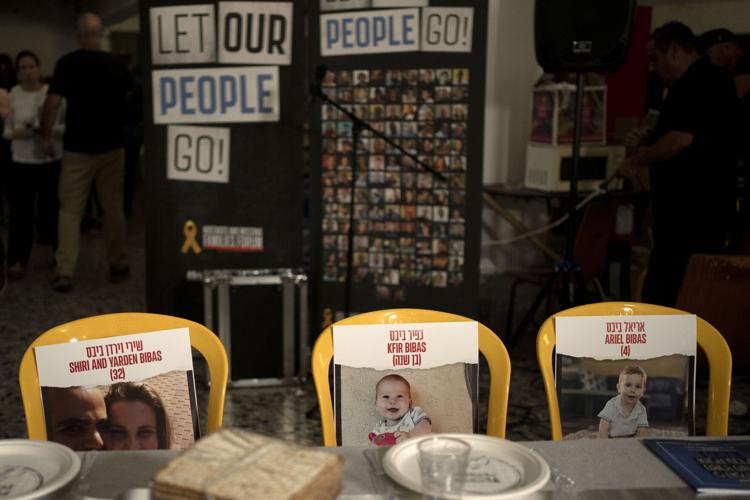
Chairs are set April 11 for missing members of the Bibas family, who are held hostage in Gaza, at a Passover Seder table at the communal dining hall at Kibbutz Nir Oz in southern Israel, where a quarter of all residents were killed or captured by Hamas on Oct. 7, 2023.
For many Jews, Passover is a time to reunite with family and recount the exodus from Egypt at a meal known as the Seder. Observant Jews avoid grains, known as chametz, a reminder of the unleavened bread the Israelites ate when they fled Egypt quickly with no time for dough to rise.
But this year many families are torn about how — or even if — to celebrate.
When Hamas attacked Kibbutz Be’eri, Gat, his wife, 3-year-old daughter, parents and sister hid for hours in their rocket-proof safe room. But fighters entered the house and killed or abducted everyone inside, except for his father who hid in the bathroom. His mother was dragged into the street and shot.
Gat, his arms and legs bound, was shoved into a car with his wife and daughter. During a brief stop, they managed to flee. Knowing he could run faster, Roman-Gat handed him their daughter. Gat escaped with her, hiding in a ditch for nearly nine hours. His wife was recaptured and held in Gaza for 54 days.
Passover this year will be more profound as freedom has taken on a new meaning, Roman-Gat said.
“To feel wind upon your face with your eyes closed. To shower. To go to the toilet without permission, and with the total privacy and privilege to take as long as I please with no one urging me, waiting for me at the other side to make sure I’m still theirs,” she said in a text message.

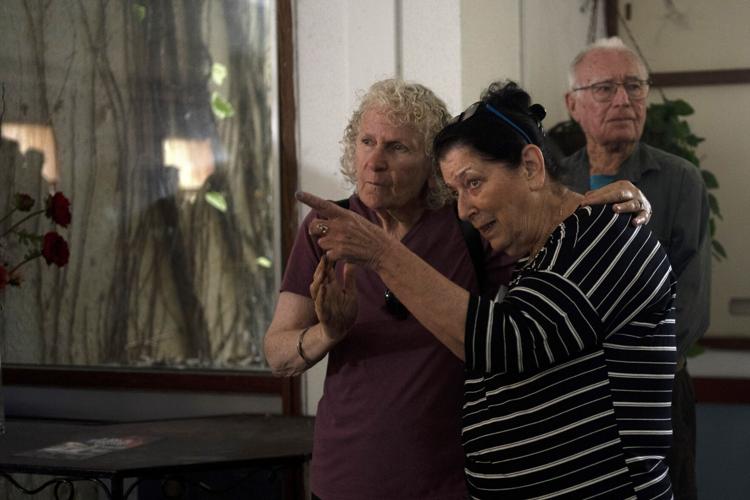
Osnat Peri, right, whose husband, Haim, is in Hamas captivity, takes part in a Passover Seder commemoration with relatives of hostages held in the Gaza Strip on April 11 at the communal dining room at Kibbutz Nir Oz.

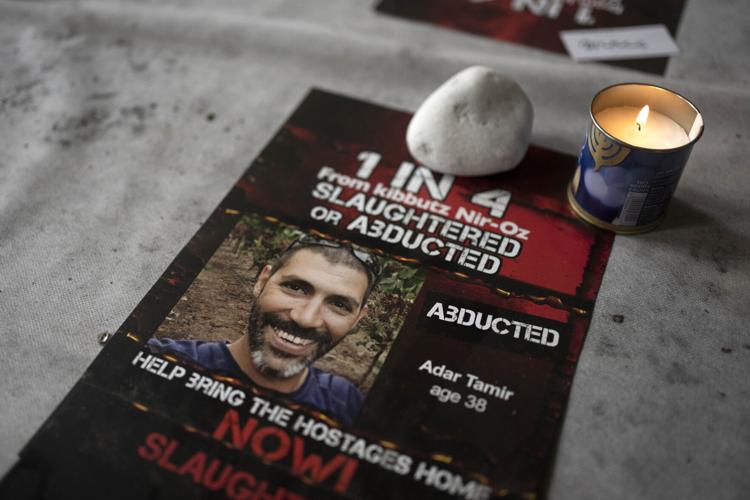
A candle burns April 11 in Kibbutz Nir Oz for Tamir Adar, who was killed by Hamas on Oct. 7 before his body was taken to the Gaza Strip.
Still, Passover will be overshadowed by deep sorrow and worry for her sister-in-law and the other hostages, she said. The family will mark the holiday with a low-key dinner in a restaurant, without celebration.
As hard as it is in times of pain, Jews have always sought to observe holidays during persecution, such as in concentration camps during the Holocaust, said Rabbi Martin Lockshin, professor emeritus at Canada’s York University, who lives in Jerusalem.
“They couldn’t celebrate freedom but they could celebrate the hope of freedom,” he said.
The crisis affects more than the hostage families. The war, in which 260 soldiers have been killed, casts a shadow over a normally joyous holiday. The government has also scaled back festivities for Independence Day in May in light of the mood and fearing public protests.
Likewise, the Muslim holy month of Ramadan, capped by the three-day Eid al-Fitr feast, was a sad, low-key affair for Palestinians. More than 80% of Gaza’s 2.3 million people have been displaced by the fighting, and Hamas health officials say nearly 34,000 people have been killed in the Israeli offensive.
The scenes of suffering, devastation and hunger in Gaza have received little attention in Israel, where much of the public and national media remain heavily focused on the aftermath of the Oct. 7 attack and ongoing war.

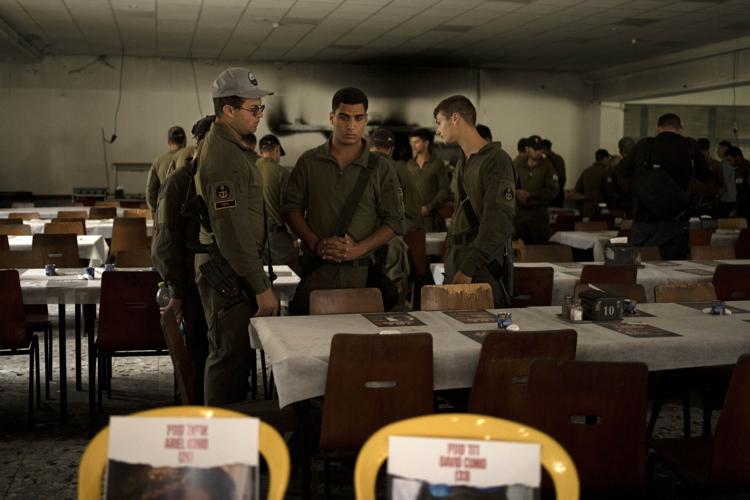
Israeli soldiers look at chairs for hostages held in Gaza at a Passover Seder table April 11 at the communal dining hall at Kibbutz Nir Oz in southern Israel.
After several months of fits and starts, negotiations on a deal to release the remaining hostages appears at a standstill — making it unlikely they will be home for Passover.
The hostages’ pain has reverberated around the world, with some in the Jewish diaspora asking rabbis for prayers specifically for the hostages and Israel to be said at this year’s Seder. Others have created a new Haggadah, the book read during the Seder, to reflect the current reality.
Some families say it’s too painful to celebrate at all.
The girlfriend of Nirit Lavie Alon’s son was abducted from the Nova music festival. Two months later the family was informed by Israel’s military that Inbar Haiman, a 27-year-old graffiti artist, was dead, her body still in Gaza.
“It’s impossible to celebrate a freedom holiday,” Alon said.

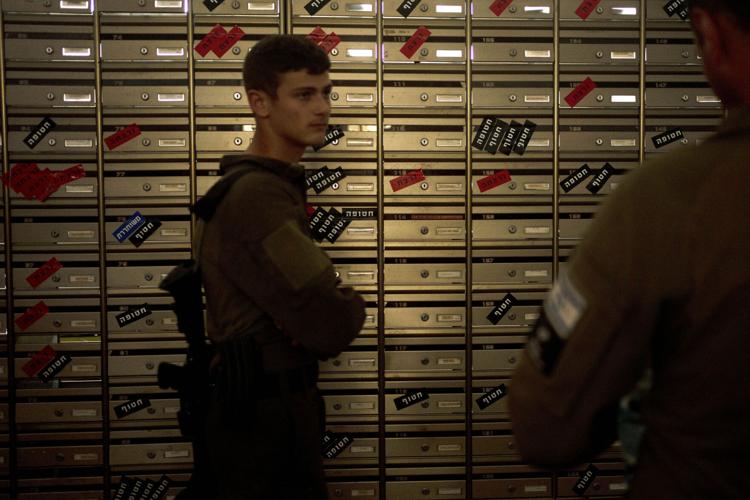
Israeli soldiers visit the mailroom April 11 in Kibbutz Nir Oz, where mailboxes are labeled with residents' status: killed (red), kidnapped (black), and released (blue).
Ahead of Passover, some families are still holding out hope their relatives will be freed in time.
Shlomi Berger’s 19-year-old daughter, Agam, was abducted two days after the start of her army service along the border with Gaza.
He refuses to give up hope.
“The Passover story says we come from slaves to free people, so this is a parallel story,” Berger said. “This is the only thing I believe that will happen. That Agam will get out from darkness to light. She and all of the other hostages.”
The vulnerability of Nir Oz: Inside Hamas’ unprecedented hostage operation

Palestinians transport a hostage, Yaffa Adar, an 85-year-old Israeli great-grandmother and Holocaust survivor, from her home in Kibbutz Nir Oz into the Gaza Strip on Oct. 7, 2023. Eight weeks into the Israel-Gaza war, the recent release of dozens of Israeli hostages — with as many still in captivity — is bringing new focus on what Hamas did on Oct. 7, the day its fighters rounded them up from communities across southern Israel. The kibbutz of Nir Oz, where militants rampaged unopposed, is perhaps the best place to understand Hamas’ hostage strategy, an operation unprecedented both in its scope and execution.

Irit Lahav stands Nov. 21 outside a neighbor's home that was destroyed by Hamas on Oct. 7 as they killed or captured a quarter of the residents of Kibbutz Nir Oz, near the Israel-Gaza border. More than 100 Palestinian militants stormed Nir Oz on Oct. 7 for hours and left with some 80 of its roughly 400 residents. People from Nir Oz made up a third of the 240 hostages taken in all and nearly half of the Israelis released, with more than 30 still in Gaza. For Israelis, Nir Oz embodies their country’s vulnerability that day, with the absence of Israeli security forces, the capture of unprotected civilians, their deaths and disappearance into Gaza and their subsequent exchange for Palestinians.

A poster calling for the release of Chana Katzir is taped to the door of her home in Kibbutz Nir Oz, on Nov. 21, 2023. Katzir was kidnapped by Hamas militants on Oct. 7, from her home and taken to the Gaza Strip. She has since been freed. Those seized from the kibbutz ranged in age from 9 months to 85 years. More than half were women and children. All 13 Israeli hostages released in the first exchange on Nov. 24 were from Nir Oz, and they bought the freedom of 39 Palestinian prisoners from Israel.

A soldier walks through the mailroom Nov. 21 in Kibbutz Nir Oz, where mailboxes are labeled with the status if it's residents — killed, captured, or recovered — near the Israel-Gaza border. A review of hundreds of messages among Nir Oz residents shared exclusively with The Associated Press, direct interviews with 17 and accounts from many more, security camera footage and Hamas’ own instruction manuals suggests that the group planned well ahead of time to target civilians. Four experts in hostage situations agreed that Hamas’ actions, both on the day of the attack and afterward, indicated a plan to seize civilians to prepare for the war to come.

Eyal Barad pauses in the safe room where he sheltered with his family on Oct. 7 as Hamas militants killed and captured a quarter of the community on Kibbutz Nir Oz, Thursday, Nov. 9, 2023. An Associated Press review of hundreds of messages shared among Nir Oz residents, security camera footage and Hamas instruction manuals show the group planned ahead of time to target civilians, a change in tactic that heavily impacted how the war in Gaza played out. Danielle Gilbert, a political scientist at Northwestern University who researches hostage-taking, said Hamas and other armed groups generally use hostages as human shields or as currency to negotiate an exchange. But the difference here, she said, is that most armed groups take able-bodied adult men.

This combination of undated images shows residents of Kibbutz Nir Oz who have been freed from Hamas captivity in the Gaza Strip, where they had been held hostage since an Oct. 7 cross-border attack. Top row from left: Adina Moshe, Sapir Cohen, Ofelia Roitman, Irena Tati, Yelena Trupanov, Ada Sagi. Second row from left: Sahar Kalderon and her brother Erez Kalderon, Liat Atzili, Ilana Gritzewsky, Shani Goren, Channa Peri. Third row from left: Yaffa Adar, Nili Margalit, sisters Aviv, right, and Raz Asher Katz, Eitan Yahalomi, Yagil Yaakov, Tamar Metzger. Bottom row from left: Dafna Elyakim and her sister Ela Elyakim, Sharon Aloni Cunio, center, and her twin daughters, Emma and Yuli, Keren Munder and her son Ohad, Ditza Heiman, Hannah Katzir.

A yellow ribbon for the hostages taken by Hamas is tied to a pole Nov. 21 in Kibbutz Nir Oz, near the Israel-Gaza border. One of the first hostages to be freed, Yocheved Lifshitz, told a news conference that they were separated by kibbutz after arriving in Gaza. A few days in, Hamas leader Yehya Sinwar met with the Nir Oz hostages, she later told Israeli media. A doctor came every few days to check on them and take care of an injured man.

Released Israeli hostage Margalit Mozes walks with an Israeli soldier upon her arrival in Israel on Nov. 24, 2023, after being held hostage by Hamas in the Gaza Strip. An Associated Press review of Hamas instruction manuals shows the group planned ahead of time to target civilians.

Siblings Aviv Asher, Raz Asher, and mother, Doron, react as they meet with Yoni, Doron's husband and their father, after they returned to Israel at the Schneider Children's Medical Center, on Nov. 24, 2023. Danielle Gilbert, a political scientist at Northwestern University who researches hostage-taking, said Hamas and other armed groups generally use hostages as human shields or as currency to negotiate an exchange. But the difference here, she said, is that most armed groups take able-bodied adult men. “It is extremely rare for armed groups to kidnap children, to kidnap women, to kidnap the elderly and people who are otherwise vulnerable,” she said. “The hostage-taker needs to make sure that their hostage can survive captivity.”

Released Israeli hostage Yagil Yaakov, 12, as he returns to Israel in an IAF helicopter on Nov. 27, 2023, after being held hostage by Hamas in the Gaza Strip.

Hadas Kalderon is overcome by emotion Oct. 30 in the ruins of her mother's home in Kibbutz Nir Oz, Israel. The kibbutz was overrun on Oct. 7 by Hamas militants, who killed or captured a quarter of its community, including Kalderon's mother, Carmela Dan, and 12-year-old niece, Noya. Kalderon's children, Erez, 12 and Sahar, 16, have been freed; the children's father, Ofer, is still in Gaza.

Released Israeli hostage Eitan Yahalomi, 12, upon his arrival at Tel Aviv Sourasky Medical Center on Nov. 27, 2023, after being held hostage by Hamas in the Gaza Strip.

Released Israeli hostage Ohad Munder, 9, sits inside an Israeli military helicopter shortly after arriving in Israel on Nov. 24, 2023, after being held hostage by Hamas in the Gaza Strip.

A street lamp shines Nov. 9 on a section of the fence that was breached by Hamas on Oct. 7 when they killed or captured a quarter of the residents of Kibbutz Nir Oz.

Bullet holes from the Oct. 7 cross-border attack by Hamas militants are seen in the door to the communal dining room in Kibbutz Nir Oz, near the Israel-Gaza border, on Nov. 21, 2023.

Palestinians transport a captured Israeli civilian, Adina Moshe, from her home in Kibbutz Nir Oz to the Gaza Strip on Oct. 7, 2023.

Yocheved Lifshitz, 85, center, who was released from captivity after being held hostage by Hamas, holds a photo of her husband Oded during a protest calling for the release of all hostages still held in the Gaza Strip, on Nov. 28, 2023, in Tel Aviv, Israel.