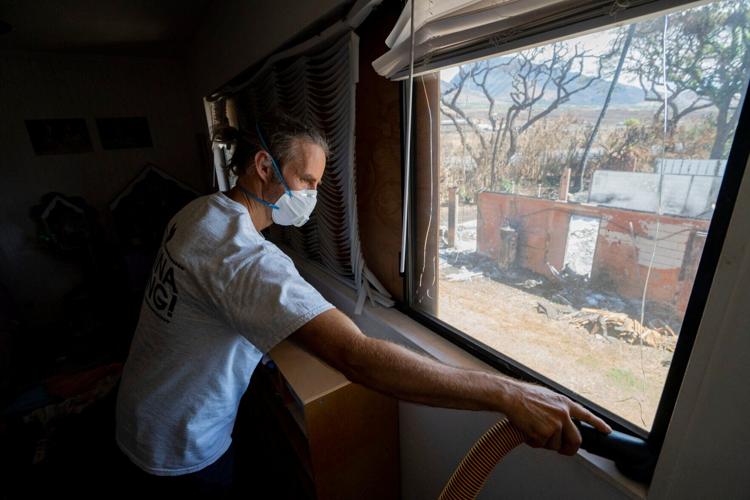
When Daniel Skousen scrubs at the ash and soot covering his Maui home, he worries about the smell.
What chemicals created the burning-trash-barrel scent that has lingered since a deadly wildfire tore through Lahaina in August? Should he believe government agencies’ assessment of when the air, land and water will be safe enough for his family to return?
Or will political and economic pressures to rebuild and restore Maui’s robust tourism industry — where visitors normally spend $14 million per day — lead officials to look at any testing results through rose-colored glasses?
“It appears very important to them to get that tourism tax revenue back,” said Skousen. “It makes you wonder if the testing will be biased.”

Daniel Skousen vacuums his home, damaged by August’s wildfire, on Nov. 3 in Lahaina, Hawaii. Concerned about health hazards, Skousen is holding off on deep-cleaning his home until the EPA removes all debris from the burnt house adjacent to his.
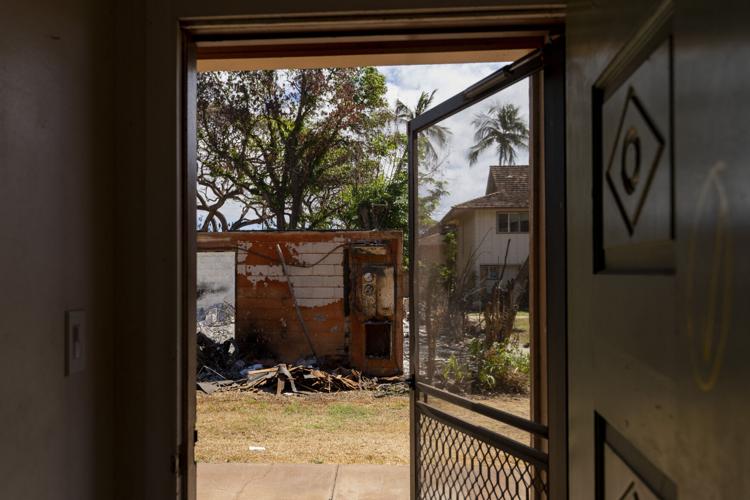
The fire blew out Skousen’s windows and filled his home with ash, but the building is still standing, and he hopes someday to move back in. The home next door burned to the ground.
People are also reading…
Skousen wants a second opinion on any government environmental assessments, preferably from an expert with a stake in the community. But the raw data isn’t easy to find, and experts say the long-term health effects from fires like the one that incinerated Lahaina are mostly unknown. There are no national standards that detail how clean is clean enough for a residential home damaged by a nearby fire.
At least 100 people died in the Aug. 8 wildfire, and thousands were displaced. Nearly 7,000 were still in short-term lodging two months later.
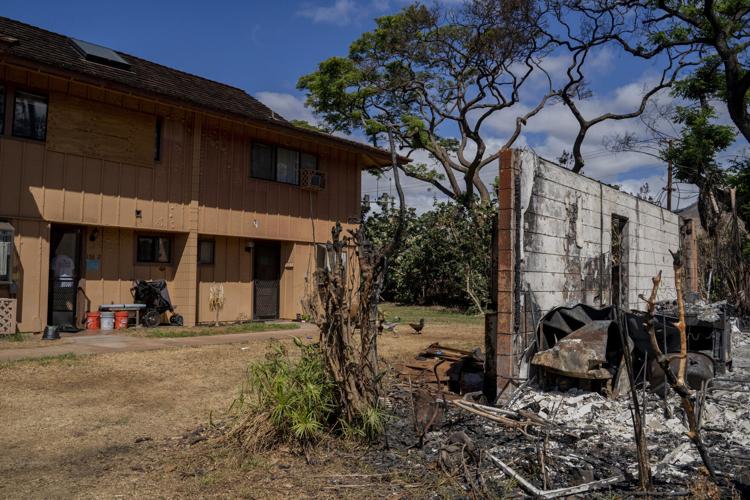
The rubble left behind includes electrical cables, plastic pipes and vehicle tires that emit dangerous dioxins when burned; lead from melted vehicles or old house paint; and arsenic-laden ash from termite-resistant building materials.

The burned house next to Daniel Skousen’s home is seen from his front door on Nov. 3 in Lahaina, Hawaii. The fire blew out Skousen’s windows and filled his home with ash, but the building is still standing, and he hopes someday to move back in.
After a major wildfire burned 1,000 homes in Boulder County, Colorado, in 2021, health officials learned that even professionally remediated homes were often still polluted with ash, char and other toxic substances long after the fire, said Bill Hayes, the county’s air quality program coordinator.
The reason? High winds — like those that plagued Maui during the wildfire this summer — forced fine particulate matter into every crevice, Hayes said. Those particulates would sit inside window panes, behind light switches, between shingles and elsewhere until the winds started up again, re-contaminating the home.
“Char is a carcinogen, so we don’t ever say any level of those particulates are safe,” Hayes said. “That became a challenge in the cleanup — determining the level of when is it clean enough?”
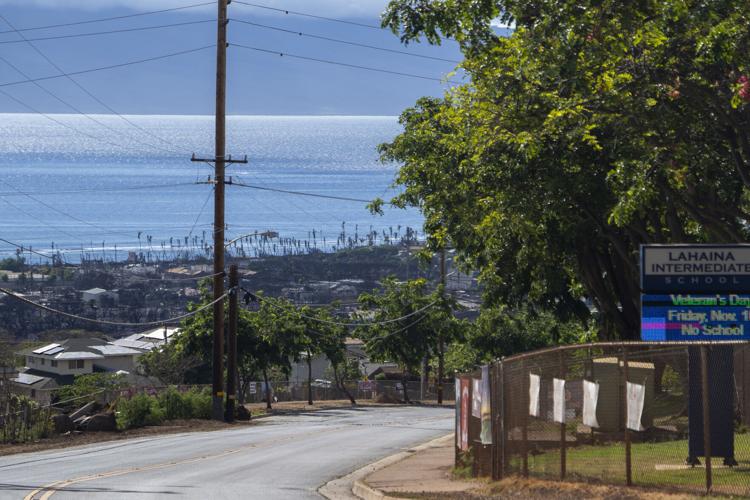
State and federal agencies have released regular updates on Lahaina’s relative safety. The water in much of the town is still unsafe to drink, and visitors have been advised to use protective gear in impacted areas. Officials say pregnant people and kids should stay out of the burn zone, though the Hawaii Department of Education says the schools, which are above the burned part of town, are safe.

The burn zone in Lahaina from August’s wildfire is visible Nov. 3 on Lahainaluna Road, where three public schools were spared in Lahaina, Hawaii.
Crews have installed air quality monitors throughout town and are spraying a soil sealant to prevent toxic ash from being washed into the ocean or blowing around.
An attorney representing Skousen and about two dozen other Lahaina residents sent a public records request to the Environmental Protection Agency last month asking for all records regarding residential testing of contaminants in Lahaina and their impact to human health.
The EPA’s reply, sent earlier this month, wasn’t reassuring: “No records could be located that are responsive to your request.”
EPA spokesman Kellen Ashford said his agency did some environmental hazard testing in the burn zone, but only to determine the immediate risk for workers involved in the initial cleanup.
He referred further questions about such testing to the Hawaii Department of Health, which he said was responsible for determining longer-term safety for residents.
The Hawaii Department of Health’s Environmental Health Services Division also told Skousen’s attorney it had no records about residential testing of contaminants to release.

Daniel Skousen’s home stands next to one that burned down in August’s wildfire in Lahaina, Hawaii, leaving behind rubble that includes electrical cables, plastic pipes and vehicle tires that emit dangerous dioxins when burned.
The Health Department declined interview requests. Spokesman Shawn Hamamoto said in an email the department will pursue additional air quality and ash testing when the U.S. Army Corps of Engineers begins removing debris from Lahaina.
“I think that they’re playing ‘hide the ball,’” said Skousen’s attorney, Edward Neiger. “The question is, why do they feel the need to hide anything?”
Ashford acknowledged some residents are skeptical of the cleanup efforts. He said the EPA has people stationed at the Lahaina Civic Center and at work sites to talk to community members about their concerns.
Dioxins, toxic compounds that can be released when plastic pipes, tires and other household materials are burned, are a particular concern. Dioxins can last for decades inside the human body, and can cause reproductive and developmental problems, damage the immune system, interfere with hormones and cause cancer, according to the World Health Organization.
Andrew Shoemaker, a fine art photographer who operated a gallery on Lahaina’s famous Front Street, believes it’s an important part of healing to go back to the burned areas to see what is left, but he has recently had a lung infection and doesn’t want to risk his health.
“I don’t even want to take the chance of going over there,” he said.
Photos show Lahaina before and after wildfire devastation

This combination of satellite images provided by Maxar Technologies shows an overview of southern Lahaina on Maui, Hawaii, on June 25, left, and an overview of the same area on Wednesday, following a wildfire that tore through the heart of the Hawaiian island. The search of the wildfire wreckage Thursday on Maui revealed a wasteland of burned homes and obliterated communities as firefighters battled the stubborn blaze that has already claimed 53 lives, making it the deadliest in the U.S. in five years.

This combination of satellite images provided by Maxar Technologies shows an overview of Banyan Court in Lahaina on Maui, Hawaii, on June 25, top, and an overview of the same area on Wednesday, following a wildfire that tore through the heart of the Hawaiian island. The flames left some people with mere minutes to act and led some to flee into the ocean.

This combination of satellite images provided by Maxar Technologies shows an overview of Lahaina on Maui, Hawaii, on June 25, left, and an overview of the same area on Wednesday.

This combination of satellite images provided by Maxar Technologies shows an overview of Lahaina Square on Maui, Hawaii, on June 25, left, and an overview of the same area on Wednesday.

Wildfire wreckage is shown Thursday in Lahaina, Hawaii, where a deadly wildfire that killed at least 53 people left a wasteland of burned-out homes and obliterated communities.

Wildfire wreckage is shown Thursday in Lahaina, Hawaii. Maui County Mayor Richard Bissen Jr. said the island had “been tested like never before in our lifetime.” “We are grieving with each other during this inconsolable time,” he said in a recorded statement. “In the days ahead, we will be stronger as a ‘kaiaulu,’ or community, as we rebuild with resilience and aloha.”

Wildfire wreckage is shown Thursday in Lahaina, Hawaii. Mauro Farinelli, of Lahaina, said the winds started blowing hard on Tuesday, and then somehow a fire started up on a hillside. “It just ripped through everything with amazing speed,” he said, adding it was “like a blowtorch.”

Wildfire wreckage is shown Thursday in Lahaina, Hawaii. Fueled by a dry summer and strong winds from a passing hurricane, the deadly fire started Tuesday and took the island by surprise, racing through parched growth and neighborhoods in the historic town of Lahaina, a tourist destination that dates to the 1700s and is the biggest community on the island's west side.