TEL AVIV, Israel — Israeli Prime Minister Benjamin Netanyahu railed Sunday against growing criticism from top ally the United States against his leadership amid the devastating war with Hamas, describing calls for a new election as “wholly inappropriate.”

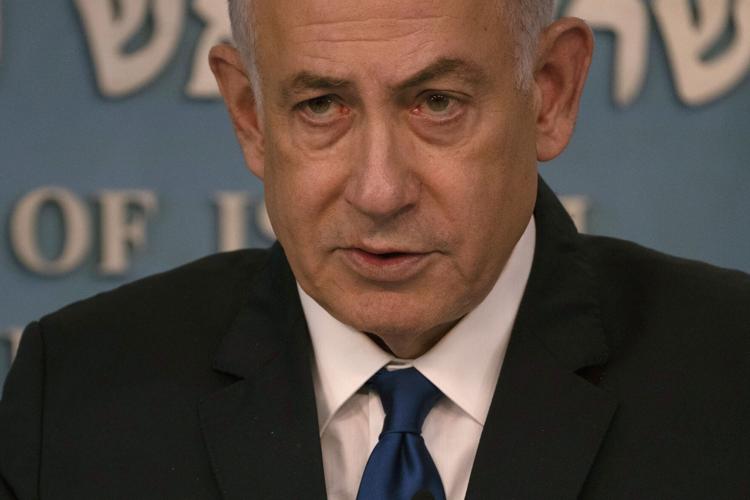
Israeli Prime Minister Benjamin Netanyahu delivers his speech after a meeting with German Chancellor Olaf Scholz on Sunday in Jerusalem.
In recent days, U.S. Senate Majority Leader Chuck Schumer, the highest-ranking Jewish official in the country and a strong Israel supporter, called on Israel to hold a new election, saying Netanyahu had “lost his way.” President Joe Biden expressed support for Schumer’s “good speech,” and earlier accused Netanyahu of hurting Israel because of the huge civilian death toll in Gaza.
Netanyahu told Fox News that Israel never would have called for a new U.S. election after the Sept. 11 attacks in 2001, and denounced Schumer’s comments as inappropriate.
“We’re not a banana republic,” he said. “The people of Israel will choose when they will have elections, and who they’ll elect, and it’s not something that will be foisted on us.”
People are also reading…
When asked by CNN whether he would commit to a new election after the war ends, Netanyahu said that “I think that’s something for the Israeli public to decide.”

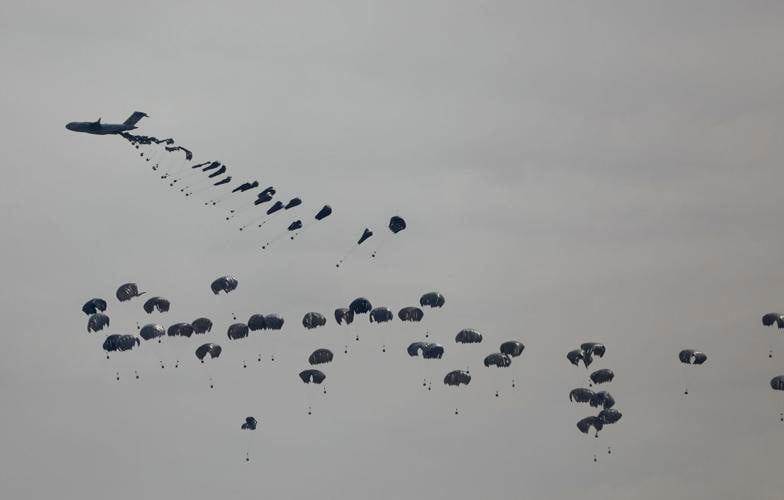
Humanitarian aid is airdropped to Palestinians on Sunday in Gaza City.
The U.S., which has provided key military and diplomatic support to Israel, also has expressed concerns about a planned Israeli assault on the southern Gaza city of Rafah, where about 1.4 million displaced Palestinians are sheltering. The spokesman for the National Security Council, John Kirby, told Fox the U.S. still hasn’t seen an Israeli plan for Rafah.
The U.S. supports a new round of talks aimed at securing a cease-fire in exchange for the return of Israeli hostages taken in Hamas’ Oct. 7 attack.
The Israeli delegation to those talks was expected to leave for Qatar after Sunday evening meetings of the Security Cabinet and War Cabinet, which will give directions for negotiations.
Despite the talks, Netanyahu made it clear he would not back down from the fighting that has killed more than 31,000 Palestinians, according to local health officials. More than five months have passed since Hamas’ attack on southern Israel killed 1,200 people and left another 250 hostage.
Earlier Sunday, Netanyahu said that calls for an election now — which polls show he would lose badly — would force Israel to stop fighting and paralyze the country for six months.
Netanyahu also reiterated his determination to attack Hamas in Rafah and said that his government approved military plans for such an operation.

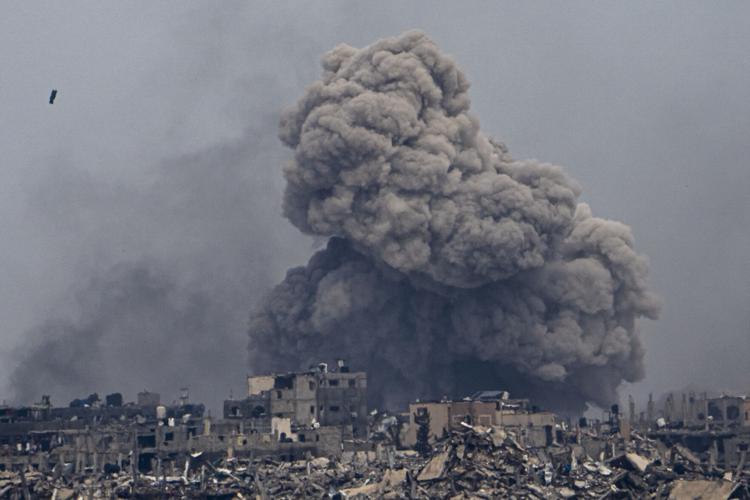
Smoke and explosions rise Sunday inside the Gaza Strip, as seen from southern Israel.
“We will operate in Rafah. This will take several weeks, and it will happen,” he said. The operation is supposed to include the evacuation of hundreds of thousands of civilians, but it is not clear how Israel will do that.
Egyptian President Abdel Fattah el-Sissi reiterated his warning that an Israeli ground offensive in Rafah would have “grave repercussions on the whole region.” Egypt says pushing Palestinians into the Sinai Peninsula would jeopardize its peace treaty with Israel, a cornerstone of regional stability.
“We are also very concerned about the risks a full-scale offensive in Rafah would have on the vulnerable civilian population. This needs to be avoided at all costs,” European Commission President Ursula von der Leyen said after meeting with el-Sissi.
And German Chancellor Olaf Scholz, after meeting with Netanyahu on Sunday, warned that “the more desperate the situation of people in Gaza becomes, the more this begs the question: No matter how important the goal, can it justify such terribly high costs, or are there other ways to achieve your goal?”
Germany is one of Israel’s closest allies in Europe and, given memories of the Holocaust, often treads carefully when criticizing Israel.
Alon Pinkas, a former Israeli consul-general in New York and an outspoken critic of Netanyahu, said that the prime minister’s comments fit with his efforts to find someone else to blame if Israel doesn’t achieve its goal of destroying Hamas.
“He’s looking on purpose for a conflict with the U.S. so that he can blame Biden,” Pinkas said.
Both sides have something to gain politically from the dispute. The Biden administration is under increasing pressure from progressive Democrats and some Arab-American supporters to restrain Israel’s war against Hamas. Netanyahu, meanwhile, wants to show his nationalist base that he can withstand global pressure, even from Israel’s closest ally.
But pressure also comes from home, with thousands protesting again in Tel Aviv on Saturday night against Netanyahu’s government and calling for a new election and a deal for the release of hostages. Large parts of the Israeli public want a deal, fearing that hostages are held in poor conditions and time is running out to bring them home alive.
Israel’s offensive has driven most of Gaza’s 2.3 million people from their homes. A quarter of Gaza’s population is starving, according to the U.N.
Airdrops by the U.S. and other nations continue, while deliveries on a new sea route have begun, but aid groups say more ground routes and fewer Israeli restrictions on them are needed to meet humanitarian needs in any significant way.
“Of course we should be bringing humanitarian aid by road. Of course by now we should be having at least two, three other entry points into Gaza,” chef José Andrés with World Central Kitchen, which organized the tons of food delivered by sea, told NBC.
The Gaza Health Ministry said at least 31,645 Palestinians have been killed in the war. The ministry doesn’t differentiate between civilians and combatants in its count, but says women and children make up two-thirds of the dead.
Muslims around world observe holy month of Ramadan

Members of the Muslim community gather Sunday, March 10, 2024, for the Taraweeh prayer during a month of Ramadan at New York's Times Square. Muslims around the world are observing the holy month of Ramadan, with worship, charity, dawn-to-dusk fasting and nightly feasts. Ramadan is the ninth month of the Islamic lunar calendar and begins with the sighting of the crescent moon.

Muslim worshippers perform a night prayer called 'Tarawih' on the first day of the Muslim holy month of Ramadan on Monday, March 11, 2024, at Fatih mosque in Istanbul, Turkey. Ramadan is the ninth month of the Islamic lunar calendar and begins with the sighting of the crescent moon. For many of the world's 1.8 billion Muslims, fasting began Monday, after an announcement from officials in Saudi Arabia, which is home to the holiest places in Islam. Muslim communities may start Ramadan on different days, due to declarations by multiple Islamic authorities around the globe on whether the crescent has been sighted or different methodologies used to determine the start of the month.

Indonesian Muslims attend an evening prayer called 'tarawih' Monday, March 11, 2024, to mark the first eve of the holy fasting month of Ramadan, at Istiqlal Mosque in Jakarta, Indonesia.
During Ramadan, Muslims refrain from eating, drinking, smoking and sexual intercourse from sunrise until sunset. Even a tiny sip of water or a puff of smoke is enough to invalidate the fast. At night, family and friends gather and feast in a festive atmosphere.
The fasting is aimed at bringing the faithful closer to God and reminding them of the suffering of the poor. Muslims are expected to strictly observe daily prayers and engage in heightened religious contemplation. They are also urged to refrain from gossip, fighting or cursing during the holy month.

Lights installed between the minarets of the Suleymaniye mosque reads in Turkish "Ramadan is the month of Quran" ahead of the Muslim holy month of Ramadan in Istanbul, Turkey, on Sunday, March 10, 2024.
The Muslim holy month of Ramadan, when the faithful fast from dawn to dusk, began at sunrise Tuesday, March 12, 2024, in much of Asia, a day after many Muslims in the Middle East began their fasts.
In the Muslim lunar calendar, months begin only when the new moon is sighted, which can lead to variations of a day or two.
Middle Eastern nations including Saudi Arabia, Egypt, Syria, Sudan and the United Arab Emirates declared the month would begin early Monday, March 11, but in the Asia-Pacific countries including Australia, Brunei, Indonesia, Malaysia and Singapore began Ramadan on Tuesday after failing to see the crescent moon the previous night. India, Pakistan and Bangladesh also began Ramadan on Tuesday, as did Iran and Jordan.

Muslims eat during Iftar, the sunset meal when Muslims break their fast in the holy month of Ramadan, on Tuesday, March 12, 2024, at a mosque in Kuala Lumpur, Malaysia.
In Malaysia, mosques began preparing bubur lambuk, a hearty traditional porridge dish made with meat and spices that is distributed for free to the public during Ramadan. But at the same time, critics urged people to keep their iftars to a reasonable size.
The Consumers’ Association of Penang said that food waste increases by up to 20% during Ramadan. Some 90,000 tonnes of food were reportedly thrown out across the country during Ramadan last year, it said.
“Ramadan is supposed to be a month of intense devotion for Muslims but for some, it has become a month of feasting and wasteful spending,” the association’s president Mohideen Abdul Kader said.

A Palestinian boy plays with fireworks Sunday, March 10, 2024, as he celebrates the start of the Muslim holy month of Ramadan next to a destroyed residential building by the Israeli airstrikes in Rafah, Gaza Strip. In Rafah in southern Gaza, Palestinians buy food for a pre-dawn meal. Ramadan this year comes as the Middle East remains inflamed by the ongoing Israel-Hamas war in Gaza, and many in the enclave are going hungry. Even where food is available, there is little beyond canned goods, and prices are high.

Muslims perform a special prayer called 'Tarawih' at Data Darbar mosque Monday, March 11, 2024, on the start of Muslim fasting month of Ramadan, in Lahore, Pakistan.

Students perform a prayer Tuesday, March 12, 2024, during the first day of the holy fasting month of Ramadan at Ar-Raudlatul Hasanah Islamic Boarding School in Medan, North Sumatra, Indonesia.
In Indonesia, where 90% of the population of 277 million practice Islam, celebrations ranged from colorful torchlight parades, to cleaning family graves, to preparing food for pre-dawn breakfasts and elaborate post-sundown meals known as "iftars." Each region in the archipelago nation has its own way to mark the start of Ramadan.
The government set the start of the holiday for Tuesday, March 12, 2024, after teams from more than 100 regions failed to sight the new moon Sunday. Religious Affairs Minister Yaqut Cholil Qoumas announced the timing late Sunday evening.
Mosques flooded with devotees offering the evening prayers known as “tarawih” on Monday night. In Jakarta’s Istiqlal Grand Mosque, the largest in Southeast Asia, tens of thousands of worshippers crammed together shoulder-to-shoulder.
It's also an exciting time for business. Hotels, restaurants and cafes all prepare special Ramadan promotions, shoppers to flock shopping centers for new clothes and home decorations for the holiday of Eid al-Fitr, which marks the end of Ramadan.

Volunteer arrange food plates to be distributed among people for breaking their fast Tuesday, March 12, 2024, during the Muslim's holy fasting month of Ramadan, in Lahore, Pakistan.

A Nepalese Muslim recites Quran on Tuesday, March 12, 2024, at the Jame Mosque on the first day of holy month of Ramadan in Kathmandu, Nepal.

Muslim worshippers perform "tarawih," an extra lengthy prayer held during the Muslim holy month of Ramadan, on Sunday, March 10, 2024, in Rafah, Gaza Strip. In Rafah in southern Gaza, Palestinians buy food for a pre-dawn meal. Ramadan this year comes as the Middle East remains inflamed by the ongoing Israel-Hamas war in Gaza, and many in the enclave are going hungry. Even where food is available, there is little beyond canned goods, and prices are high.

Palestinians buy food for a pre-dawn meal before fasting Sunday, March 10, 2024, during the Muslim holy month of Ramadan in Rafah, Gaza Strip.

Volunteers distribute food for those breaking their fast Tuesday, March 12, 2024, during the Muslim's holy fasting month of Ramadan, at Memon mosque in Karachi, Pakistan.

Myanmar Muslim men join evening prayer before their fast-breaking during the first day of Muslim's holy fasting month of Ramadan at Nwe Aye Mosque in Yangon, Myanmar, Tuesday, March 12, 2024.

A "Happy Ramadan" sign is illuminated on the occasion of the beginning of the holy month of Ramadan, when observant Muslims fast from dawn to dusk, in a pedestrian zone in Frankfurt, Germany, Sunday, March 10, 2024.

Indonesian Muslims attend an evening prayer called 'tarawih' marking the first eve of the holy fasting month of Ramadan, at Istiqlal Mosque in Jakarta, Indonesia, Monday, March 11, 2024.

Muslims offer prayer inside a Mosque on the first day of Ramadan, in Srinagar, Indian controlled Kashmir, Tuesday, March 12, 2024. The Muslim holy month of Ramadan, when the faithful fast from dawn to dusk, began at sunrise Tuesday in much of Asia.

A Muslim reads the Quran while they fast during the first day of Ramadan at the Niujie Mosque in Beijing, China, Tuesday, March 12, 2024.

A Muslim woman reads Quran during an evening prayer called 'tarawih' marking the first eve of the holy fasting month of Ramadan, at Istiqlal Mosque in Jakarta, Indonesia, Monday, March 11, 2024.

People wait to break their fast during the Muslim's holy fasting month of Ramadan, at a free meal distribution point in Peshawar, Pakistan, Tuesday, March 12, 2024.

Volunteers distribute food among people for breaking their fast during the Muslim's holy fasting month of Ramadan, at a free meal distribution point, in Rawalpindi, Pakistan, Tuesday, March 12, 2024.

A Muslim worshipper reads the Quran, Islam's holiest book, during the Muslim holy fasting month of Ramadan at Hagia Sophia mosque in Istanbul, Turkey, Tuesday, March 12, 2024.

Indonesian Muslims attend an evening prayer called 'tarawih' marking the first eve of the holy fasting month of Ramadan, at Istiqlal Mosque in Jakarta, Indonesia, Monday, March 11, 2024.