Idaho librarian June Meissner was closing up for the day at the downtown Boise Public Library when a man approached her asking for help.
As an information services librarian, answering patrons’ questions is part of Meissner’s day-to-day work, and serving the community is one of her favorite parts of the job.
But when the man got close enough, “he took a swing at me and tried to punch me in the head,” said Meissner, a transgender woman. “I blocked it and he started yelling slurs and suggesting that he was going to come back and kill me.”

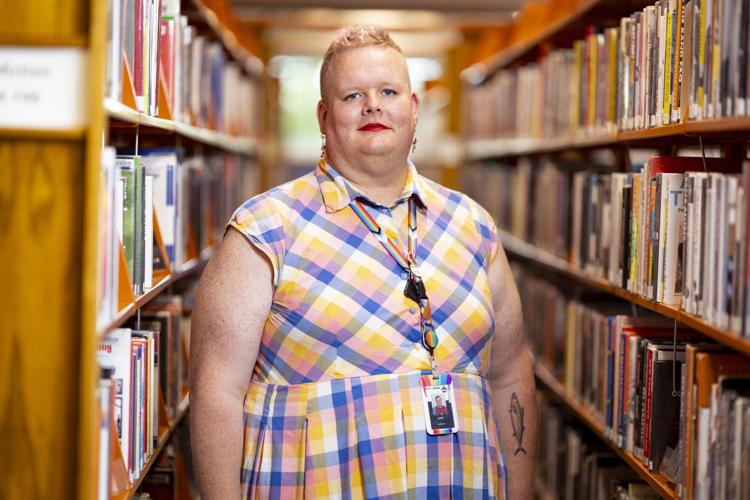
June Meissner poses for a photo June 6 at the Boise Public Library in Boise, Idaho.
Worldwide Pride Month events are well underway to celebrate LGBTQ+ culture and rights. But they come at a time when people who identify as LGBTQ+ say they face increasing difficulties at work, ranging from being misgendered to physically assaulted.
Gender nonconforming library workers in particular also are grappling with growing calls for book bans across the U.S. Books about gender identity, sexual orientation and race top the list of most criticized titles, making the attacks all the more personal.
People are also reading…
“When we see attacks on those books, we have to understand that those are attacks on those kinds of people as well,” said Emily Drabinski, who is the president of the American Library Association and is gay. “To have my identity weaponized against libraries and library workers, the people and institutions I care about the most, has made it a difficult and painful year.”
The ALA said last year it documented the highest-ever number of titles targeted for censorship in more than 20 years of tracking: 4,240. That total surpassed 2022’s previous record by 65%, with Maia Kobabe’s coming-of-age story “Gender Queer” topping the list for most criticized library book for the third straight year.
Lawmakers are increasingly considering lawsuits, fines and even imprisonment for distributing books some regard as inappropriate, including in Meissner’s home state of Idaho. Lawmakers there passed legislation that empowers prosecutors to bring charges against public and school libraries if they don’t keep “harmful” materials away from children. The new law will go in effect July 1.
“I do think that a lot of that political speech around it does make things more dangerous and worse for me,” Meissner said.

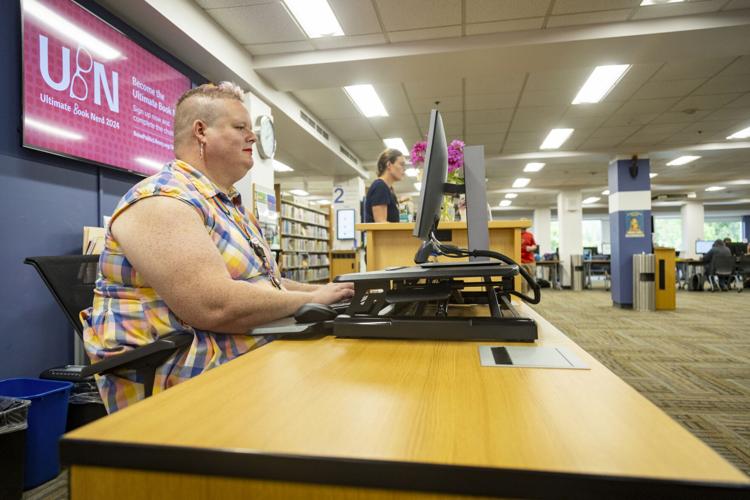
June Meissner uses a computer June 6 at a workstation on the second floor of the Boise Public Library in Boise, Idaho.
Meissner’s attacker was arrested and convicted. While the vast majority of her interactions at work are positive, she says she still struggles to let her guard down.
“As somebody who is working face to face with the public and trying to help people as much as possible, that really does get in the way,” she said.
Florida-based conservative nonprofit Moms for Liberty, which describes itself as a parental rights organization, has been at the forefront of a nationwide push to remove books that deal with race and gender identity.
Co-founder Tiffany Justice says the organization — she says it has over 300 chapters in 48 states and more than 130,000 active members — is not anti-LGBTQ+, though she told the AP she thinks the Q, which stands for queer or questioning in the acronym, “needs to go into the trash bin.”
According to the ALA’s Office for Intellectual Freedom, about 38% of book challenges that “directly originated” from Moms for Liberty activity have LGBTQ+ themes.
Justice said Moms for Liberty challenges books like “Gender Queer” — a graphic novel about a young person’s struggle with gender identity that contains illustrations of sexual contact, masturbation and a sex toy — because the group views the material as sexually explicit, not because it covers LGBTQ+ topics.
“The least interesting thing about a child should be their sexual orientation,” Justice said. “Why are we flooding them with sexual content?”
Legal standards for deeming materials obscene or harmful to minors — and therefore not protected speech under the First Amendment — are very specific and high, and courts historically sided with libraries, according to Vera Eidelman, a staff attorney for the American Civil Liberties Union who focuses on rights to free speech in the digital age.
“The mere fact that something is describing sex, describing nudity, even depicting those things, is not enough to make it qualify as obscenity,” she said.
Still, book bans in many cases restricted access to materials in which LGBTQ+ youth can see themselves depicted.
As of June 1, Louisiana libraries must allow parents or guardians to decide which books their child can check out.
M’issa Fleming, a public librarian in New Orleans who uses they/them pronouns, says the new law could make it even more dangerous for queer and trans kids, who are already at higher risk of being victims of violence, substance use and suicide than their straight, cisgender peers. Losing access to LGBTQ+ themed books may cause kids to turn to less reliable sources such as social media.
“Public libraries could be offering as many ways as possible to make it less dangerous to learn about yourself, and the law just added another challenge,” Fleming said.

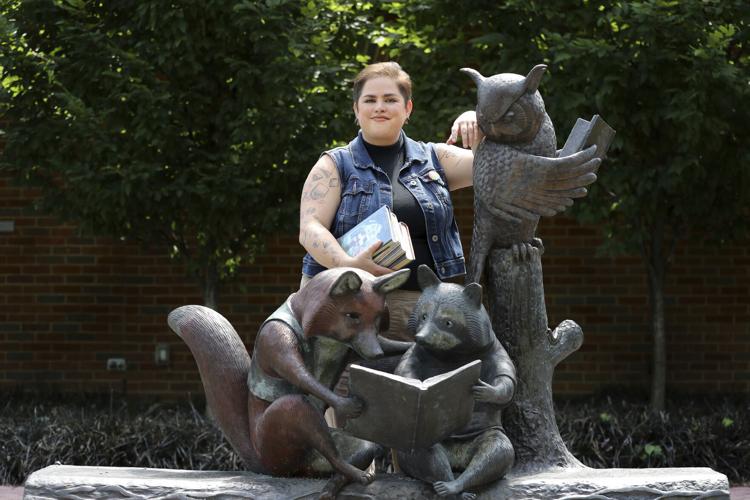
Chaz Carey poses for a photo June 11 at a library in Worthington, Ohio.
Chaz Carey, a children’s librarian in Worthington, Ohio, knows firsthand how powerful books can be. Alison Bechdel’s 2006 graphic memoir “Fun Home,” in which the author comes to grips with her sexual orientation, changed Carey’s life as a teenager.
“I felt seen. It was like my whole body just let out a breath,” said Carey, who is queer and uses they/them pronouns. “It is just so important that these books remain on shelves. They save lives.”
Carey says being a children’s librarian is a dream job, but the rise in book challenges and anti-LGBTQ+ rhetoric takes a mental toll. They are frequently misgendered at work, including by some patrons who go out of their way to do so while airing their political beliefs.
“The political environment is just an extra kind of weight as we navigate our lives and our places in our community,” said Carey, who chairs ALA’s Rainbow Roundtable, which aims to serve the information needs of LGBTQ+ people.
For Carey, what helps is “taking some time to feel sad, but then choosing queer joy and pride.”