Revved-up climate change now permeates Americans’ daily lives with harm that is “already far-reaching and worsening across every region of the United States,” a massive new government report says.
The National Climate Assessment, which comes out every four to five years, was released Tuesday with details that bring climate change’s impacts down to a local level.
Overall, it paints a picture of a country warming about 60% faster than the world as a whole, one that regularly gets smacked with costly weather disasters and faces even bigger problems in the future.

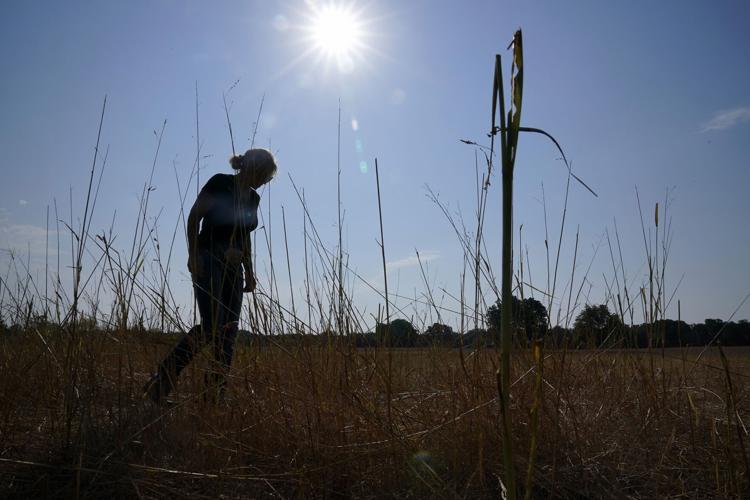
Gilda Jackson walks on a pasture on her property Aug. 21 that she grows hay on in Paradise, Texas.
Since 1970, the Lower 48 states have warmed by 2.5 degrees (1.4 degrees Celsius) and Alaska has heated up by 4.2 degrees (2.3 degrees Celsius), compared to the global average of 1.7 degrees (0.9 degrees Celsius), the report said. But what people really feel is not the averages, but when weather is extreme.
People are also reading…
With heat waves, drought, wildfire and heavy downpours, “we are seeing an acceleration of the impacts of climate change in the United States,” said study co-author Zeke Hausfather of the tech company Stripe and Berkeley Earth.
And that’s not healthy.
Climate change is “harming physical, mental, spiritual, and community health and well-being through the increasing frequency and intensity of extreme events, increasing cases of infectious and vector-borne diseases, and declines in food and water quality and security,” the report said.
Compared to earlier national assessments, this year’s uses far stronger language and “unequivocally” blames the burning of coal, oil and gas for climate change.

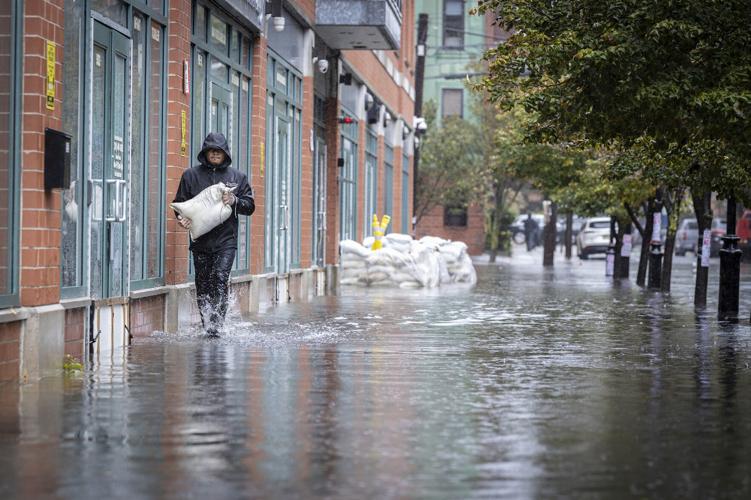
A person carries sandbags through water Sept. 29 as heavy rains cause streets to flood in Hoboken, N.J.
The 37-chapter assessment includes an interactive atlas that zooms down to the county level. It finds that climate change is affecting people’s security, health and livelihoods in every corner of the country in different ways, with minority and Native American communities often disproportionately at risk.
In Alaska, which is warming two to three times faster than the global average, reduced snowpack, shrinking glaciers, thawing permafrost, acidifying oceans and disappearing sea ice affect everything from the state’s growing season, to hunting and fishing, with projections raising questions about whether some Indigenous communities should be relocated.
The Southwest is experiencing more drought and extreme heat — including 31 consecutive days this summer when Phoenix’s daily high temperatures reached or exceeded 110 degrees — reducing water supplies and increasing wildfire risk.
Northeastern cities are seeing more extreme heat, flooding and poor air quality, as well as risks to infrastructure, while drought and floods exacerbated by climate change threaten farming and ecosystems in rural areas.

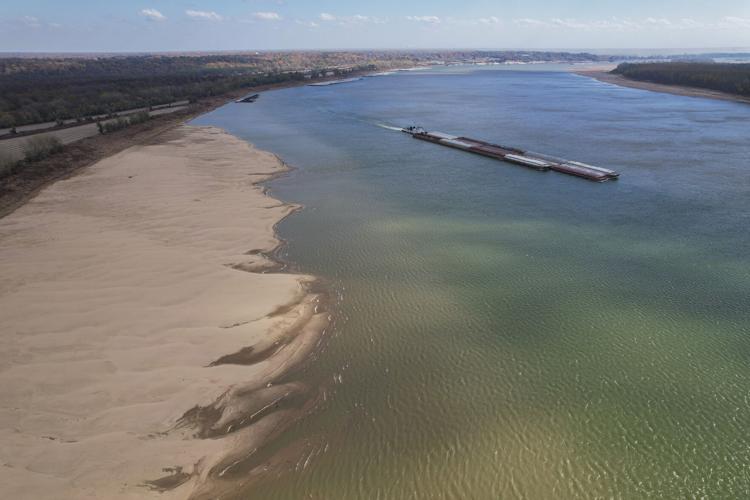
A barge moves Nov. 8 on the Mississippi River near Cairo, Ill.
In the Midwest, both extreme drought and flooding threaten crops and animal production, which can affect the global food supply.
In the northern Great Plains, weather extremes like drought and flooding, as well as declining water resources, threaten an economy dependent largely on crops, cattle, energy production and recreation. Meanwhile, water shortages in parts of the southern Great Plains are projected to worsen, while high temperatures are expected to break records in all three states by mid-century.
In the Southeast, minority and Native American communities — who may live in areas with higher exposures to extreme heat, pollution and flooding — have fewer resources to prepare for or to escape the effects of climate change.
In the Northwest, hotter days and nights that don’t cool down much have resulted in drier streams and less snowpack, leading to increased risk of drought and wildfires. The climate disturbance has also brought damaging extreme rain.
Brown University climate scientist Kim Cobb, who wasn’t part of the assessment team, said, “at the center of the report are people — across every region of the country — who have escalating risks associated with climate change as well as clear opportunities for win-win climate action.”

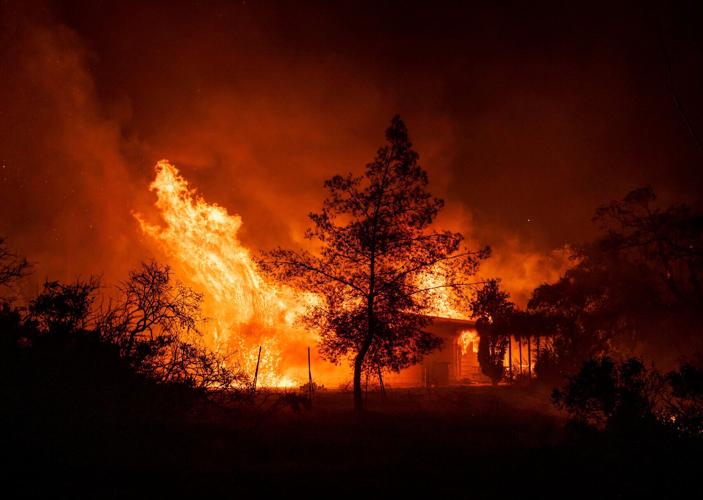
A structure is engulfed in flames Oct. 30 as the Highland Fire burns in Aguanga, Calif.
The United States will warm in the future about 40% more than the world as a total, the assessment said. The AP calculated, using others’ global projections, that would slate America to get about 3.8 degrees hotter by the end of the century.
“Climate change is finally moving from an abstract future issue to a present, concrete, relevant issue. It’s happening right now,” said report lead author Katharine Hayhoe, chief scientist at the Nature Conservancy and a professor at Texas Tech University. Five years ago, when the last assessment was issued, fewer people were experiencing climate change firsthand.
Surveys this year by The Associated Press-NORC Center for Public Affairs Research show that.
In September, about 9 in 10 Americans (87%) said they’d experienced at least one extreme weather event in the past five years — drought, extreme heat, severe storms, wildfires or flooding. That was up from 79% who said that in April.
But some scientists said parts of the assessment are too optimistic.
“The report’s rosy graphics and outlook obscure the dangers approaching,” Stanford University climate scientist Rob Jackson said. “We are not prepared for what’s coming.”
Climate change fueling crime wave in Mediterranean’s olive oil industry

Workers use electric combs to harvest olives from a tree as the sun rises in Spata suburb, east of Athens, Greece, Oct. 30, 2023. Surging olive oil prices, driven in part by two years of drought in Spain, has meant opportunity for criminals across the Mediterranean. Warehouse break-ins, dilution of premium oil with inferior product, and falsification of shipping data are on the rise in olive-growing heartlands of Greece, Spain and Italy. And perhaps worst of all: Gangs using chainsaws to steal heavily laden branches and even entire trees from unguarded groves.

Olives hang on a tree during the harvest period in Spata suburb, east of Athens, Greece, on Oct. 30, 2023. The crimes mean fewer olives for growers already contending with high production costs and climate change that has brought warmer winters, major flooding and more intense forest fires. In Italy’s southern Puglia region, growers are pleading with police to form an agriculture division. Greek farmers want to bring back a rural police division that was phased out in 2010. In Spain, a company has developed tracking devices that look like olives to try and catch thieves.

A worker uses an electric comb to harvest olives from a tree in Spata suburb, east of Athens, Greece, on Oct. 30, 2023. Across the Mediterranean, warm winters, massive floods, and forest fires are hurting a tradition that has thrived for centuries. Olive oil production has been hammered by the effects of climate change, causing a surge in prices for southern Europe's healthy staple.

A worker collects olives during the harvest period in Spata suburb, east of Athens, Greece, on Oct. 30, 2023. Across the Mediterranean, warm winters, massive floods, and forest fires are hurting a tradition that has thrived for centuries. Olive oil production has been hammered by the effects of climate change, causing a surge in prices for southern Europe's healthy staple.

Olives are collected during the harvest period in Spata suburb, east of Athens, Greece, on Oct. 31, 2023. Across the Mediterranean, warm winters, massive floods, and forest fires are hurting a tradition that has thrived for centuries. Olive oil production has been hammered by the effects of climate change, causing a surge in prices for southern Europe's healthy staple.

Workers load olives on a van during the harvest period in Spata suburb, east of Athens, Greece, on Oct. 31, 2023. Across the Mediterranean, warm winters, massive floods, and forest fires are hurting a tradition that has thrived for centuries. Olive oil production has been hammered by the effects of climate change, causing a surge in prices for southern Europe's healthy staple.

Two men wait to unload olives into a loading bin at an olive oil mill in Spata suburb, east of Athens, Greece, on Oct. 23, 2023. Across the Mediterranean, warm winters, massive floods, and forest fires are hurting a tradition that has thrived for centuries. Olive oil production has been hammered by the effects of climate change, causing a surge in prices for southern Europe's healthy staple.

Olives are collected during the harvest period in Spata suburb, east of Athens, Greece, on Oct. 31, 2023. Across the Mediterranean, warm winters, massive floods, and forest fires are hurting a tradition that has thrived for centuries. Olive oil production has been hammered by the effects of climate change, causing a surge in prices for southern Europe's healthy staple.

Workers load olives on a van during the harvest period in Spata suburb, east of Athens, Greece, on Oct. 31, 2023. Across the Mediterranean, warm winters, massive floods, and forest fires are hurting a tradition that has thrived for centuries. Olive oil production has been hammered by the effects of climate change, causing a surge in prices for southern Europe's healthy staple.

A man unloads olives into a loading bin as others look on at an olive oil mill in Spata suburb, east of Athens, Greece, on Oct. 23, 2023. Across the Mediterranean, warm winters, massive floods, and forest fires are hurting a tradition that has thrived for centuries. Olive oil production has been hammered by the effects of climate change, causing a surge in prices for southern Europe's healthy staple.