SEOUL, South Korea — South Korea’s parliament on Tuesday passed a landmark ban on production and sales of dog meat, as public calls for a prohibition have grown sharply over concerns about animal rights and the country’s international image.
Some dog farmers said they plan to challenge the bill’s constitutionality and hold protest rallies, a sign of continued heated debate over the ban.
After a three-year grace period, the bill would make slaughtering, breeding and sales of dog meat for human consumption illegal from 2027 and punishable by 2-3 years in prison. It doesn’t provide any penalties for eating dog meat.
Dog meat consumption, a centuries-old practice on the Korean Peninsula, is neither explicitly banned nor legalized in South Korea. It has long been viewed as a source of stamina on hot summer days.

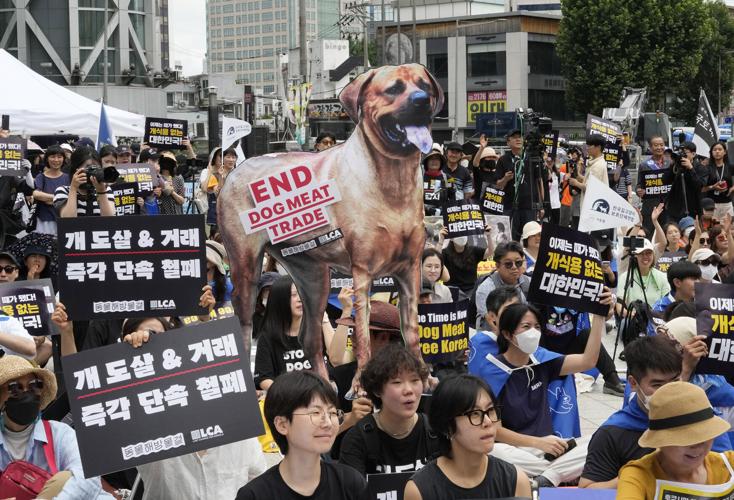
Animal rights activists stage a rally July 8 opposing South Korea’s traditional culture of eating dog meat in Seoul, South Korea.
Recent surveys show more than half of South Koreans want dog meat banned and a majority no longer eat it. But one in every three South Koreans still opposes a ban even though they don’t consume it.
People are also reading…
The National Assembly passed the bill by a 208-0 vote. It will become law after being endorsed by the Cabinet Council and signed by President Yoon Suk Yeol, considered formalities since his government supports the ban.
“This law is aimed at contributing to realizing the values of animal rights, which pursue respect for life and a harmonious co-existence between humans and animals,” the legislation says.
The bill offers assistance to dog farmers and others in the industry in shutting down their businesses and shifting to alternatives. Details are to be worked out among government officials, farmers, experts and animal rights activists.
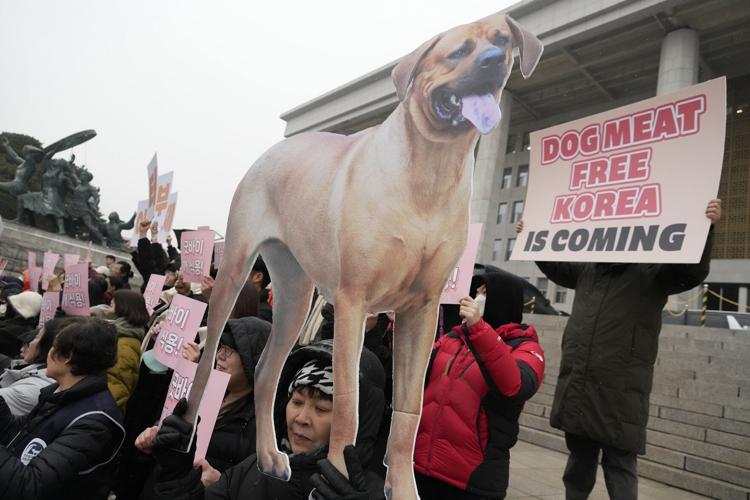
Dozens of animal rights activists gathered at the National Assembly to celebrate the bill’s passage. They carried large photos of dogs, chanted slogans and held placards reading “Dog meat-free Korea is coming.”

Animal rights activists attend a rally Tuesday supporting the government-led dog meat ban at the National Assembly in Seoul, South Korea.
Humane Society International called the legislation’s passage “history in the making.”
“I never thought I would see in my lifetime a ban on the cruel dog meat industry in South Korea, but this historic win for animals is testament to the passion and determination of our animal protection movement,” said JungAh Chae, executive director of HSI’s Korea office.
Dogs are also eaten in China, Vietnam, Indonesia, North Korea and in some African countries. But South Korea’s dog meat industry has drawn more attention because of the country’s reputation as a cultural and economic powerhouse. It’s also the only nation with industrial-scale dog farms. Most farms in South Korea raise about 500 dogs, but one visited by The Associated Press in July had about 7,000.
Farmers were extremely upset by the bill’s passage.
“This is a clear case of state violence as they are infringing on our freedom to choose our occupation. We can’t just sit by idly,” said Son Won Hak, a farmer and former leader of a farmers’ association.
Son said dog farmers will file a petition with the Constitutional Court of Korea and hold demonstrations. He said farmers will meet on Wednesday to discuss other steps.

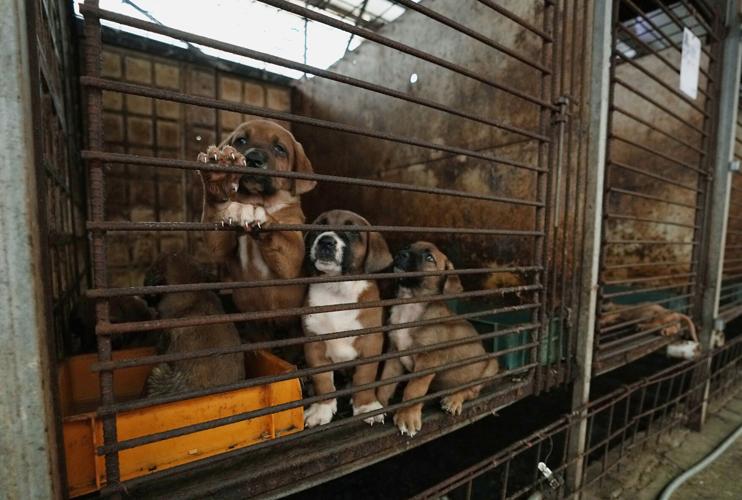
Dogs are seen June 27 in a cage at a dog farm in Pyeongtaek, South Korea.
There is no reliable official data on the exact size of South Korea’s dog meat industry. Activists and farmers say hundreds of thousands of dogs are slaughtered for meat each year.
The anti-dog meat campaign received a huge boost from the country’s first lady, Kim Keon Hee, who has repeatedly expressed her support for a prohibition. She has become the subject of withering criticism and crude insults during demonstrations by farmers.
The legislation doesn’t clearly specify how dog farmers and others in the industry will be supported. Agriculture Minister Song Mi-ryung said Tuesday the government will try to formulate reasonable assistance programs for them.
Ju Yeongbong, an official of the farmers’ association, said most farmers are in their 60-80s and hope to continue their businesses until older people, their main customers, die. But Ju said the legislation would “strip them of their right to live” because it would likely end up only offering assistance for dismantling their facilities and for transitions, without compensation for giving up their dogs.
Son said many elderly dog farmers are willing to close their farms if proper financial compensation is provided because of the extremely negative public view of their jobs.
Cheon JinKyung, head of Korea Animal Rights Advocates in Seoul, accused farmers of demanding unrealistically high compensation. She said compensation based on the number of dogs owned by farmers won’t be accepted, but acknowledged that payments would likely be a major issue.
Today in history: Jan. 9
1861: Star of the West

In 1861, Mississippi became the second state to secede from the Union, the same day the Star of the West, a merchant vessel bringing reinforcements and supplies to Federal troops at Fort Sumter, South Carolina, retreated because of artillery fire.
1945: Battle of Luzon

In 1945, during World War II, American forces began landing on the shores of Lingayen Gulf in the Philippines as the Battle of Luzon got underway, resulting in an Allied victory over Imperial Japanese forces.
1972: Howard Hughes

In 1972, reclusive billionaire Howard Hughes, speaking by telephone from the Bahamas to reporters in Hollywood, said a purported autobiography of him by Clifford Irving was a fake.
1987: Oliver North

In 1987, the White House released a January 1986 memorandum prepared for President Ronald Reagan by Lt. Col. Oliver L. North showing a link between U.S. arms sales to Iran and the release of American hostages in Lebanon.
2005: Mahmoud Abbas

In 2005, Mahmoud Abbas, the No. 2 man in the Palestinian hierarchy during Yasser Arafat’s rule, was elected president of the Palestinian Authority by a landslide.
2012: Alabama

Ten years ago: No. 2 Alabama beat No. 1 LSU 21-0 for the first shutout in BCS title game history.
2012: Amir Mirzaei Hekmati

Ten years ago: Iranian state radio reported that a court had convicted former U.S. Marine Amir Mirzaei Hekmati of working for the CIA and sentenced him to death. (The Obama administration and his family denied Hekmati was a CIA spy; Hekmati was released in January 2016 as part of a prisoner swap.)
2012: Barry Larkin

Ten years ago: Cincinnati Reds shortstop Barry Larkin was elected to baseball’s Hall of Fame.
2015: Paris

In 2015, French security forces shot and killed two al-Qaida-linked brothers suspected of carrying out the rampage at the satirical newspaper Charlie Hebdo that had claimed 12 lives, the same day a gunman killed four people at a Paris kosher grocery store before being killed by police.
2017: Clemson

In 2017, in college football’s first national championship rematch, No. 3 Clemson took down top-ranked Alabama 35-31.
2017: Jared Kushner

Five years ago: President-elect Donald Trump appointed his influential son-in-law Jared Kushner as a White House senior adviser.
2021: The Capitol

One year ago: Police charged more people in the Jan. 6 Capitol riots as more graphic details of the mob’s violence and brutality emerged. Jacob Anthony Chansley, an Arizona man seen in photos and video with a painted face and wearing a horned, fur hat, was arrested and charged.
2021: The Java Sea

One year ago: An Indonesian jetliner nosedived into the Java Sea after taking off from Jakarta, killing all 62 people on board.