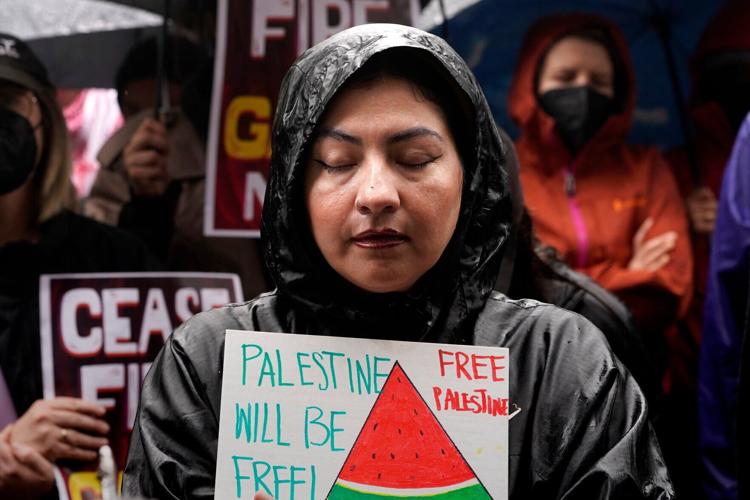
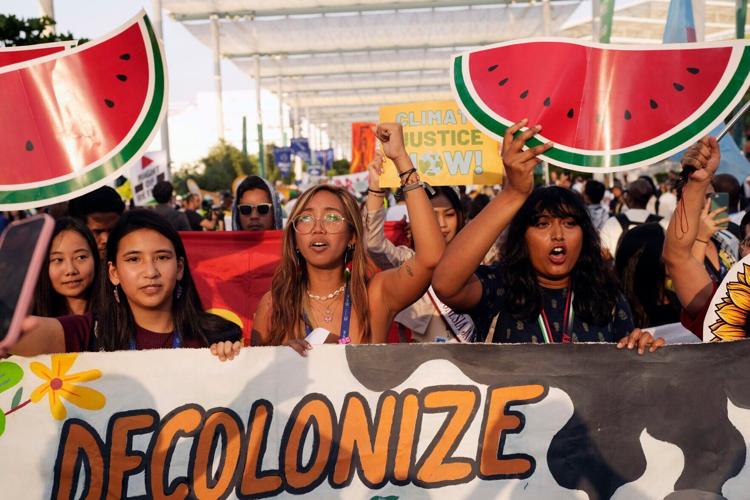
Over the past three months, on banners and T-shirts and balloons and social media posts, one piece of imagery has emerged around the world in protests against the Israel-Hamas war: the watermelon.
The colors of sliced watermelon — with red pulp, green-white rind and black seeds — are the same as those on the Palestinian flag. From New York and Tel Aviv to Dubai and Belgrade, the fruit has become a symbol of solidarity, drawing together activists who don't speak the same language or belong to the same culture but share a common cause.

FILE - Mitzi Jonelle Tan, of the Philippines, center, and activists demonstrate for climate justice and a ceasefire in the Israel-Hamas war at the COP28 U.N. Climate Summit, Saturday, Dec. 9, 2023, in Dubai, United Arab Emirates. Over the past three months, on banners and T-shirts and balloons and social media posts, one piece of imagery has emerged around the world in protests against the Israel-Hamas war: the watermelon. The fruit has increasingly come to be recognized as a symbol of Palestinian resistance and a global sign of solidarity. (AP Photo/Rafiq Maqbool, File)
To avoid repressive censorship, Chinese dissidents once pioneered "algospeak," or creative shorthands that bypass content moderation, recently seen with Winnie the Pooh memes mocking Chinese President Xi Jinping. People around the world began using algospeak to subvert algorithmic biases on TikTok, Instagram and other platforms.
People are also reading…
The internet is now teeming with pictorial signs — pixelated images, emoji and other typographical codes — that signal political dissent. The watermelon emoji is the latest example.
Here's how the watermelon went from being a symbol of protest in the West Bank and Gaza to a global sign of solidarity with Palestinians online.

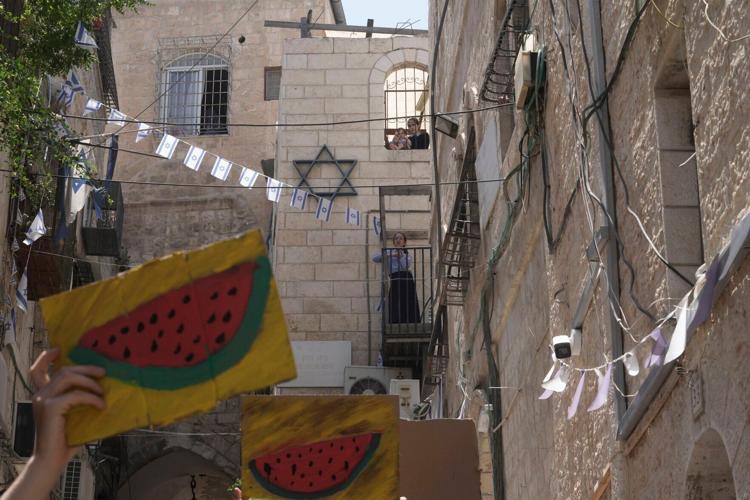
FILE - Jewish girls watch Israelis and Palestinians holding pictures of watermelon, a Palestinian symbol, as they protest the imminent eviction of a Palestinian family by a Jewish settler organization outside their home in the Muslim Quarter of the Old City of Jerusalem, June 16, 2023. Watermelons have emerged on banners, t-shirts, cars and social media over the past three months in protests against the Israel-Hamas war. From New York and Tel Aviv to Dubai and Belgrade, the fruit has caught on globally as a symbol of solidarity with the Palestinian people. (AP Photo/Mahmoud Illean, File)
HISTORICAL CONTEXT
After the 1967 Mideast war, the Israeli government cracked down on displays of the Palestinian flag in Gaza and the West Bank. In Ramallah in 1980, the military shut down a gallery run by three artists because they showed political art and works in the colors of the Palestinian flag — red, green, black and white.
The trio was later summoned by an Israeli officer. According to artist and exhibit organizer Sliman Mansour, an Israeli officer told him, "It is forbidden to organize an exhibition without permission from the military, and secondly, it is forbidden to paint in the colors of the Palestinian flag." The officer mentioned a watermelon as one example of art that would violate the army's rules, Mansour told The Associated Press last week.
In protest, people began to wave the fruit in public.

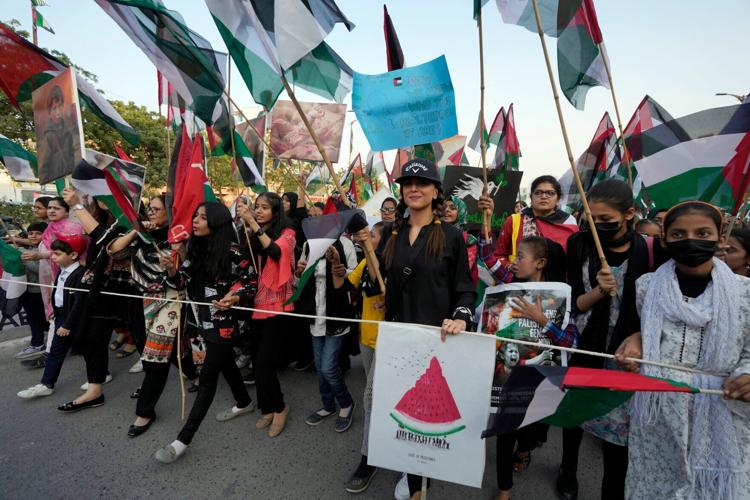
FILE - Pakistani civil society and political parties chant slogans during a demonstration against Israeli airstrikes on Gaza, and to show solidarity with the Palestinian people, in Karachi, Pakistan, Wednesday, Nov. 29, 2023. Over the past three months, on banners and T-shirts and balloons and social media posts, one piece of imagery has emerged around the world in protests against the Israel-Hamas war: the watermelon. The fruit has increasingly come to be recognized as a symbol of Palestinian resistance and a global sign of solidarity. (AP Photo/Fareed Khan, File)
"There are stories of young men who defiantly walked the streets with slices of the fruit, risking arrest from Israeli soldiers," Jerusalem-born author Mahdi Sabbagh wrote. "When I see a watermelon, I think of the unbreakable spirit of our people."
From the mid-90s, when Israelis and Palestinians reached interim peace deals, until the current nationalist Israeli government took office a year ago, raising the Palestinian flag receded as a major issue. Three decades later, "it became a national symbol" again, Mansour said.
A year ago, Israel's far-right National Security Minister Itamar Ben-Gvir banned Palestinian flags in public places. This effort was met with fervent opposition. In response, Zazim, an activist group of Arab and Jewish Israelis, plastered taxis in Tel Aviv with large watermelon stickers that read: "This is not a Palestinian flag."

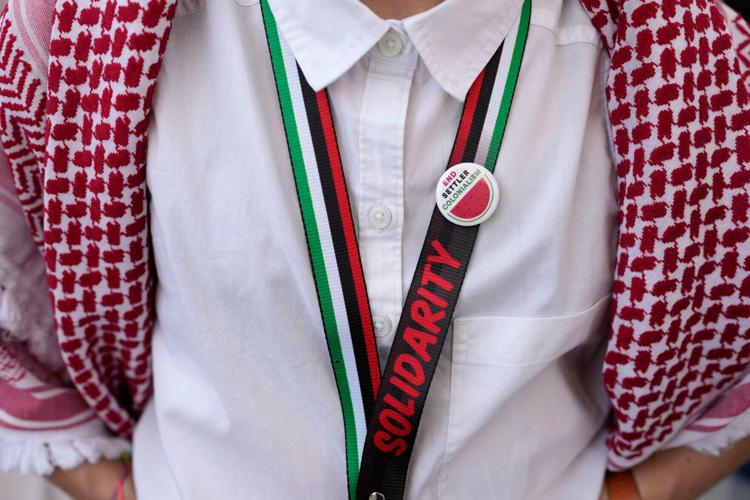
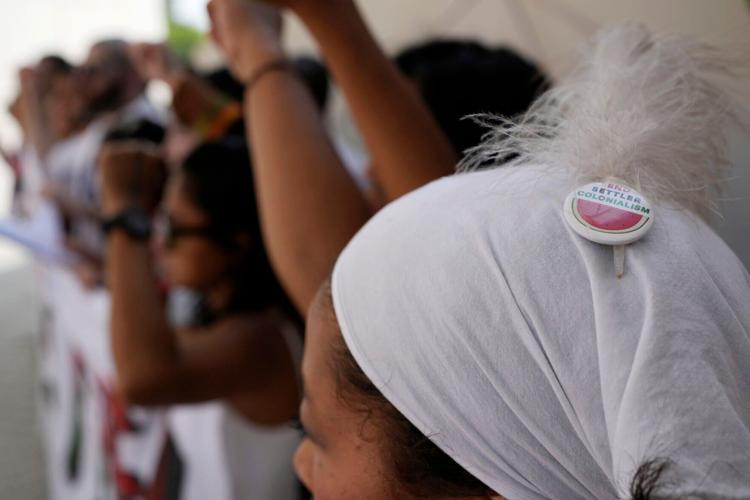
FILE - A protester wearing a pin with a symbol of a watermelon participates in a demonstration calling for a ceasefire in the Israel-Hamas war at the COP28 U.N. Climate Summit, Sunday, Dec. 3, 2023, in Dubai, United Arab Emirates. Over the past three months, on banners and T-shirts and balloons and social media posts, one piece of imagery has emerged around the world in protests against the Israel-Hamas war: the watermelon. The fruit has increasingly come to be recognized as a symbol of Palestinian resistance and a global sign of solidarity. (AP Photo/Rafiq Maqbool, File)
"Our message to the government is clear," the organization said in a written statement. "We'll always find a way to bypass any absurd ban and we won't stop struggling for freedom of expression and democracy — whether this involves the Pride flag or the Palestinian flag."
For some, embracing the colors of the flag is about striving for freedom and equality rather than necessarily statehood.
"I've never cared for flags or nationalism," says Mayssoun Sukarieh, an expert in Middle Eastern studies at King's College London. "But when it comes to Palestine, it's a flag of a colonized people who never saw independence. And because it has been banned, it becomes more of a symbol of resistance than it is of nationalism."

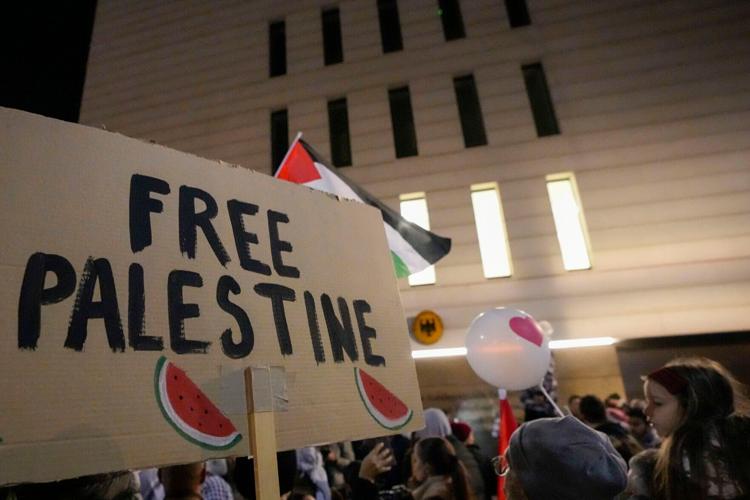
FILE - People shout slogans in front of the German embassy during a pro-Palestinian gathering in Belgrade, Serbia, Sunday, Nov. 12, 2023. Watermelons have emerged on banners, t-shirts, cars and social media over the past three months in protests against the Israel-Hamas war. From New York and Tel Aviv to Dubai and Belgrade, the fruit has caught on globally as a symbol of solidarity with the Palestinian people. (AP Photo/Darko Vojinovic, File)
WATERMELON EMOJI
Watermelons have long been a staple of food in the region, with some dishes, like a popular salad in southern Gaza, originating with Bedouin Arab tribes.
Increasingly, young activists have adopted the watermelon emoji in calling for a cease-fire in Gaza. Emoji may confuse algorithms that advocates say tech companies deploy to suppress posts with keywords like "Gaza" and even just "Palestinian."
"With the watermelon (emoji), I think this is actually really the first time where I've seen it widely used as a stand-in. And that to me marks a notable uptick in censorship of Palestinian content," says Jillian York, the director for international freedom of expression at the Electronic Frontier Foundation.
The Berlin-based York has analyzed Meta's policies. While "shadow banning," or the limited visibility of certain posts, can be difficult to discern, advocacy and nonprofit organizations studying digital rights in the Middle East say they have tracked stark biases, especially on the Meta platforms Facebook and Instagram. Meta hasn't said much directly about this but cites a statement it released in October.
"Censorship is somewhat obvious" on Instagram, York said. In mid-October, people began to notice that if one's Instagram bio said "Palestinian" in English alongside the Palestinian flag emoji and "Praise be to god" in Arabic, the app translated the text to "Terrorist." Meta released a public apology.

FILE - Demonstrators hold up their fists and a sign calling for a ceasefire in the Israel-Hamas war at the COP28 U.N. Climate Summit, Sunday, Dec. 3, 2023, in Dubai, United Arab Emirates. Watermelons have emblazoned banners, t-shirts, balloons and social media posts over the past three months in global protests against the Israel-Hamas war. The fruit has increasingly come to be recognized as a symbol of Palestinian resistance and a global sign of solidarity. (AP Photo/Rafiq Maqbool, File)
Watermelons are not the only symbol to catch on with activists. Other signs of global Palestinian solidarity include keys, spoons, olives, doves, poppies and the keffiyeh scarf. In November, to connect with the peaceful message of Armistice Day, when many Brits traditionally wear red poppy pins, protesters this year passed out white poppy pins, to commemorate victims of all wars. On the holiday, scores of protesters wearing poppy pins marched across London calling for an end to the war in Gaza.
In the United States, Jewish Voice for Peace amplified watermelon imagery in calling for a cease-fire in Gaza last month. The group held signs in New York in the colors of the Palestinian flag and with triangular watermelons, leveraging the triangle symbol of ACT UP, the historic AIDS activist group.
Jason Rosenberg, a member of both organizations, said, "Our reinvented image shows that our fight for liberation and fight to end the epidemic is intrinsically connected to the Palestinian struggle."

FILE - People participate in a sit-in demanding a cease-fire in the Israel-Hamas war at De Longpre Park in Los Angeles, Wednesday, Nov. 15, 2023. Over the past three months, on banners and T-shirts and balloons and social media posts, one piece of imagery has emerged around the world in protests against the Israel-Hamas war: the watermelon. The fruit has increasingly come to be recognized as a symbol of Palestinian resistance and a global sign of solidarity. (AP Photo/Damian Dovarganes, File)
SEED IMAGERY
Another reason the watermelon might resonate: It has seeds. There is a saying, often attributed to the Greek poet Dinos Christianopoulos, that is popular among activists: "They wanted to bury us; they didn't know we were seeds."
"You might be able to smash a watermelon. You might be able to destroy a fruit, but the seed is a little harder to crush," says Shawn Escarciga, an artist who created the coalition's design. "It's really powerful that life can come out of something so small and something so resilient — and that it can be spread so, so easily."
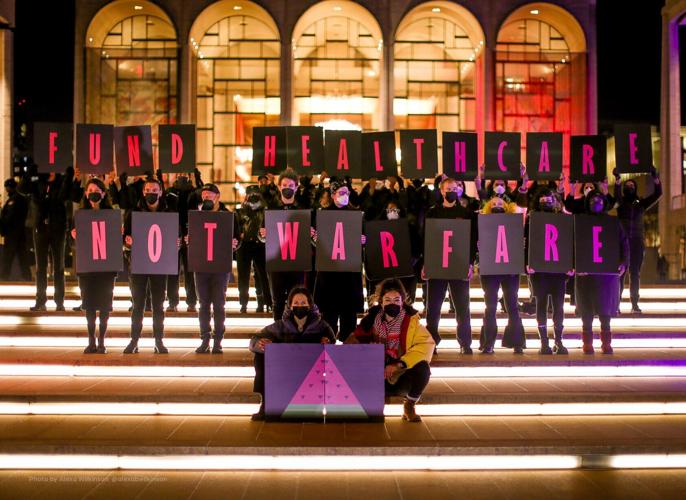
The image of a watermelon punctuated by bold, triangular seeds was held up at the groups' protest at Manhattan's Lincoln Center, and has since proliferated online. That often happens — art emerges from protest movements and then enters the mainstream.

In this photo provided by Jewish Voice for Peace, protesters demonstrate outside Lincoln Center on World AIDS Day, Dec. 1, 2023, in New York. Watermelons have emblazoned banners, T-shirts, balloons and social media over the past three months in global protests against the Israel-Hamas war. From New York and Tel Aviv to Dubai and Belgrade, the fruit has caught on globally as a symbol of solidarity with the Palestinian people. (Alexa Wilkinson/Jewish Voice for Peace via AP)
"Artists have always been at the forefront of revolution, resistance, politics, in varying degrees," Escarciga says. "We're doing this, using this iconic imagery, because AIDS isn't over — and war is obviously not over."
Israel's air, ground and sea assault in Gaza has killed more than 24,000 people, some 70% of them women and children, according to the Health Ministry in the Hamas-ruled territory. The count does not differentiate between civilians and combatants.
Throughout, activists around the world have continued to call for peace and a permanent cease-fire. Israel says ending the war now, before Hamas is crushed, would give a victory to the militants who attacked southern Israel on Oct. 7 and killed some 1,200 people and took about 250 hostage.
"We're seeing Palestinian flags being banned, even the emoji online being flagged — and, you know, the word 'Palestine' being censored online," Escarciga said. "But having this image that transcends language, that transcends culture, that transcends algorithms — can really reach people."

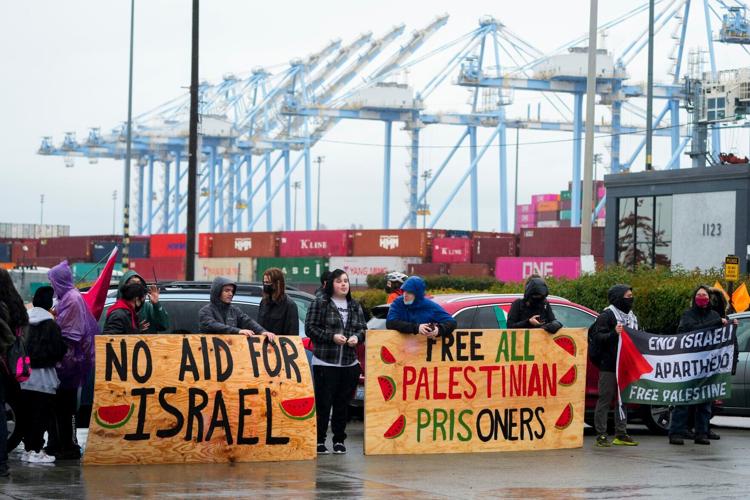
FILE - Protesters against the Israel-Hamas war hold up large wooden signs as they block the main Port of Tacoma entrance to delay the loading of the Cape Orlando vessel, Monday, Nov. 6, 2023, in Tacoma, Wash. Watermelons have appeared on banners, t-shirts, balloons and social media posts over the past three months in global protests against the Israel-Hamas war. The fruit has increasingly come to be recognized as a symbol of Palestinian resistance and a global sign of solidarity. (AP Photo/Lindsey Wasson, File)
___
Israel-Hamas war at 100 days

Police officers evacuate a woman and a child Oct. 7 from a site hit by a rocket fired from the Gaza Strip in Ashkelon, southern Israel.

Palestinians wave their national flag Oct. 7 and celebrate by a destroyed Israeli tank at the southern Gaza Strip fence east of Khan Younis.

Fire and smoke rise Oct. 8 following an Israeli airstrike in Gaza City.

Israelis evacuate a site struck by a rocket fired Oct. 9 from the Gaza Strip in Ashkelon, southern Israel.

An Israeli firefighter kneels to compose himself Oct. 9 after he and his colleagues extinguished cars set on fire by a rocket fired from the Gaza Strip in Ashkelon, Israel.

Palestinians inspect the rubble of the Yassin Mosque on Oct. 9 after it was hit by an Israeli airstrike at Shati refugee camp in Gaza City.

An Israeli soldier walks Oct. 11 by a house destroyed in fighting with Hamas militants in kibbutz Be'eri.

Antonio Macías' mother cries over her son's body covered with the Israeli flag Oct. 15 at Pardes Haim cemetery in Kfar Saba, near Tel Aviv, Israel. Macias was killed by Hamas militants Oct. 7 while attending a music festival in southern Israel.

Mourners gather around the five coffins of the Kotz family during their funeral Oct. 17 in Gan Yavne, Israel. The family was killed by Hamas militants on Oct. 7 at their house in Kibbutz Kfar Azza near the border with the Gaza Strip.

Rockets are fired from the Gaza Strip toward Israel over destroyed buildings Oct. 19 following Israeli airstrikes on Gaza City, central Gaza Strip.

An Israeli soldier hugs his partner Oct. 20 near the border with the Gaza Strip, southern Israel.

Palestinians walk Oct. 20 by buildings destroyed in an Israeli bombardment on al-Zahra, on the outskirts of Gaza City.

Palestinians evacuate a building hit Oct. 22 in an Israeli bombardment of the Gaza Strip in Rafah.

Palestinians inspect the rubble of destroyed buildings Oct. 26 following Israeli airstrikes on the town of Khan Younis, southern Gaza Strip.

Israeli security forces on Nov. 1 inspect charred vehicles burned in the Oct. 7 cross-border attack by Hamas militants outside the town of Netivot, southern Israel.

Kenzi al Madhoun, a 4-year-old wounded in an Israeli bombardment, lies Nov. 1 at Al Aqsa Hospital in Deir al Balah City, Gaza Strip.

An Israeli soldier stands in an apartment Nov. 8 during a ground operation in the Gaza Strip.

Palestinians flee Nov. 11 to the southern Gaza Strip on Salah al-Din Street in Bureij, Gaza Strip.

Palestinians wounded in an Israeli bombardment of the Gaza Strip wait for treatment Nov. 15 at a hospital in Khan Younis.

Palestinians displaced by the Israeli bombardment of the Gaza Strip seek cover from a winter rainfall Nov. 19 at a U.N. tent camp in the southern town of Khan Younis, Gaza Strip. Hundreds of thousands of Palestinians fled their homes in northern Gaza as Israel moved ahead with a ground offensive against the ruling Hamas militant group.

Palestinians flee to northern Gaza as Israeli tanks block the Salah al-Din road Nov. 24 in the central Gaza Strip, as a temporary cease-fire begins.

A Red Cross vehicle carrying Israeli hostages drives by Nov. 25 at the Gaza Strip crossing into Egypt in Rafah.

An Israeli soldier looks at Palestinians fleeing south Nov. 26, the third day of a temporary cease-fire between Hamas and Israel, at Salah al-Din road in central Gaza Strip.

Israelis embrace Nov. 28 next to photos of people killed and taken captive by Hamas during militants' Oct. 7 rampage through the Nova music festival in southern Israel, at the site of the event near kibbutz Re'im.

A Palestinian woman gestures Dec. 7 following Israeli airstrikes in Khan Younis refugee camp, southern Gaza Strip.

Israeli soldiers on Dec. 8 stand by a truck packed with bound and blindfolded Palestinian detainees rounded up for interrogation in northern Gaza during a search for Hamas fighters.

Palestinians mourn Dec. 20 outside a morgue in Khan Younis for relatives killed in the Israeli bombardment of the Gaza Strip.

Palestinians line up for a free meal Dec. 21 in Rafah, Gaza Strip. International aid agencies say Gaza is suffering from shortages of food, medicine and other essential supplies as a result of the war.

A makeshift tent camp Jan. 1 where Palestinians displaced by the Israeli bombardment of the Gaza Strip are staying in the Muwasi area.

With the U.S Capitol in the background, demonstrators rally Jan. 13 during the March on Washington for Gaza at Freedom Plaza in Washington. The protest was part of a global day of action ahead of the Israel-Hamas war's 100-day mark.