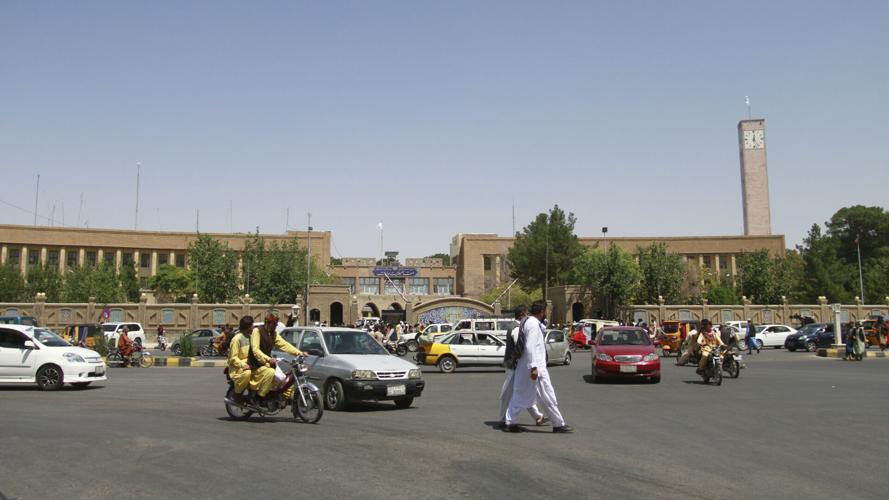
Pedestrians and motorists travel near the Herat provincial official office west of Kabul, Afghanistan on Aug. 14, 2021, after the province was taken by the Taliban. Hasan, an Afghan evacuee, used to live with his wife in Herat, but they were separated during the fall of Afghanistan to the Taliban. Hasan was able to escape to Pennsylvania, but his wife remains stuck in Afghanistan.
Hasan misses waking up at 5 a.m. each morning for his job as an information technology professor at Herat University in Afghanistan, and his wife waking up with him.
Even though she didn’t need to be awake that early, she would eat breakfast with him, walk him to the front door, say goodbye and then go back to bed each day. Hasan said he cherished that time with her.
He has been separated from his wife for four years.
Hasan, who asked to be identified by his first name only for safety reasons, now lives in Lancaster, Pennsylvania. He evacuated Afghanistan as it fell to the Taliban in August 2021 because his work on IT projects for the U.S. Embassy and Afghan government put him in danger of Taliban retaliation. But his wife was not able to escape with him and remains in Afghanistan under Taliban rule.
Hasan had fled to the capital city of Kabul because he thought it would be safer than Herat, which the Taliban captured on Aug. 12, 2021. He planned for his wife to meet him in Kabul, but when he got there, the airport was "full chaos," with thousands crowding the gates.
People are also reading…
"I couldn't even wait for her," Hasan said.
Hasan expected to be able to reunite with his wife, but the family reunification process under President Joe Biden was slow, and under President Donald Trump, it has ground to a halt.
Trump’s June travel ban bars most Afghan family members stuck abroad — including Hasan’s wife — from traveling to the U.S. Some Afghan families, but not all, are exempt from the ban.
Advocates hope the Trump administration will make a more comprehensive exemption for Afghan families or lift the travel ban, but it’s unclear when that would happen, if at all.
“We cannot do anything,” Hasan said. “It is not in our hands.”
‘It’s not living’
The uncertainty and continued separation have “taken a toll” on both Hasan and his wife’s mental health, he said.
Hasan said he has lost interest in socializing. He no longer calls his friends and often turns down invitations to spend time with them. He has tried to find the motivation to go fishing or go to the gym, but instead, he finds himself sitting at home on his laptop until he falls asleep.
“I feel like I’ve fallen into a state of chronic depression,” Hasan said.
But Hasan said he is more worried about his wife’s emotional well-being than his own. Although he’s struggling, he has still been able to push himself to complete his work for his job in data analytics.
His wife, however, can hardly do anything while living under the Taliban’s restrictive rules for women. She cannot go out in public without a male chaperone. She lives with her parents and mostly stays at home, Hasan said.
She used to work at a hair salon about a five-minute walk from their house, but she is no longer allowed to work, Hasan said. She is also barred from furthering her education. Hasan said she has lost the motivation to learn English online since it is unclear whether she will ever be able to come to the U.S.
“She’s alive,” Hasan said. “It’s not living.”

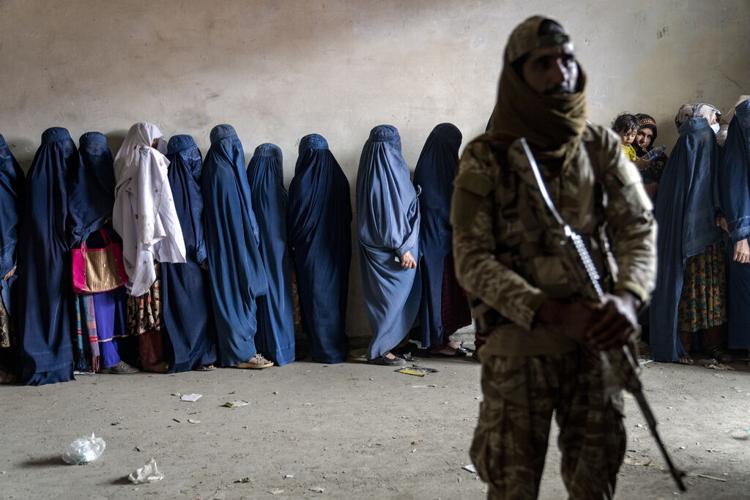
A Taliban fighter stands guard in 2023 as women wait to receive food rations distributed by a humanitarian aid group in Kabul, Afghanistan. Since taking power in August 2021, the Taliban has barred women from getting an education past the 6th grade and going out in public without male guardians.
Messy process
Hasan said he has tried everything he can think of to get his wife out of Afghanistan and into the U.S.
As someone who was granted asylum, Hasan can petition the government to bring his wife here. The U.S.’s asylum statute allows the spouses and children of asylees to join them in the U.S. and also be granted asylum.
Hasan said his application for his wife to come to the U.S. was approved by U.S. Citizenship and Immigration Services. But she needs to have an interview at a U.S. Embassy abroad before she can travel to the U.S., and Afghanistan no longer has a U.S. Embassy.
Her case was assigned to the embassy in Doha, Qatar, but Hasan said he couldn’t get a travel visa for his wife to go there.
Over several months, Hasan reached out to lawyers, friends, travel agencies, embassies in multiple countries and even his local Congressman to try to get his wife’s case transferred to another country.
Hasan said in late August that U.S. Rep. Lloyd Smucker’s office got back to him and helped him move his wife’s case to Saudi Arabia, which he said would be more likely to issue her a travel visa. Hasan said he was very grateful for the congressman's help.
But several days later, the U.S. Department of State announced a new policy requiring that all Afghanistan residents finish their visa processing in Islamabad, Pakistan. So now her case needs to be transferred there instead. Hasan is unsure whether the U.S. embassy in Saudi Arabia will handle the transfer or if he needs to go through that process on his own.
Hasan hopes her interview will get scheduled soon and that the travel ban will be lifted by then.
“We want to reunite together now, not in the next five years or 10 years,” Hasan said.
Hasan and his wife have even discussed his returning to Afghanistan, but that’s not really an option for him. Hasan said he fears the Taliban would kill him for working with Americans and being part of the Hazara ethnic group, a minority that has been persecuted by the Taliban.
“Taliban are against our people. They don’t care about our people,” Hasan said. “They easily kill our people without any hesitation.”
So despite Hasan’s recent mental health struggles, he has worked hard to make Lancaster his home.
Hasan volunteered as a youth soccer coach, leading his team to win first place in a championship. He coached refugee children at The Haven Lancaster, a local organization that provides Afghan evacuees with English classes, driving lessons, childcare and mentorship.
Hasan said he served as an interpreter for U.S. Citizenship and Immigration Services’ asylum offices in Newark and Philadelphia. And he was a public speaker at local events for International Refugee Day and International Day of Peace.
Hasan said he is also a homeowner and a U.S. taxpayer.
“My message is directed to the decision makers, those who may not be fully aware of human realities behind cases like mine,” Hasan said. “I sincerely hope they take a moment to reflect (on) the decision they made.
“Because behind every denial case number, there is a hope, there is a life, there is a story.”