Afghan immigrants sued President Donald Trump’s administration Tuesday in a challenge to the June travel ban that prevents them from reuniting with family members who have been stuck abroad for four years.
Many of their spouses and children have been approved to come to the U.S., but the Department of State has refused to issue them travel documents, citing the travel ban. The lawsuit, filed in Virginia, argues that this practice is unlawful, unconstitutional and inhumane.

“Once again, the Trump administration is failing our Afghan allies,” said Pedro Sepulveda, Jr., litigation fellow at the International Refugee Assistance Project. “Our clients put their lives in danger for the United States and are now being told their loved ones are banned from this country.”
The International Refugee Assistance Project and other attorneys filed the lawsuit on behalf of seven Afghan immigrants and their spouses and children stuck abroad. The Afghans risked their lives as soldiers, pilots and bodyguards while fighting the Taliban alongside the U.S. They now live in Illinois, Maryland, Michigan, Missouri and Virginia.
People are also reading…
About 16,000 Afghans are stuck abroad, unable to join their families in the U.S., according to a May 2025 U.S. Department of State report obtained by nonprofit organization #AfghanEvac.
The Lee Enterprises public service journalism team previously interviewed four Afghan immigrants living in Wisconsin, Pennsylvania and California who said they were confused about how to bring their families to the U.S. and said the continued separation has taken an emotional toll on them.
Mulakhil lives in California without his wife and three sons. He asked to be identified by his last name only for his safety because he worked in a U.S.-backed special unit of the Afghan Army that went after the Taliban, Al-Qaeda and other terrorist groups.
“It’s been four years,” Mulakhil said. “You are separated … from your family, from your children, and children from their parents. It’s so difficult, and it’s not fair.”
“I miss them,” he said. “They’re my kids.”

Durani, an Afghan evacuee who was granted asylum due to the danger he would face if he returned to Afghanistan, now lives in Milwaukee, Wisconsin. President Donald Trump's travel ban prevents his family from joining him in the U.S., but a new lawsuit challenges that.
Mulakhil has asylum, a legal immigration status that can lead to a U.S. green card. The U.S. asylum statute states that when someone is granted asylum, they can have their immediate family join them. Their family is then granted the same immigration status.
Mulakhil's application to have his family join him in the U.S. was approved by U.S. Citizenship and Immigration Services.
So they traveled to Pakistan to have an interview at a U.S. Embassy to get travel documents — the last step before coming to the U.S. That step can no longer be done in Afghanistan because the embassy there has closed.
But when Mulakhil's family had their embassy interview in September, they were denied. The letter denying them entry to the U.S. cited Trump's travel ban as the reason.
It's these sorts of denials that the lawsuit is challenging.

The embassy interview is usually a perfunctory step to confirm family members’ identities and make sure they don’t have communicable diseases before coming to the U.S.
Normally, families are only denied in "extremely rare" circumstances, such as if the applicants were convicted of a crime, engaged in terrorist activity, committed immigration fraud or engaged in "moral depravity," according to the lawsuit.
But since the travel ban was enacted in June, all Afghan families are getting denials during the interviews, the lawsuit states.
Five of the Afghan families in the lawsuit had their requests for travel documents rejected after taking "dangerous, difficult and expensive" journeys to third countries for their embassy interviews, the lawsuit states. The two other families haven't had their interviews yet.
The Department of State is being sued because it oversees the embassy offices that are issuing these denials.
The lawsuit argues that "the state department does not have authority or discretion to deny travel documentation" in these cases because they've already been approved.
U.S. Citizenship and Immigration Services is the office that decides whether an asylum holder's immediate family can join them in the U.S. And the Afghan families had gotten approval from that office; that's how they got the embassy interview in the first place.
Further, the lawsuit argues, the travel ban is not supposed to apply to asylum holders.
"The travel ban is explicit in saying that individuals who have been granted asylum or are seeking asylum are not prohibited from entering the United States under the travel ban," Sepulveda said.

That would include Afghan family members stuck abroad because they are seeking to come into the U.S. under the asylum statute.
The plaintiffs have asked the court to declare that the Department of State's current practices banning Afghan asylum seekers are unlawful, void any travel denials issued so far and prohibit the Department of State from continuing to issue denials during embassy interviews.
If the relief is granted, it would also extend to family members of asylum holders from the 18 other countries included in the travel ban.
The U.S. government has about 60 days to provide an initial response to the lawsuit. Sepulveda said he's not sure how long the case will take, but he hopes it will move along quickly and that the court will grant the Afghans relief so they can reunite with their families.
It's possible that the Department of State could change its policy ahead of any court proceedings to "avoid unnecessary litigation," Sepulveda said. But it's unclear whether the administration has any interest in that.
Sepulveda said the plaintiffs in the lawsuit were granted asylum for a reason. They put their lives on the line fighting the Taliban alongside the U.S., and their lives continue to be at risk because of it.

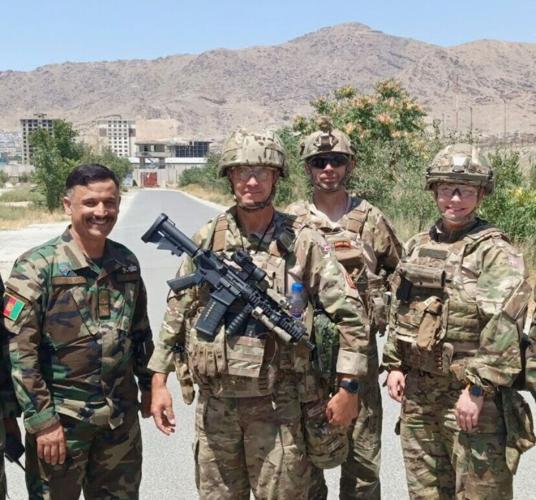
Durani, left, a former member of the Afghan air force, worked with U.S. soldiers in Afghanistan before his country fell to Taliban rule. Durani was deputy commander of the Kabul Air Base, which he helped defend against Taliban attacks. The base was surrendered to the Taliban in 2021.
Durani, an Afghan asylum holder living in Wisconsin, spent 12 years in the Afghan Air Force fighting the Taliban alongside U.S. troops, which makes him a Taliban target. He is not part of the lawsuit, but his family is also stuck abroad.
“If I am forced to return to my country, I am certain the Taliban will find me, torture me and eventually kill me,” Durani wrote in his asylum application to stay in the U.S. “There is nowhere in my country that the Taliban can’t reach me.”
One of the Afghans in the lawsuit, a man living in Virginia, was a helicopter pilot in an elite unit of the Afghan Air Force, where he risked his life many times fighting the Taliban.
He was nearly killed when a Taliban-fired mortar hit his helicopter as he landed in April 2019. During a mission in November 2020, the Taliban shot down two helicopters from his team. He saw eight friends die.
On other missions, he faced heavy fire from Taliban machine guns, grenade launchers and missiles that killed colleagues.

When Afghanistan's capital city, Kabul, fell to Taliban rule more than four years ago on Aug. 15, 2021, he and his colleagues were ordered to fly military aircraft to Uzbekistan to keep them out of Taliban hands. He had to leave his family behind, including his wife who was three months pregnant.
His wife and children are stuck in Pakistan, facing possible deportation back to Taliban rule.
"These individuals have gone through unimaginable risks and dangers in Afghanistan (while fighting) against the Taliban in support of the U.S. government," Sepulveda said. "They are in danger, and they cannot bring their family members, ... their wives and children, to the United States because of an unlawful reading of the travel ban by the Department of State.
"It's unconscionable. It's unlawful. And we should make every effort to ensure that our plaintiffs see justice."