Labor rights leader Dolores Huerta says she was sexually abused by César Chavez amid reported allegations of abuse by others during his tenure as president of The United Farm Workers union.
In a statement released Wednesday, Huerta said she stayed silent for 60 years out of concern that her words would hurt the farmworker movement.
She described two sexual encounters with Chavez, one where she was "manipulated and pressured" and another where she was "forced against my will."
"I carried this secret for as long as I did because building the movement and securing farmworker rights was life's work," she said. "The formation of a union was the only vehicle to accomplish and secure those rights and I wasn't going to let Cesar or anyone else get in the way."
Earlier Wednesday, a New York Times investigation found Chavez groomed and sexually abused young girls who worked in the movement, including Huerta.
People are also reading…

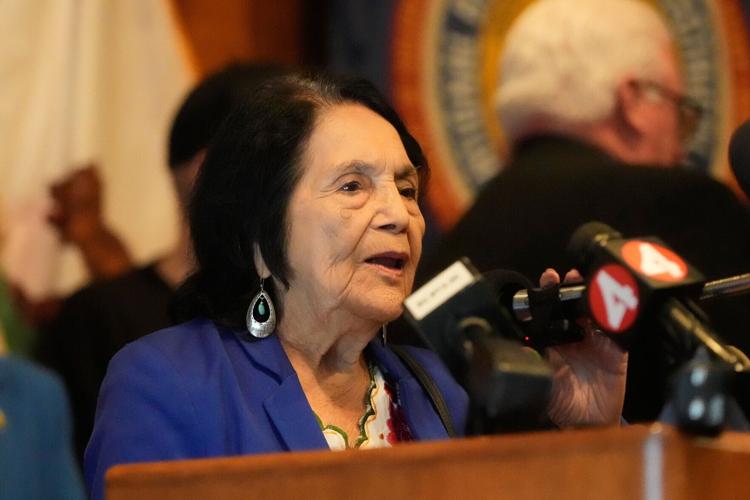
Dolores Huerta, co-founder of The United Farm Workers union, speaks Nov. 3 during a campaign event on Proposition 50 in San Francisco.
Activists weigh allegations
In their reactions to the news, Latino civil rights advocates emphasized that the farmworker movement was not just Chavez but thousands of other individuals who came together to fight for justice.
Voto Latino leaders said no matter his legacy or historical framing, Chavez' actions are inexcusable. Similarly, LULAC condemned any form of sexual violence, stating, "no individual, regardless of statue or legacy is above accountability."
While the news of these allegations are devastating to the Latino community, Voto Latino said it does not erase the work done by the thousands women and men who built the farmworker movement.
"The women who organized, marched, and sacrificed alongside farmworkers carried this movement on their backs," Voto Latino said. "Dolores Huerta — a fighter, a giant of the labor movement, and someone who is among the survivors of this abuse — helped build everything this movement stands for."
U.S. Congresswoman Teresa Leger Fernández, chair of the Democratic Women's Caucus, issued a statement Wednesday saying she was heartbroken and deeply disturbed by the stories of women who say they were abused as girls by Chavez and Huerta's account.
Leger Fernández said the farmworker and civil rights movement was built by countless people, including women and families who sacrificed for a better future.
She said the women's caucus will stand with survivors and continue fighting for "a future where all women and girls are safe in their communities, homes, and at work."
The United Farm Workers union already distanced itself from annual celebrations of its founder, calling the allegations troubling.
In a statement Tuesday, the union said allegations of "abuse of young women or minors" were concerning enough to urge people around the country to participate in immigration justice events or acts of service instead of the typical events in March to commemorate Chavez's legacy.
Days before the allegations were detailed, several Chavez celebrations in San Francisco, Texas and Arizona were canceled at the request of the foundation. Organizers of canceled events did not immediately respond to the AP's requests for comment.
Both groups said they'd work to establish ways for anyone who might have been harmed by Chavez to share experiences confidentially.

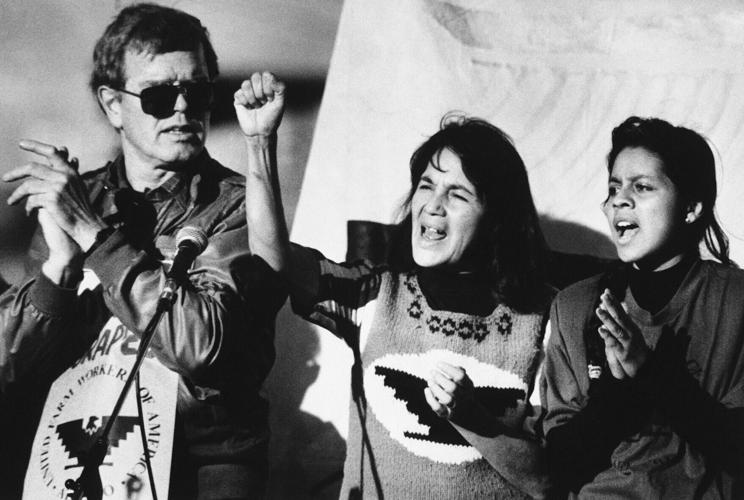
United Farm Workers leader Dolores Huerta, center, leads a Nov. 19, 1988, rally along with Howard Wallace, left, president of the San Francisco chapter of the UFW, and Maria Elena Chavez, 16, right, the daughter of Cesar Chavez, in San Francisco's Mission District as part of a national boycott of what the UFW claimed was the dangerous use of pesticides on table grapes.
Celebrations and renamings reconsidered
California became the first state to establish March 31, Chavez's birthday, as a day commemorating the labor leader. Others followed. In 2014, then-President Barack Obama proclaimed March 31 as national César Chavez Day, urging Americans to honor his legacy.
California Gov. Gavin Newsom on Wednesday said he's still "processing" the news and urged more reflection. The Democratic governor wouldn't commit to making any changes to the state holiday at the end of the month.
The farmworker movement "was much bigger than one man," he said. "It's about labor. It's about social justice, economic justice, racial justice."
Arizona Gov. Katie Hobbs declined to recognize March 31 as César Chávez Day as she has in the two prior years, said spokeswoman Liliana Sota. It is not an Arizona state holiday.
There are already calls to rename landmarks that honor Chavez.
U.S. Sen. Ben Ray Luján, a New Mexico Democrat, issued a statement saying abuse of any kind, especially against children, is indefensible and a betrayal of the values that Latino leaders championed for generations. “His name should be removed from landmarks, institutions and honors,” he said of Chavez. “We cannot celebrate someone who carried out such disturbing harm.”

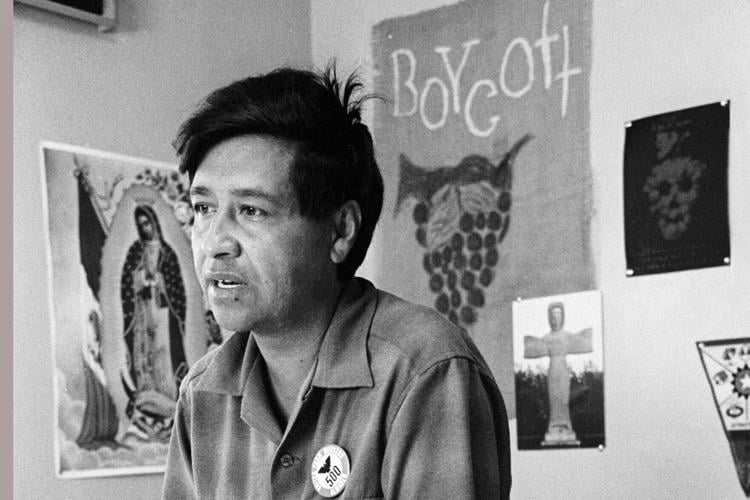
César Chavez, a farm worker, labor organizer and leader of the California grape strike, is seen in 1965 in a California works office.
Born in Yuma, Arizona, Chavez grew up in a Mexican American family that traveled around California picking lettuce, grapes, cotton and other seasonal crops. He died in California in 1993 at age 66.
Chavez is known nationally for his early organizing in the fields, a hunger strike, a grape boycott and eventual victory in getting growers to negotiate with farmworkers for better wages and working conditions.
In 1962, Chavez and Huerta co-founded the National Farm Workers Association, which became the United Farm Workers of America.
Farmworkers are crucial to agribusiness in California, which grows nearly half the nation's fruits, nuts and vegetables.
Chavez protested against poor pay and often-miserable work conditions. There were no toilets in the fields for workers, who weeded fields with short-handled hoes that forced them to bend over for hours at a time.
Bosses frequently ignored the health and wages of their workers, many of whom were Spanish-speakers in the country temporarily or illegally and had little political or legal clout to prevent abuses.
Huerta said she did not know Chavez hurt other women and condemned his actions, but reminded readers that the farmworker movement is bigger than one person.
"César's actions do not reflect the values of our community and our movement," she said. "The farmworker movement has always been bigger and far more important than any one individual. César's actions do not diminish the permanent improvements achieved for farmworkers with the help of thousands of people. We must continue to engage and support our community, which needs advocacy and activism now more than ever."
___
Associated Press writers Susan Montoya Bryan in Albuquerque, New Mexico; Trân Nguyễn in Sacramento, Calif.; Dorany Pindea in Los Angeles; Felicia Fonseca and Jacques Billeaud in Arizona contributed to this report.
15 women who made a difference (and a few who still are)
Sojourner Truth

She was born into slavery but escaped with her daughter in 1826. The African-American abolitionist and women’s rights campaigner gave a noteworthy extemporaneous speech “Ain’t I a woman?” in 1851, powerfully and simply speaking about the racism and sexism of her day.
Harriet Tubman

She was a slave who escaped in 1849 and then went back to lead other slaves to freedom on the Underground Railroad. She became a speaker on the experiences of slavery and an advocate for the rights of African-Americans and black women.
Susan B. Anthony, Lucretia Mott, and Elizabeth Cady Stanton

Stanton was a U.S. activist and leading figure in the early women’s rights movement. She also was the main author of “Declaration of Sentiments” in 1848. Along with activist Susan B. Anthony, she founded the National Woman Suffrage Association in 1869. Anthony fought against slavery and for the promotion of women’s and workers rights. She began campaigning with the temperance movement and became convinced that women should have the vote. Her work helped pave the way for the 19th Amendment (1920), which finally gave women the right to vote. Mott was one of the leading voices of the abolitionist and feminist movements of her time. She helped form the Philadelphia Female Anti-Slavery Society in 1833, and later was among the founders of the American women’s rights movement.
Elizabeth Blackwell

Born in Britain in 1821, Blackwell was the first woman to receive a medical degree in the U.S. and was the first woman to be on the U.K. medical register. She helped to smash social barriers that prevented women doctors from being accepted.
Marie Sklodowska Curie

The Polish/French scientist was the first woman to receive the Nobel Prize and the first person to win the Nobel in two categories. Her first award was for research into radioactivity, in 1903. Her second Nobel was for chemistry, in 1911. She also helped develop the first X-ray machines.
Helen Keller

The U.S. crusader for the handicapped overcame the challenges of being blind and deaf to become one of the 20th century's leading humanitarians, activists and lecturers. She also co-founded the ACLU in 1920.
Emily Murphy

She was the first woman magistrate in the British Empire, and in 1927, she joined forces with four other Canadian women who sought to challenge a Canadian law that declared, “Women should not be counted as persons.”
Hedy Lamarr

The stunning actress starred with Clark Gable, Spencer Tracey and others on the silver screen in the 1930s and 1940s. She also was a scientist, helping to invent an early technique for spread spectrum communications, which led to the wireless communications we enjoy today.
Rosa Parks

The seamstress quietly but firmly refused to give up her seat to a white man on a Montgomery, Ala., city bus in 1955, and created a firestorm of activism that quickly spread. The leaders of the local black community organized a bus boycott that began the day Parks was convicted of violating segregation laws. Her action emboldened the civil rights movement.
Wangari Maathai

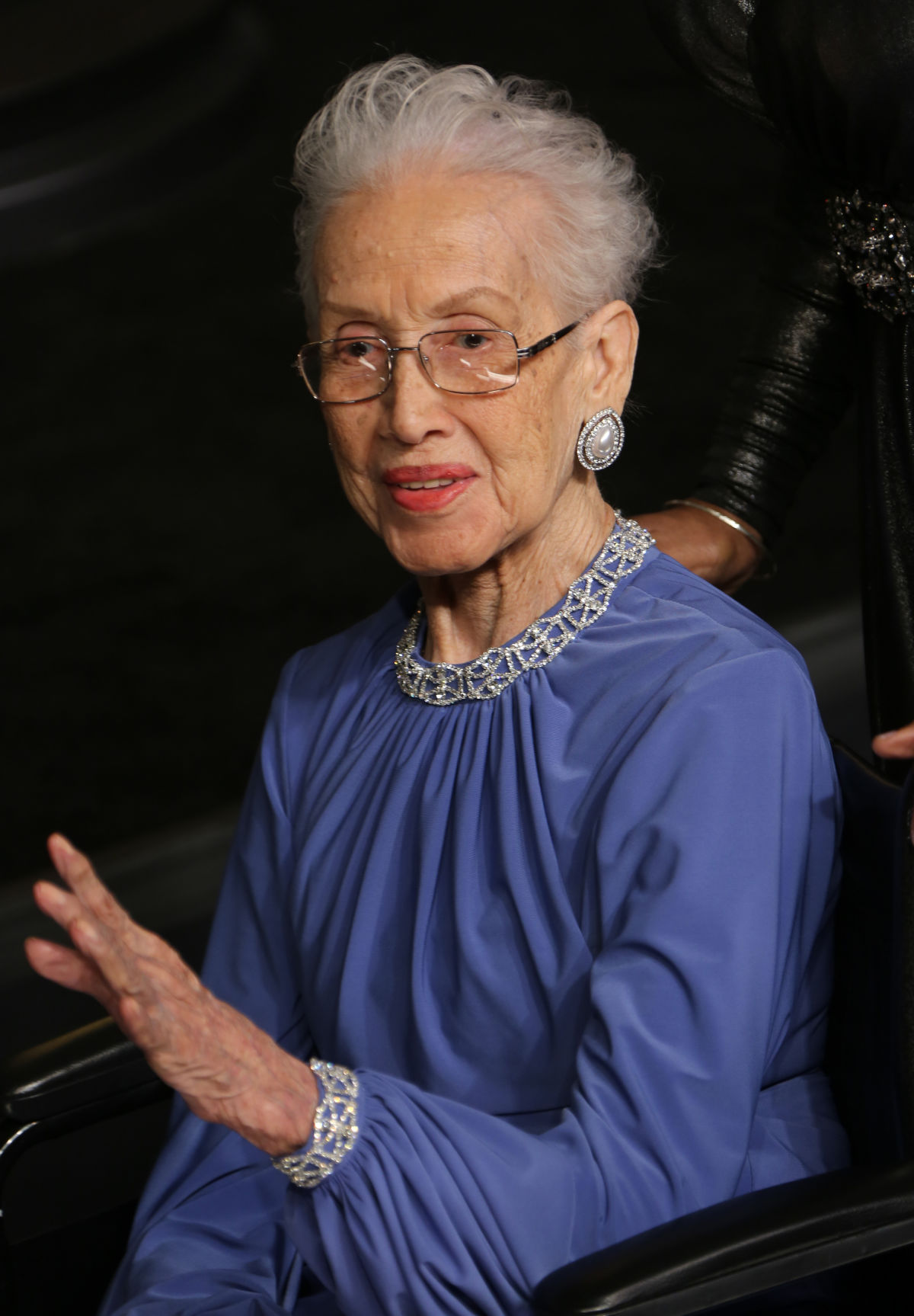
Katherine Johnson
Gloria Steinem

Shirley Chisholm

Chisholm was the first black congresswoman in U.S. history and served for seven terms. She ran for the 1972 Democratic nomination for the presidency, becoming the first major-party African-American candidate to do so. She also fought for education opportunities and social justice.
Dolores Huerta

The co-founder of what would become the United Farm Workers was one of the most influential labor activists of the 20th century. Huerta today continues to work to improve social and economic conditions for farm workers and to fight discrimination.
Malala Yousafzai

The Pakistani activist was only a teenager when she began to speak out against the Taliban and its attacks on education for girls. She was shot in an assassination attempt at age 15. It only made her more determined. In 2014, Yousafzai and Kailash Satyarthi were awarded the Nobel Peace Prize for their activism. Today the Malala Fund works to ensure girls receive an education.