Climate change's rising seas may threaten tens of millions more people than scientists and government planners originally thought because of mistaken research assumptions on how high coastal waters already are, a new study said.
Researchers studied hundreds of scientific studies and hazard assessments, calculating that about 90% of them underestimated baseline coastal water heights by an average of 1 foot, according to a study this past week in the journal Nature. It's a far more frequent problem in the Global South, the Pacific and Southeast Asia, and less so in Europe and along Atlantic coasts.

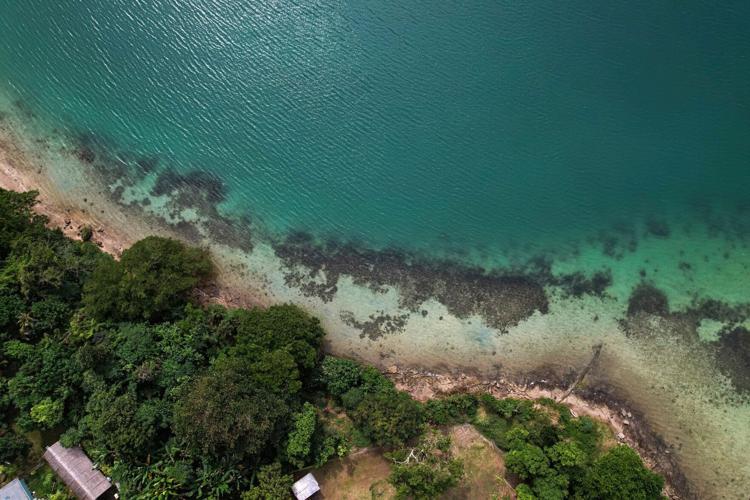
The coastline of Efate Island, Vanuatu, is visible on July 19.
The cause is a mismatch between the way sea and land altitudes are measured, said study co-author Philip Minderhoud, a hydrogeology professor at Wageningen University & Research in the Netherlands. And he attributed that to a "methodological blind spot" between the different ways those two things are measured.
People are also reading…
Each way measures its own areas properly, he said. But where sea meets land, there are a lot of factors that often don't get accounted for when satellites and land-based models are used. Studies that calculate sea level rise impact usually "do not look at the actual measured sea level so they used this zero-meter" figure as a starting point, said lead author Katharina Seeger of the University of Padua in Italy. In some places in the Indo-Pacific, it's close to 3 feet, Minderhoud said.
One simple way to understand this is that many studies assume sea levels without waves or currents, when the reality at the water's edge is oceans constantly roiled by wind, tides, currents, changing temperatures and things like El Niño, said Minderhoud and Seeger.
Adjusting to a more accurate coastal height baseline means that if seas rise by a little more than 3 feet — as some studies suggest will happen by the end of the century — waters could inundate up to 37% more land and threaten 77 million to 132 million more people, the study said.
That would trigger problems in planning and paying for the impacts of a warming world.

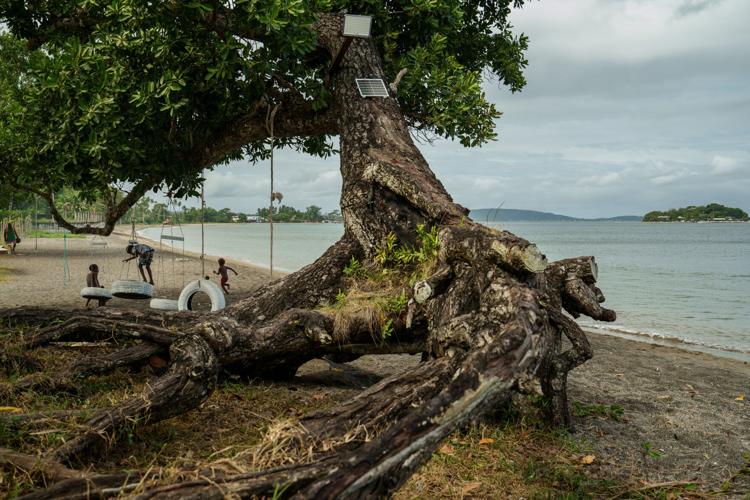
Children play on an uprooted tree along a beach in Mele, Vanuatu, July 19, that was once lined with vegetation, now largely lost to storms, erosion and other environmental pressures.
People at risk
"You have a lot of people here for whom the risk of extreme flooding is much higher than people thought," said Anders Levermann, a climate scientist at the Potsdam Institute for Climate Impacts Research in Germany, who wasn't part of the study. Southeast Asia, where the study finds the biggest discrepancy, has the most people already threatened by sea level rise, he said.
Minderhoud pointed to island nations in that region as areas where the reality of discrepancy hits home.
For 17-year-old climate activist Vepaiamele Trief, the projections aren't abstract. On her island home in the South Pacific archipelago of Vanuatu, the shoreline has visibly retreated within her short lifetime, with beaches eroded, coastal trees uprooted and some homes now barely 3 feet from the sea at high tide. On her grandmother's island of Ambae, a coastal road from the airport to her village has been rerouted inland because of encroaching water. Graves have been submerged, and entire ways of life feel under threat.
"These studies, they aren't just words on a paper. They aren't just numbers. They're people's actual livelihoods," she said. "Put yourself in the shoes of our coastal communities — their lives are going to be completely overturned because of sea level rise and climate change."

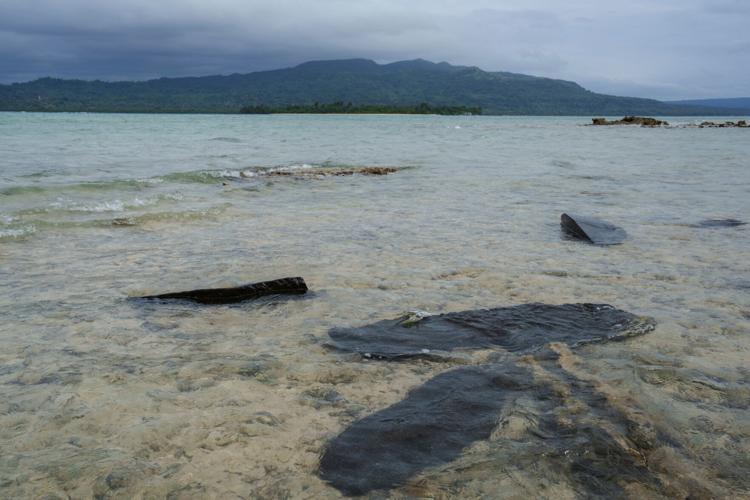
Gravestones sit submerged in water on Pele Island, Vanuatu, a country heavily affected by rising seas, July 18.
Paying attention to the starting point
Calculations that may be correct for the seas overall or for land aren't quite right at that key intersection point of water and land, Seeger and Minderhoud said.
It's especially true in the Pacific.
"To understand how much higher a piece of land is than the water, you need to know the land elevation and the water elevation. And what this paper says the vast majority of studies have done is to just assume that zero in your land elevation dataset is the level of the water. When in fact, it's not," said sea level rise expert Ben Strauss, CEO of Climate Central. His 2019 study was one of the few that got it right, according to the new paper.
"It's just the baseline that you start from that people are getting wrong," said Strauss, who wasn't part of the research.

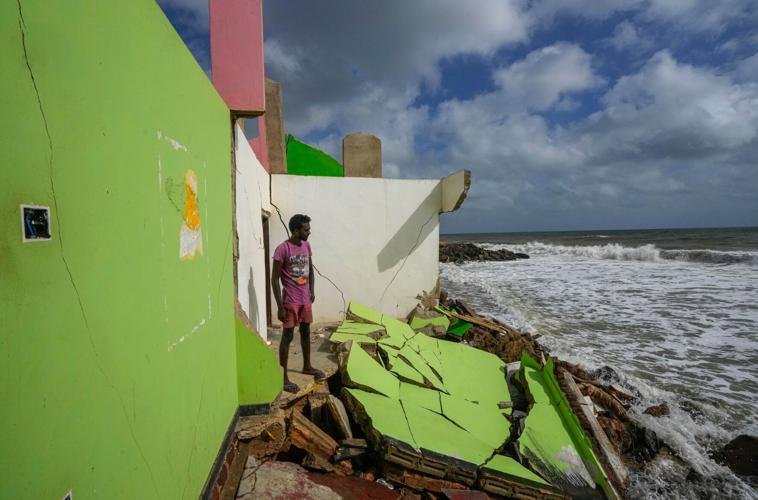
Dilrukshan Kumara looks at the ocean as he stands by the remains of his family's home in Iranawila, Sri Lanka, June 15, 2023.
Maybe not so bad, some scientists say
Other outside scientists said that Minderhoud and Seeger may be making too much of the problem.
"I think they're exaggerating the implications for impact studies a bit — the problem is actually well understood, albeit addressed in a way that could probably be improved," said Gonéri Le Cozannet, a scientist at the French geological survey. Most local planners know their coastal issues and plan accordingly, Rutgers University sea level expert Robert Kopp said.
The findings come as a new UNESCO report warns of major gaps in understanding how much carbon the ocean absorbs. That report said that models differ by 10% to 20% in estimating the size of that carbon sink, raising questions about the accuracy of global climate projections that rely on them.
Together, the studies suggest governments may be planning for coastal and climate risks with an incomplete picture of how the ocean is changing.
Photos capture destruction, heartache and resilience as climate change advanced in 2025

Joe Chyuwei, right, Addison Black, front center, James Black, front left, and back row from left, Helen Chyuwei, Jameson Black, Grace Chyuwei and Grayson Black watch the sunset in the heat at Zabriskie Point, Aug. 3, 2025, in Death Valley National Park, Calif. (AP Photo/John Locher, File)

The head of a dead fish lies in the almost dry Aume River, Aug. 14, 2025, in Saint-Fraigne, France. (AP Photo/Yohan Bonnet, File)

Local farmer Turkan Ozkan, 64, cries next to one of her animals killed during a fire Aug. 12, 2025, in Guzelyeli, Turkey. (AP Photo/Khalil Hamra, File)

Members of the Mura Indigenous community maneuver a boat Feb. 17, 2025, in the Lago do Soares village in Autazes, Amazonas state, Brazil. (AP Photo/Edmar Barros, File)

Afeli Bernice Adzo leans against the remains of her father's room as she looks at the ocean that destroyed her family home March 5, 2025, in Avegadzi, Ghana. (AP Photo/Misper Apawu, File)

Scientists and veterinarians capture a pink river dolphin in the Amazon River to perform health checks Sept. 7, 2025, in Puerto Narino, Colombia. (AP Photo/Fernando Vergara, File)

Wanona Harp rescues a cat stranded on her neighbor's porch flooded by the Kentucky River, April 8, 2025, in Lockport, Ky. (AP Photo/Carolyn Kaster, File)

Mamadou Gueye, a 39-year-old farmer who lost his left hand after a fight with a herder over cattle in May 2022, guards his fields of peanuts Oct. 12, 2025, in Ross Bethio, Senegal. (AP Photo/Andrea Ferro)

An environmental agent of the Chico Mendes Institute takes photos of turtle hatchlings Nov. 17, 2025, at the Abufari Biological Reserve in Tapaua, Brazil. (AP Photo/Edmar Barros, File)

Luciane Mengual, 22, an Indigenous woman from the Wayuu community, poses with her baby at home Feb. 4, 2025, in the Villa del Sur neighborhood, on the outskirts of Riohacha, Colombia. (AP Photo/Ivan Valencia, File)

A Sudanese farmer carries his livestock after his farm was destroyed by floods Oct. 1, 2025, in Wad Ramli village, Sudan. (AP Photo/Marwan Ali, File)

Members of the Gadaba Indigenous communities gather tendu leaves to sell April 16, 2025, in Hatipakna village, India. (AP Photo/Rafiq Maqbool, File)

Cows stand in floodwaters at a farm July 25, 2025, in Buenos Aires province, Argentina. (AP Photo/Natacha Pisarenko, File)

An Indigenous group attends the opening ceremony of the People's Summit offsite from the COP30 U.N. Climate Summit, Nov. 12, 2025, in Belem, Brazil. (AP Photo/Fernando Llano, File)

Schuyler Clogston, left, makes shadows puppets with Agnes Suárez after setting up a sheet and light to attract moths for observation Oct. 7, 2025, in Charleston, S.C. (AP Photo/Joshua A. Bickel, File)

Cassandra Garduño cleans a canal in her chinampa, an island farm built by the Aztecs thousands of years ago May 8, 2025, in San Gregorio Atlapulco, a borough of Mexico City. (AP Photo/Felix Marquez, File)

Members of the Navajo Scouts firefighter crew kick up dust as they clear debris from a landslide across a road on a hillside as they battle the Eaton Fire, Jan. 17, 2025, in Altadena, Calif. (AP Photo/John Locher, File)

Fisherman Sunil Kumar, bottom, spreads a fishing net to help remove the weeds floating on Doddajala Lake, Aug. 23, 2025, on the outskirts of Bengaluru, India. (AP Photo/Aijaz Rahi, File)

Young Indigenous guards play on the walls of an old military defense barrier made of sandbags, remnants of the military occupation in the area July, 19, 2025, in the Lopez Adentro reserve in Caloto, Colombia. (AP Photo/Nadège Mazars, File)

Women open freshly cooked oysters Aug. 6, 2025, in Tsokomey, Ghana. (AP Photo/Misper Apawu, File)

Firefighters work from a deck as the Palisades Fire burns a beachfront property Jan. 8, 2025, in Malibu, Calif. (AP Photo/Etienne Laurent, File)

A Navy officer helps a woman cross a flooded street Oct. 12, 2025, in Poza Rica, Veracruz state, Mexico. (AP Photo/Felix Marquez, File)

Relatives of Rosiclaire Lenchise mourn during a funeral of victims killed by a landslide triggered by Hurricane Melissa, Nov. 15, 2025, in Petit Goave, Haiti. (AP Photo/Odelyn Joseph, File)

Arturo Huidobro, center, and a worker prepare to remove dead pigs from a farm following heavy rainfall Oct. 11, 2025, in Poza Rica, Mexico. (AP Photo/Felix Marquez, File)

Tanzin Dolma milks a yak as her husband, Punchuk Namdol, collects dung in the background on an early morning July 8, 2025, in Maan village, Ladakh, India. (AP Photo/Dar Yasin, File)

Baby ostriches huddle after being moved into a barn following recent flooding July 9, 2025, at a farm in Bend, Texas. (AP Photo/Joshua A. Bickel, File)

Members of the Lion Intervention Brigade conduct a patrol Jan. 14, 2025, at Niokolo Koba National Park, Senegal. (AP Photo/Annika Hammerschlag, File)

Judy Bertuso, left, feeds her husband Apollo inside a tent at an evacuation center as Typhoon Fung-wong enters the country Nov. 9, 2025, in Quezon city, Philippines. (AP Photo/Aaron Favila, File)

Olsjen Mucobega, 32, uses his motorcycle to evacuate a sheep from a wildfire Aug. 13, 2025, in Patras, Greece. (AP Photo/Thanassis Stavrakis, File)

A man rides his bicycle through an inundated street during the aftermath of Hurricane Melissa, Oct. 30, 2025, in Black River, Jamaica. (AP Photo/Matias Delacroix, File)

Ari Rivera, rear, and Anderson Hao hold each other in front of their destroyed home Jan. 9, 2025, in Altadena, Calif. (AP Photo/John Locher, File)

Gentoo penguins nest at Neko Harbour in Antarctica, Saturday, Nov. 22, 2025. (AP Photo/Mark Baker)

A pod of orcas swim in the Drake Passage en route to Antarctica, Friday, Nov. 21, 2025. (AP Photo/Mark Baker)

Passengers walk inside the volcano at Deception Island in Antarctica, Wednesday, Nov. 26, 2025. (AP Photo/Mark Baker)

Gentoo penguins walk at Neko Harbour in Antarctica, Saturday, Nov. 22, 2025. (AP Photo/Mark Baker)

Gentoo penguins nest at Neko Harbour in Antarctica, Saturday, Nov. 22, 2025. (AP Photo/Mark Baker)

A member of the ship's crew looks at an iceberg near Yalour Islands in Antarctica, Monday, Nov. 24, 2025. (AP Photo/Mark Baker)

A crew member looks for whales at Yalour Islands in Antarctica, Monday, Nov. 24, 2025. (AP Photo/Mark Baker)

The sun sets near a iceberg in Antarctica, Friday, Nov. 21, 2025. (AP Photo/Mark Baker)

Passengers watch as a ship sails through the Lemaire Channel in Antarctica, Monday, Nov. 24, 2025. (AP Photo/Mark Baker)

Adelie penguins stand on a block of floating ice at Yalour Islands in Antarctica, Monday, Nov. 24, 2025. (AP Photo/Mark Baker)

A elephant seal reacts at Walker Island in Antarctica, Wednesday, Nov. 26, 2025. (AP Photo/Mark Baker)

Gentoo penguins nest at Walker Island in Antarctica, Wednesday, Nov. 26, 2025. (AP Photo/Mark Baker)

Gentoo penguins prepare to enter the water at Walker Island in Antarctica, Wednesday, Nov. 26, 2025. (AP Photo/Mark Baker)

An ice covered rock formation is reflected in the waters at Pleneau Island in Antarctica, Monday, Nov. 24, 2025. (AP Photo/Mark Baker)

A Pintado petrel flys over the Drakes Passage on the way to Antarctica, Thursday, Nov. 20, 2025. (AP Photo/Mark Baker)

Sea ice covers the ocean at Yalour Islands in Antarctica, Monday, Nov. 24, 2025. (AP Photo/Mark Baker)
The Associated Press receives support from the Walton Family Foundation for coverage of water and environmental policy. The AP is solely responsible for all content. For all of AP's environmental coverage, visit https://apnews.com/hub/climate-and-environment