BERLIN — A stranded humpback whale in Germany’s Baltic Sea looks weaker, and experts fear it won’t be able to find its way back to the Atlantic despite several attempts at its rescue.
A 500-yard restricted area was enforced around the whale so it could get some rest and hopefully free itself, officials said Sunday in a news conference in the eastern German coastal town of Wismar, near where the giant cetacean is stuck.
“He would be able to do so if he regains his strength, and that is why we decided to leave him alone, allowing him to actually set off and then successfully leave this area," said Till Backhaus, the environment minister of the state of Mecklenburg-Pomerania, where Wismar is located.

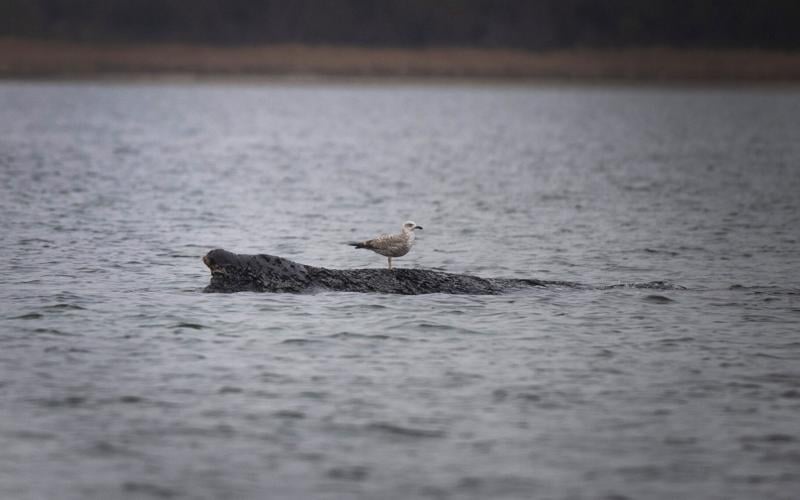
A whale lies on a sandbank Saturday in the Bay of Wismar, Germany.
“But we also have to assume that he is weakened. And he is also sick,” said Backhaus, adding that the humpback whale may have injuries because it came into contact with a fishing net.
People are also reading…
Previous efforts to rescue the 39- to 49-foot whale off a sandbank at Timmendorfer Strand beach and in the Wismar Bay with the help of an excavator and boats, creating large waves to help it swim free earlier this week, captivated Germans — with media sending news alerts of updates on its progress and streaming live video from the scene.
The whale also became a popular topic of conversation across the country, with people exchanging text messages about rescue efforts.
But by now, hopes are dimming that the whale is still strong enough to swim free and find its way back to the Atlantic through German and Danish waters.
“It is very noticeable that the animal is showing significantly less activity,” said Stefanie Groß from the Institute for Terrestrial and Aquatic Wildlife Research at the University of Veterinary Medicine Hannover. “Its respiratory rate has dropped considerably. The animal is not moving. It did not react even when we drove closer.”

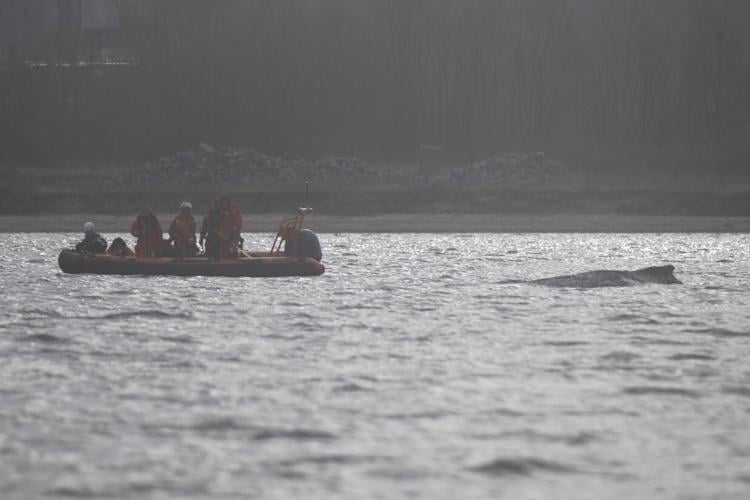
Environmentalists move close to a humpback whale Sunday in the Wismar Bay near Wismar, Germany.
It is not clear why the whale swam into the Baltic Sea. Some experts say the animal may have lost its way when it swam after a shoal of herring, or during migration, as it is most likely a male.
The marine mammal cannot survive in the Baltic Sea long-term as the salt concentration of the water isn’t high enough. It has already developed a skin disease. Another issue is that it can't find the right kind of nutrition it needs, though whales can go without food for weeks.
If it is to survive, it will need to return to the Atlantic Ocean via the North Sea.
“When you consider how narrow the straits are and that there are still about 310 miles to go, you realize that it’s a real bottleneck you have to navigate, and naturally, the chances of success are relatively slim," said Burkard Baschek, the director of the German Maritime Museum in Stralsund.
The whale was first spotted swimming in the Baltic on March 3, but reports of it being stranded surfaced last week.
Fragile, fierce and fleeting: AP’s best animal and nature photos of 2025

A newborn chick looks out of the feathers of its mother at a farm in Wehrheim near Frankfurt, Germany, July 14, 2025. (AP Photo/Michael Probst, File)

A raccoon eats peanuts on the boardwalk in Panama City, March 23, 2025. (AP Photo/Matias Delacroix, File)

A Drosera capensis plant traps an insect at a carnivorous plant exhibit at the Botanical Garden in Bogota, Colombia, April 3, 2025. (AP Photo/Fernando Vergara, File)

A stag is silhouetted as it walks through a forest in the Taunus region near Frankfurt, Germany, Oct. 1, 2025. (AP Photo/Michael Probst, File)

Sandhill cranes are seen at the Wheeler National Wildlife Refuge, Jan. 13, 2025, in Decatur, Ala. (AP Photo/George Walker IV, File)

An albino turtle hatchling sits among other Arrau turtles (podocnemis expansa) ahead of their release at the Abufari Biological Reserve, in Tapaua, Amazonas state, Brazil, Nov. 17, 2025. (AP Photo/Edmar Barros, File)

A Monitor Lizard rests on a tree inside the Kaziranga National Park in Kaziranga, India, March 4, 2025. (AP Photo/Anupam Nath, File)

A stork couple is backdropped by the rising sun after a night of minus seven degrees Celsius (19.4 Fahrenheit) weather, on a field in Wehrheim near Frankfurt, Germany, Feb. 19, 2025. (AP Photo/Michael Probst, File)

A herd of sheep is guided through central Madrid, Spain, as shepherds lead them through the streets in defense of ancient grazing and migration rights, Oct. 19, 2025, in Madrid, Spain. (AP Photo/Manu Fernandez, File)

Brown marmorated stink bugs sit on a dandelion flower at a park in Tallinn, Estonia, May 25, 2025. (AP Photo/Sergei Grits, File)

A peacock alights next to a pickup truck at Mack's Fish Camp, a family-owned airboat tour business and campground on the Eastern edge of the Everglades, May 28, 2025, near Miramar, Fla. (AP Photo/Rebecca Blackwell, File)

Butterflies gather around flowers along the Riverwalk, July 18, 2025, in San Antonio. (AP Photo/Eric Gay, File)

A ladybug sits on a dandelion flower at a park in Tallinn, Estonia, May 25, 2025. (AP Photo/Sergei Grits, File)

A female African elephant named Pupy stands in her enclosure at the Ecoparque in Buenos Aires, Argentina, March 25, 2025, as she is trained for her relocation to a sanctuary in Brazil. (AP Photo/Natacha Pisarenko, File)

A golden snub-nosed monkey is seen in Shennongjia National Park in central China's Hubei province, June 18, 2025. (AP Photo/Ng Han Guan, File)

Mute swans float on the River Thames, Oct. 10, 2025, in Windsor, England. (AP Photo/Julia Demaree Nikhinson, File)

A humpback whale breaches off the coast of Port Stephens north of Sydney, Australia, June 18, 2025. (AP Photo/Mark Baker, File)

Migrating cranes flock at sunrise in Hula Lake conservation area, north of the Sea of Galilee, northern Israel, Jan. 23, 2025. (AP Photo/Ariel Schalit, File)

A frog swims in a pond behind the Bellevue Palace in Berlin, Germany, May 12, 2025. (AP Photo/Markus Schreiber, File)

Vultures fly over the decomposed body of an animal, unseen, in Jammu, India, May 27, 2025. (AP Photo/Channi Anand, File)

The veins of an adult periodical cicada's translucent wings are illuminated shortly after shedding its nymphal skin after a heavy rain, May 16, 2025, in Cincinnati. (AP Photo/Carolyn Kaster, File)

A young wild horse stands by its mother in a meadow near the city of Duelmen, Germany, where the herd lives in almost unmanaged feral conditions, April 19, 2025. (AP Photo/Martin Meissner, File)

Storks fly over fields in Buettelborn near Frankfurt, Germany, Sept. 23, 2025. (AP Photo/Michael Probst, File)

A polar bear is seen in front of an abandoned research station on Koluchin Island, off Chukotka, Russia, in the country's Far East, Sept. 14, 2025. (AP Photo/Vadim Makhorov, File)

A hummingbird drinks from a flower in a garden on the outfield lawn before a spring training baseball game between the Kansas City Royals and the Athletics, Feb. 24, 2025, in Surprise, Ariz. (AP Photo/Lindsey Wasson, File)

A bee collects pollen from a blue salvia, part of the blue, green, and white flower color scheme at the All England Lawn Tennis and Croquet Club, ahead of the Wimbledon Championships in London, June 25, 2025. (AP Photo/Kirsty Wigglesworth, File)

A grey squirrel jumps amongst autumn leaves in a London park, Nov. 4, 2025. (AP Photo/Kin Cheung, File)

An adult periodical cicada, in the process of shedding its nymphal skin, is seen on May 20, 2025, in Cincinnati. (AP Photo/Carolyn Kaster, File)

A couple of White-tailed eagles fight while hunting at the Bosfor Vostochny channel in Vladivostok, Russia, Feb. 10, 2025. (AP Photo/Anton Balashov, File)