WASHINGTON — Extreme views adopted by some local, state and federal political leaders who try to limit what history can be taught in schools and seek to undermine how Black officials perform their jobs are among the top threats to democracy for Black Americans, the National Urban League says.
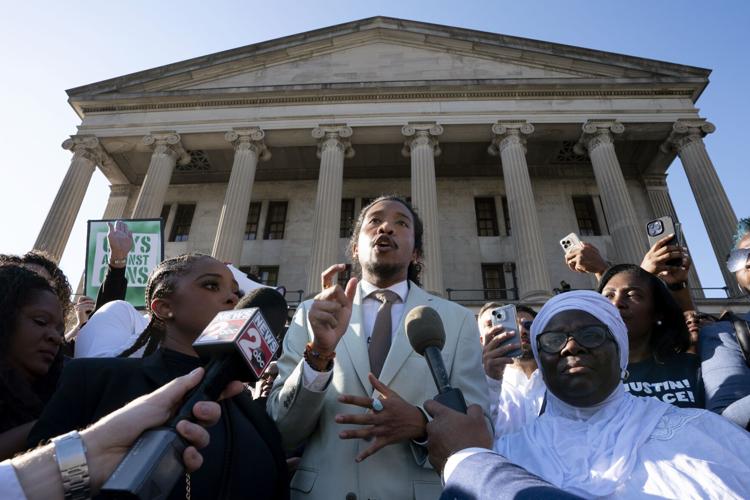
Marc Morial, the former New Orleans mayor who leads the civil rights and urban advocacy organization, cited the most recent example: the vote this month by the Republican-controlled Tennessee House to oust two Black representatives for violating a legislative rule. The pair participated in a gun control protest inside the chamber after a shooting that killed three students and three staff members at a Nashville school.
"We have censorship and Black history suppression, and now this," Morial said in an interview. "It's another piece of fruit of the same poisonous tree, the effort to suppress and contain."
People are also reading…
Both Tennessee lawmakers were quickly reinstated by leaders in their districts after an uproar that spread well beyond the state.

State Rep. Justin Jones, D-Nashville, delivers remarks outside the state Capitol on April 10, the day Nashville’s metro council voted to reinstate him to the Tennessee House after he was expelled by a Republican supermajority, in Nashville, Tenn.
The Urban League's new annual State of Black America report draws on data and surveys from a number of organizations, including the UCLA Law School, the Southern Poverty Law Center and the Anti-Defamation League. The collective findings reveal an increase in recent years in hate crimes and efforts to change classroom curriculums, attempts to make voting more difficult and extremist views being normalized in politics, the military and law enforcement.
One of the most prominent areas examined is so-called critical race theory. Scholars developed it as an academic framework during the 1970s and 1980s in response to what they viewed as a lack of racial progress following the civil rights legislation of the 1960s. The theory centers on the idea that racism is systemic in the nation's institutions and they function to maintain the dominance of white people in society.
Director Taifha Alexander said the Forward Tracking Project, part of the UCLA Law School, began in response to the backlash that followed the protests of George Floyd's killing in 2020 and an executive order that year from then-President Donald Trump restricting diversity training.
The project's website shows that 209 local, state and federal government entities introduced more than 670 bills, resolutions, executive orders, opinion letters, statements and other measures against critical race theory since September 2020.
Anti-critical race theory is "a living organism in and of itself. It's always evolving. There are always new targets of attack," Alexander said.

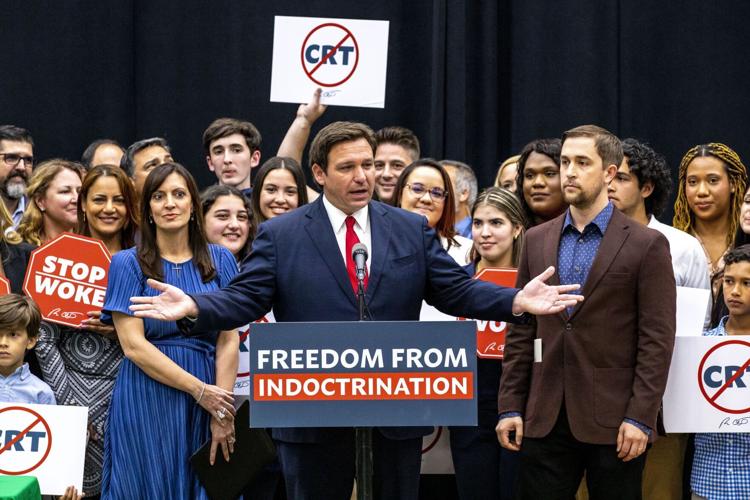
Florida Gov. Ron DeSantis addresses the crowd April 22, 2022, before publicly signing legislation dubbed the "stop woke" bill during a news conference at Mater Academy Charter Middle/High School in Hialeah Gardens, Fla.
She said the expanded scope of some of those laws, which are having a chilling effect on teaching certain aspects of U.S. racial conflicts, will lead to major gaps in understanding history and social justice.
"This anti-CRT campaign is going to frustrate our ability to reach our full potential as a multiracial democracy" because future leaders will be missing information they could use to tackle problems, Alexander said.
She said one example is the rewriting of Florida elementary school material about civil rights figure Rosa Parks and her refusal to give up her seat to a white rider on a Montgomery, Alabama, bus in 1955 — an incident that sparked the bus boycott there. Mention of race was omitted entirely in one revision, a change first reported by The New York Times.
Florida has been the epicenter of many of the steps, including opposing AP African American studies, but it's not alone.
"The things that have been happening in Florida have been replicated, or governors in similarly situated states have claimed they will do the same thing," Alexander said.

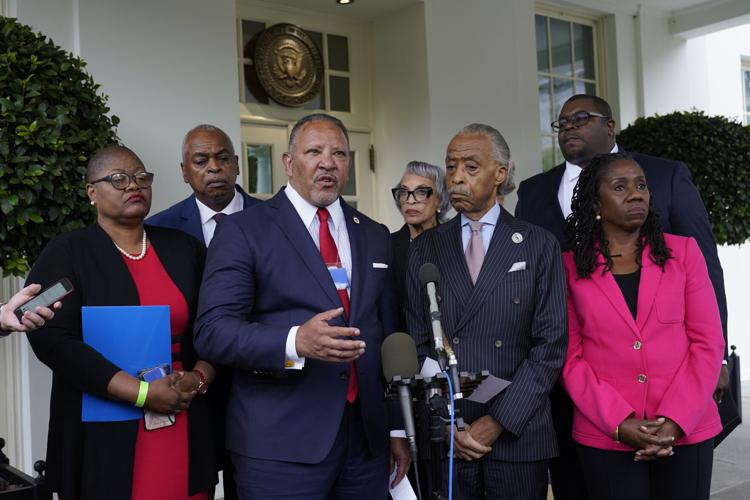
Marc Morial, center, president and chief executive officer of the National Urban League, talks with reporters July 8, 2021, outside the West Wing of the White House in Washington, following a meeting with President Joe Biden and leaders of top civil rights organizations.
In Alabama, a proposal to ban "divisive" concepts passed out of legislative committee this past week. Last year, the administration of Virginia Gov. Glenn Youngkin, a Republican, rescinded a series of policies, memos and other resources related to diversity, equity and inclusion it characterized as "discriminatory and divisive concepts" in the state's public education system.
Oklahoma public school teachers are prohibited from teaching certain concepts of race and racism under a bill Republican Gov. Kevin Stitt signed into law in 2021.
On Thursday, the Llano County Commissioners Court in Texas held a special meeting to consider shutting down the entire public library system rather than follow a federal judge's order to return a slate of books to the shelves on topics ranging from teenage sexuality to bigotry.
After listening to public comments, the commissioners decided to remove the item from the agenda.
Other issues in Urban League's report address extremism in the military and law enforcement, energy and climate change, and how current attitudes can affect public policy. Predominantly white legislatures in Missouri and Mississippi have proposals that would shift certain government authority from some majority Black cities to the states.
Forty percent of voters in last year's elections said their local K-12 public schools were not teaching enough about racism in the U.S., while 34% said it already was too much, according to AP VoteCast, an expansive survey of the American electorate; 23% said the current curriculum was about right.
About two-thirds of Black voters said more should be taught on the subject, compared with about half of Latino voters and about one-third of white voters.
50 movies that address the history of racism in America
50 movies that address the history of racism in America

Movies give us perspective and allow us to watch certain events play out in front of our eyes. They can be educational and entertaining, making proper representation a significant factor in filmmaking. Black representation in Hollywood was almost nonexistent in the early 20th century, and when images of African Americans were shown, they were given negative stereotypes and criticized with racist imagery and oppression.
Years of systematic racism riddle the Black community today, but it was even more blatant back then. Young Black children around the country would turn on the television to a lack of positive images outside of racial stereotypes. As the years went on, Black representation slowly but surely began to make its way through the airwaves, and it started to educate people on the realities of Black lives as many Black filmmakers, actors, and writers created a new cycle of Black cinema with a variety of genres.
Black films have become a staple in the Black community, leaving long-lasting impacts on the culture for years to come. Black artistry continues to rise in theaters and on television as the industry learns to cater to different skin types, film angles, genre diversities, and plot lines within Black culture.
Stacker extensively researched the history of Black filmmaking and Black lives captured on screen in both fiction features and documentaries, and compiled a list of 50 diverse films that address the history of racism in America in one way or the other using IMDb data as of June 3, 2020. To amplify Black voices and firsthand experience, the overwhelming majority of the films on this list are made by Black filmmakers. The films are organized chronologically.
Check out these stories that shine a light on Black voices throughout cinema.
You may also like: 25 of the most expensive TV series of all time
Within Our Gates (1920)

- Director: Oscar Micheaux
- IMDb user rating: 6.3
- Metascore: data not available
- Runtime: 79 min
"Within Our Gates" follows a mixed-race woman who ventures North during the Jim Crow era in hopes of raising money for a Black school in the South. Oscar Micheaux, the first major African American feature-filmmaker, portrays racial violence and strict contrasts between the Black people who lived in rural areas to those who migrated to urban cities. The silent film is highly critiqued to be a response to D.W. Griffith's "Birth of a Nation," and a turning point for African American cinema.
Shadows (1958)

- Director: John Cassavetes
- IMDb user rating: 7.3
- Metascore: 86
- Runtime: 87 min
Leila, a white-passing, Black woman in New York City, falls in love with a white man, but the relationship ends when he meets her dark-skinned brother and realizes she is Black. Leila and her two brothers navigate their racial identity with their skin complexion at the forefront of their narratives. This movie brings awareness to the multifaceted issues that surround Black livelihood.
A Raisin in the Sun (1961)

- Director: Daniel Petrie
- IMDb user rating: 8.0
- Metascore: 87
- Runtime: 128 min
Attempting to fulfill the American dream in a racially segregated Chicago, a Black family looking to buy a home in a white neighborhood becomes a victim of housing discrimination and racial threats. The film addresses the racial injustices Black people face when attempting to follow their dreams, bearing the question, "what happens to a dream deferred?"
Guess Who's Coming to Dinner (1967)

- Director: Stanley Kramer
- IMDb user rating: 7.8
- Metascore: 63
- Runtime: 108 min
This classic film depicts a couple's interracial love as they confront each other's family members' initial disapproval. Katharine Houghton and Sidney Poitier's characters dive deep into the anti-miscegenation laws of the time and explore certain hypocrisies that potentially stem from white-liberalism.
In the Heat of the Night (1967)

- Director: Norman Jewison
- IMDb user rating: 7.9
- Metascore: 75
- Runtime: 110 min
In this five-time Academy Award-winning movie, a Black detective (Sidney Poitier) gets caught in the middle of a murder investigation and eventually proves his innocence. After his release, he's now in charge of the case but faces difficulties when he's partnered with the racist sheriff (Rod Steiger), who accused him of murder. The film was shot during the civil rights movement and examined racial policing and bigotry.
You may also like: 100 best films of the 21st century, according to critics
Symbiopsychotaxiplasm: Take One (1968)

- Director: William Greaves
- IMDb user rating: 7.3
- Metascore: 71
- Runtime: 75 min
William Greaves experiments "a film within a film within a film." While at times baiting his predominantly white crew over political topics, Greaves allows the actors to follow their narratives on issues of race and sexuality. In fact, the lack of direction is how he wanted to bring out the reality of his crew's thoughts on screen.
The Story of a Three-Day Pass (1968)

- Director: Melvin Van Peebles
- IMDb user rating: 7.0
- Metascore: data not available
- Runtime: 87 min
An African American soldier named Turner is stationed in France and struggles with his own identity as a Black man in the army. After meeting and spending the weekend with a French woman, Turner finds that he is not exempt from racial prejudices, and he's forced to face his lack of freedom and discrimination within the military.
The Learning Tree (1969)

- Director: Gordon Parks
- IMDb user rating: 7.1
- Metascore: data not available
- Runtime: 107 min
Gordon Parks tackles adolescent sexuality, morality, and racism, centering a young Black teenager in 1920s rural Kansas. The tragic trial of events portrayed in the film speaks volumes to the harsh realities Black Americans face beginning at a young age.
Cotton Comes to Harlem (1970)

- Director: Ossie Davis
- IMDb user rating: 6.5
- Metascore: data not available
- Runtime: 97 min
This slapstick comedy is widely known as one of the earliest examples of blaxploitation. Popular throughout the 1970s, the genre has been criticized but also praised by the Black community for characters who, at their core, promote messages of Black empowerment. The story follows a man attempting to raise money to return to Africa (mirroring the teachings of Marcus Garvey), all of which was actually an elaborate scam.
Sounder (1972)

- Director: Martin Ritt
- IMDb user rating: 7.5
- Metascore: 80
- Runtime: 105 min
A Black sharecropping family and their dog experience extreme poverty during the Great Depression. They fight to survive after the father is jailed for stealing food. Starring Cicely Tyson, the story themes prison labor, Black poverty, and access to education within the Black community.
You may also like: 1984 and 19 other dystopian novels that predicted the future
The Spook Who Sat by the Door (1973)

- Director: Ivan Dixon
- IMDb user rating: 7.1
- Metascore: data not available
- Runtime: 102 min
"The Spook Who Sat by the Door" follows the first Black man in a fictional CIA, who is aware of his token status in the agency. After learning a few techniques from the agency, he organizes the "Freedom Fighters" to help protect Black Americans and ensure their freedom. The film addresses the need for Black people's self-defense, a notion practiced during the civil rights movement.
Ganja & Hess (1973)

- Director: Bill Gunn
- IMDb user rating: 6.3
- Metascore: data not available
- Runtime: 110 min
One of the first few horror films to have Black representation, Bill Gunn plays his own lead in "Ganja & Hess" and portrays diversity and range for Black actors in cinema. The film presents two Black lovers who've been killed and have emerged as immortal vampires. Initially pitched as a blaxploitation film, the movie is more experimental and artistic.
Killer of Sheep (1978)

- Director: Charles Burnett
- IMDb user rating: 7.3
- Metascore: 96
- Runtime: 80 min
This black-and-white film follows a Black man who works in a slaughterhouse to feed his family. While the adults face challenges of their own, the children are almost accustomed to their dangerous surroundings. The film mirrors the harsh realities of the ghetto, trauma, and financial struggle due to racial inequity from childhood to adulthood.
Losing Ground (1982)

- Director: Kathleen Collins
- IMDb user rating: 6.4
- Metascore: data not available
- Runtime: 86 min
Sara, a young Black woman, is having trouble with her marriage after her husband sparks interest in a Puerto Rican woman, causing Sara to question her own identity and self-worth being both Black and a woman. "Losing Ground" was one of the first feature-length films created by a Black woman.
She's Gotta Have It (1986)

- Director: Spike Lee
- IMDb user rating: 6.7
- Metascore: 79
- Runtime: 84 min
The themes of "She's Gotta Have It" include gender, Black feminism, and sexual liberation. Nola Darling lives a sexually liberated lifestyle with three men before she is forced to choose one lover. Spike Lee examines the representation of Black women's wellness and freedom of stereotypes.
You may also like: 40 Black artists music wouldn't be the same without
Tongues Untied (1989)

- Director: Marlon Riggs
- IMDb user rating: 6.7
- Metascore: data not available
- Runtime: 55 min
This documentary focuses on the expression of gay Black men and their culture. Marlon Riggs explores the intersectionality of being both Black and gay in a racist and homophobic society. Riggs shines a light on many issues the community faces, including examples of hypersexualized Black men in relation to their white counterparts.
Do the Right Thing (1989)

- Director: Spike Lee
- IMDb user rating: 7.9
- Metascore: 92
- Runtime: 120 min
A series of racially motivated events is outlined after an Italian-owned restaurant has a wall-of-fame with only Italian actors in a predominantly Black neighborhood. Believing there should be Black actors on the wall, heightened emotions on race relations lead to a race riot. This staple in the Black community is a representation of racial inequity and injustices themed across the country today.
Daughters of the Dust (1991)

- Director: Julie Dash
- IMDb user rating: 6.5
- Metascore: 81
- Runtime: 112 min
This film portrays the effects of Black enslavement past the borders of America and into West Africa and creolized cultures. A family of women in the Gullah community struggles to carry on their vibrant Yoruba culture away from their homeland. Julie Dash's film heavily inspired Beyonce's "Lemonade" video as it explores Black womanhood and the search for freedom after slavery.
Boyz n the Hood (1991)

- Director: John Singleton
- IMDb user rating: 7.7
- Metascore: 76
- Runtime: 112 min
Based on his own life, John Singleton portrays three young Black men in a neighborhood riddled with poverty, gang violence, and other harsh issues that hit the community. Each man navigates their path through Central Los Angeles when tragedy strikes, symbolizing a trauma cycle of "what's going on in the hood."
Just Another Girl on the I.R.T. (1992)

- Director: Leslie Harris
- IMDb user rating: 6.4
- Metascore: data not available
- Runtime: 92 min
Chantel Mitchell is a Black, 17-year-old high schooler from Brooklyn, New York, who dreams of going to college and hopes to become a doctor. Her plans fall short when she becomes pregnant. Mitchell copes with her fears of becoming a statistic, riddled with stereotypes that follow young Black girls.
You may also like: 50 best space movies of all time
Malcolm X (1992)

- Director: Spike Lee
- IMDb user rating: 7.7
- Metascore: 72
- Runtime: 202 min
Malcolm X was a Black activist who taught against racism and white violence while promoting Black empowerment and separation. Denzel Washington gives a powerful performance of the real-life events in the activist's life and his impact on the Black community; many sentiments still followed and repeated to this day.
Hoop Dreams (1994)

- Director: Steve James
- IMDb user rating: 8.3
- Metascore: 98
- Runtime: 170 min
This documentary follows two Black teenage boys from a predominantly Black neighborhood in Chicago. They attend a predominately white school in hopes of pursuing their dreams of becoming professional basketball players. The film constantly touches on race, social class, and the education system with topics in code-switching, economic hardships, and racism.
Devil in a Blue Dress (1995)

- Director: Carl Franklin
- IMDb user rating: 6.7
- Metascore: 78
- Runtime: 102 min
Denzel Washington makes another appearance on the list as a World War II veteran. He finds himself entangled in a case involving a missing white woman. Racism is at the center of the story's plot as Washington's character is consistently demeaned and belittled, and the film portrays an overall lack of care for Black lives by society.
The Watermelon Woman (1996)

- Director: Cheryl Dunye
- IMDb user rating: 6.7
- Metascore: 74
- Runtime: 90 min
In the first feature film directed by a Black lesbian woman, Cheryl, who plays herself in the film, is a struggling filmmaker who hopes to make a film about a Black lesbian character who is often belittled to "mammy" roles in early 20th century movies. The movie explores lesbianism, Blackness, and womanhood as each can intersect and coexist to their fullest identity.
Down in the Delta (1998)

- Director: Maya Angelou
- IMDb user rating: 6.7
- Metascore: 73
- Runtime: 112 min
Alfre Woodard stars in "Down in the Delta" as a character named Loretta, who is sent to Mississippi from Chicago to get clean from drugs and reconnect with her family's traditions. As a result of slavery, Black Americans have difficulties following family trees and often hit dead ends. Maya Angelou gives us a story of family, heritage, and traditions reborn.
You may also like: Famous authors who only wrote one novel
Bamboozled (2000)

- Director: Spike Lee
- IMDb user rating: 6.5
- Metascore: 50
- Runtime: 135 min
This satirical piece mirrors early 20th-century film as a television executive (Damon Wayans) decides to bring minstrel shows back to television. The film hits many racist stereotypes throughout including blackface, "jive" dances, and other racist tropes. The abstract film leans into old portrayals of Black characters as an examination of the past, present, and future of Black film.
How to Eat Your Watermelon in White Company (and Enjoy It) (2005)

- Director: Joe Angio
- IMDb user rating: 7.2
- Metascore: 70
- Runtime: 85 min
This documentary discusses Melvin Van Peebles' story and his breakthrough into Hollywood. Peebles' filmmaking style of the 1970s is highlighted throughout the film as a call for revolution within the Black community and more Black representation in film.
The Untold Story of Emmett Louis Till (2005)

- Director: Keith Beauchamp
- IMDb user rating: 7.6
- Metascore: 80
- Runtime: 70 min
Emmett Till was a Black, 14-year-old child from Chicago who, on a visit to his great-uncle's home in Mississippi, was brutally murdered by two white men. This documentary tells the story of Till, his murderer's acquittal in court by an all-white, all-male jury, and the racial uprising that followed in the 1950s. The film emphasizes the injustices of the racist South and white violence against the Black community.
The Great Debaters (2007)

- Director: Denzel Washington
- IMDb user rating: 7.5
- Metascore: 65
- Runtime: 126 min
Denzel Washington directs and stars in this true story of a Black professor's quest to begin a debate team at Wiley College, during the Great Depression. The now-legacy was unheard of at the time as Jim Crow laws were as prominent as ever, and the fear of violence against the Black community rang high. The film is a testament to the team and its coach for overcoming a racially unjust society.
Trouble the Water (2008)

- Directors: Carl Deal, Tia Lessin
- IMDb user rating: 7.3
- Metascore: 83
- Runtime: 93 min
"Trouble the Water" journeys a young Black couples' tragedy during Hurricane Katrina. The film shows predominantly Black neighborhoods flooded, families destroyed, and people killed during the natural disaster. The film is a visual displaying the lack of government support due to racism and classism during the historical event.
You may also like: Ranking the best years in movie history
The Black Power Mixtape 1967-1975 (2011)

- Director: Göran Olsson
- IMDb user rating: 7.5
- Metascore: 73
- Runtime: 100 min
"The Black Power Mixtape" documents the Black Power movement and its turning points within Black history. The found footage touches on many topics presented during the movement, including Dr. King's assassination, the War on Drugs, Black nationalism, and more.
12 Years a Slave (2013)

- Director: Steve McQueen
- IMDb user rating: 8.1
- Metascore: 96
- Runtime: 134 min
This slave memoir adaptation tells the story of a free Black man named Soloman, who was kidnapped and sold into slavery. For 12 years, Solomon faced the brutalities of slavery, as he jumps from one plantation to the next in hopes to find his way back home. The film, which can be hard to watch, portrays some harsh realities Black people faced during centuries of enslavement.
Fruitvale Station (2013)

- Director: Ryan Coogler
- IMDb user rating: 7.5
- Metascore: 85
- Runtime: 85 min
Oscar Grant was a Black, 22-year-old man who was shot and killed by a white police officer in Oakland's Fruitvale district station. Michael B. Jordan portrays the young man, who faced with deprivations as a Black man in America, journeyed through life as a Bay Area resident before his tragic murder. With footage caught on film, Grant's story brought a call for change towards police brutality and racial profiling that happens every day towards Black people.
Dear White People (2014)

- Director: Justin Simien
- IMDb user rating: 6.1
- Metascore: 79
- Runtime: 108 min
This Netflix special follows a group of Black students at a predominantly white university. The students navigate cultural biases at the Ivy League college, and the story mirrors real-life social injustices that mark Black students in similar positions.
Selma (2014)

- Director: Ava DuVernay
- IMDb user rating: 7.5
- Metascore: 81
- Runtime: 128 min
Ava DuVernay takes us into the story of Dr. Martin Luther King Jr.'s march on Selma in the fight for Black suffrage. The historical context speaks to Black people's relationship with the government as they are forced to navigate the judicial system as second-class citizens. The film follows the events of Dr. King's eventual push towards the Voting Rights Act of 1965.
You may also like: Can you answer these real 'Jeopardy!' questions about movies?
Rat Film (2016)

- Director: Theo Anthony
- IMDb user rating: 6.6
- Metascore: 83
- Runtime: 82 min
This documentary examines the rat infestation problem surrounding Baltimore and keys in on topics of discrimination, redlining, and other elements that encourage racial divide. Baltimore filmmaker, Theo Anthony alludes through the study of the infestation that the city's layout is built on the back of these racial inequities.
I Am Not Your Negro (2016)

- Director: Raoul Peck
- IMDb user rating: 7.8
- Metascore: 95
- Runtime: 93 min
In the mid-1970s, James Baldwin produced an unfinished manuscript that became the basis of the film "I Am Not Your Negro." The film relies heavily on what was left of Baldwin's written word to tell the story of America's racist history and its correlation to today's racial, political climate.
O.J.: Made in America (2016)

- Director: Ezra Edelman
- IMDb user rating: 8.9
- Metascore: data not available
- Runtime: 467 min
O.J. Simpson was arguably one of the most infamous names of the 1990s. Pieced together to make a five-part miniseries, "O.J.: Made in America" is the story that recounts Simpson's trial and acquittal for the murders of Nicole Brown Simpson and Ronald Lyle Goldman. A symbol of racial division, Simpson's story left a long-lasting impact on American culture.
Loving (2016)

- Director: Jeff Nichols
- IMDb user rating: 7.0
- Metascore: 79
- Runtime: 123 min
In 2016, the real-life interracial romance between Richard and Mildred Loving, a white man and a Black woman, was put on the big screen for all to see. In 1958, this romance was illegal and was challenged in the U.S. Supreme Court decision, Loving v. Virginia, which ultimately led to interracial laws being prohibited across the country.
13th (2016)

- Director: Ava DuVernay
- IMDb user rating: 8.2
- Metascore: 83
- Runtime: 100 min
Ava DuVernay tells another story in Black history, this time of the 13th Amendment (the abolishment of slavery) and how it marked the beginning of a new type of slavery—the mass incarceration of Black Americans. The film focuses on the racially disproportionate numbers in American prisons and features interviews from prominent figures like Michelle Alexander, Angela Davis, and more.
You may also like: Most famous musician born the same year as you
Get Out (2017)

- Director: Jordan Peele
- IMDb user rating: 7.7
- Metascore: 85
- Runtime: 104 min
"Get Out" follows a Black man (Chris) and his white girlfriend (Rose) as they travel to meet Rose's family for the first time. This film has been critically praised for hitting numerous themes of modern America, including white liberalism, cultural appropriation, racism, racial discrimination in policing, and more.
Did You Wonder Who Fired the Gun? (2017)

- Director: Travis Wilkerson
- IMDb user rating: 6.7
- Metascore: 78
- Runtime: 90 min
"Did You Wonder Who Fired the Gun?" dives into the South during the 1940s as a man investigates the murder of a Black man by his racist, white great-grandfather. Incorporating scenes from "To Kill a Mockingbird," the film mirrors the society that allowed racial injustices and brutal murders to occur.
Strong Island (2017)

- Director: Yance Ford
- IMDb user rating: 6.4
- Metascore: 86
- Runtime: 107 min
Yance Ford documents the investigation into the murder of his brother, 24-year-old William Ford Jr., in 1992. It is revealed that Ford was killed by a white man who was acquitted by an all-white jury. The film takes us through the heartbreak of a family who could not escape the racial injustices that plague Black families and their lives.
The Force (2017)

- Director: Peter Nicks
- IMDb user rating: 6.7
- Metascore: 80
- Runtime: 92 min
"The Force" highlights the demand for police reform by the Oakland police department amid the events and protests in Ferguson, Missouri. The film addresses scandals caused by the police department and encourages police accountability.
Mudbound (2017)

- Director: Dee Rees
- IMDb user rating: 7.4
- Metascore: 85
- Runtime: 134 min
In the midst of Jim Crow, a Black family struggles to build "the American dream" while working on a farm. This film's timeline is set in the post-World War II era, and the strict rules enforced on race relations of the time are at the forefront of the film, with classism, sexism, and issues surrounding PTSD lingering close behind.
Hale County This Morning, This Evening (2018)

- Director: RaMell Ross
- IMDb user rating: 6.3
- Metascore: 85
- Runtime: 76 min
Critics have described this avant-garde style film as "pure cinematic poetry." Two Black men learn to live within the social constructs of society and explore Black people's deep-rooted history and culture. The film captures elements of life that stem from racial injustices placed on Black people.
If Beale Street Could Talk (2018)

- Director: Barry Jenkins
- IMDb user rating: 7.1
- Metascore: 87
- Runtime: 119 min
Tish and Fonny's happily ever after is shattered when Fonny, a Black man, is falsely accused of a crime he did not commit against a white woman. The film explores topics like housing discrimination, racial violence, and mass incarceration. The film questions justice for Black people who are pinned against a society of systematic oppression.
Sorry to Bother You (2018)

- Director: Boots Riley
- IMDb user rating: 6.9
- Metascore: 80
- Runtime: 112 min
Lakeith Stanfield and Tessa Thompson make a dynamic duo in a film that studies Blackness in white, corporate spaces. Stanfield, whose character finally reaches a level of success in his career, must choose between his friends and coworkers or his achievements. The film takes a look at the double-edged sword that exists in the Black middle class.
The Hate U Give (2018)

- Director: George Tillman Jr.
- IMDb user rating: 7.4
- Metascore: 81
- Runtime: 133 min
"The Hate U Give" puts the audience in the shoes of a Black teenage girl named Starr Carter, who lives a double life attending a predominantly white private school. She is placed in the middle of protests and race riots after her friend, a Black boy, is killed by police. The story implements the strong racial tensions of today.
Just Mercy (2019)

- Director: Destin Daniel Cretton
- IMDb user rating: 7.5
- Metascore: 68
- Runtime: 137 min
Based on a true story in 1989, "Just Mercy" follows Bryan Stevenson, a law school graduate, who vows to defend Black inmates falsely sitting on death row. Stevenson, who experiences racial discrimination in the workplace himself, works endlessly to fight for the justice and freedom of Walter McMillian, a Black man falsely accused of murdering a white woman.
You may also like: 100 best movies of all time