

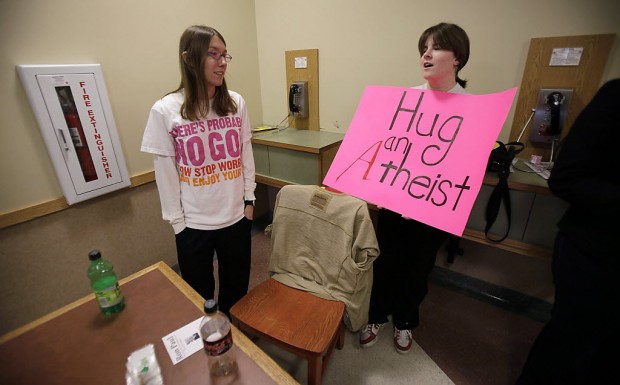
AMES, Iowa - The sign sits propped on a wooden chair, inviting all comers: "Ask an Atheist."
Whenever a student gets within a few feet, Anastasia Bodnar waves and smiles, trying to make a good first impression before eyes drift down to a word many Americans rank down there with "socialist."
Bodnar is the happy face of atheism at Iowa State University. Once a week at this booth at a campus community center, the Ph.D. student who spends most of her time researching genetically engineered corn takes questions and occasional abuse while trying to raise the profile of religious skepticism.
"A lot of people on campus either don't know we exist or are afraid of us or hate us," says Bodnar, president of the ISU Atheist and Agnostic Society. "People assume we're rabble-rousing, when we're one of the gentlest groups on campus."
People are also reading…
As the stigma of atheism has diminished, campus atheists and agnostics are coming out of the closet, fueling a sharp rise in the number of clubs like the 10-year-old group at Iowa State.
The number of campus affiliates of the Secular Student Alliance has gone from 80 in 2007 to 100 in 2008 and 174 this fall, providing the atheist movement new training grounds for future leaders. In another sign of growing acceptance, at least three universities, including Harvard, now have humanist chaplains meeting the needs of the not-so-spiritual.
With the growth has come soul-searching - or the atheist equivalent - about what secular campus groups should look like. It's part of a broader self-examination in the atheist movement triggered by the rise of the so-called "new atheists," best-selling authors who denigrate religion and blame it for the world's ills.
Should student atheist groups go it alone or build bridges with Christian groups? Organize political protests or quiet discussion groups? Adopt the militant posture of the new atheists? Or wave and smile?
As teenagers move into young adulthood, some leave God behind. But not in huge numbers.
More than three-quarters of young adults taking part in the National Study of Youth and Religion profess a belief in God. But almost 7 percent fewer believe in God as young adults (ages 18 to 23) than did as teenagers, according to the study, which is tracking the same group of young people as they mature.
What young adults are less likely to believe in is religion. The number of those who describe themselves as "not religious" nearly doubled, to 27 percent, in young adulthood.
Growing hostility toward religion was found, too. About 1 in 10 young adults are "irreligious" - or actively against religion - after virtually none of them fit that description as teenagers.
At Iowa State, most of the club's roughly 30 members are "former" somethings, mostly Christians. Many stress that their lives are guided not by anti-religiousness, but belief in science, logic and reason.
"The goal," said Andrew Severin, a Ph.D. student in biophysics, "should be to obtain inner peace for yourself and do random acts of kindness for strangers."
Severin calls himself a "spiritual atheist." He doesn't believe in God or the supernatural but thinks experiences like meditation or brushes with nature can produce biochemical reactions that feel spiritual.
When the ISU club began in 1999, it was mostly a discussion group. But it became clear that young people who leave organized religion miss something: a sense of community. So the group added movie and board-game nights and Sunday brunches.
Members also seek to engage their peers at Iowa State, a 28,000-student science and technology school where the student body leans conservative. There's a "Brews and Views" night at a local coffeehouse and talks by visiting speakers common to any college campus.
"This is not a group of angry atheists. It's a group of very exuberant atheists," said faculty sponsor Hector Avalos, a secular humanist and well-known Biblical scholar who used to be a Pentecostal preacher. "Their primary aim is not to destroy the faith of Christians on campus. It's more live and let live."
At Texas State University in San Marcos, a group led by a former Lutheran organizes rock-climbing outings and has co-sponsored a debate with a campus Christian group.
The University of South Florida is home to two active clubs: a free-thinkers group that held a back-to-school barbecue and an atheist group that protested an anti-abortion group's campus visit.
Still other clubs embrace rituals. At the University of Southern Maine, a secular humanist organization has celebrated HumanLight, a secular alternative to Christmas and Hanukkah.


