

Who do you think would make it better, your barista or a robot?
Forget facial recognition technology — researchers say they can identify you from the veins on the backs of your hands.
Biometric recognition has become more prevalent in recent years. Facial recognition technology is used everywhere from airport check-in lines to police departments and even nightclubs, while iris, fingerprint and voice recognition is used across a variety of sectors, for security purposes.
But researchers from Australia's University of New South Wales say that some biometric methods have "well known weaknesses."
Fingerprints can be collected from a surface someone has touched and duplicated to create a dummy print, facial recognition technology could be bypassed using images garnered from social media, and contact lenses could be used to confound iris based mechanisms, said Syed Shah, a researcher at the University of New South Wales' School of Computer Science and Engineering.
People are also reading…
"Vein patterns lie underneath the skin, thus do not leave any imprint, unlike fingerprints, are not available over social media, unlike facial photographs, and cannot be obtained surreptitiously, unlike irises," Shah said. "Therefore, we believe that a vein based approach will be much more difficult to bypass."
Using an off-the-shelf depth camera — an Intel RealSense D415 Depth Camera — researchers took some 17,500 images from 35 people, where participants made a fist, and established the vein patterns of the hand.
Using artificial intelligence, researchers extracted "discriminating features" from these patterns — these, they say, could then be used to identify an individual with more than 99% accuracy from a group of 35 participants.
"Specially, the requirement of making (a) fist for vein extraction makes it difficult for an adversary to obtain vein patterns furtively," Shah explained.
Shah said that, while the idea of using veins to identify people is not new, it usually requires specialist technology — but his team's research uses off-the-shelf 3D cameras.
The team from Australia say their study, published in IET Biometrics, shows the technique could be used for authenticating individuals on personal devices, like laptops and mobile phones.
Last week's weird news
Koala rescued after causing 5-car pileup on Australian freeway, and more of this week's weirdest news
A rare yellow lobster, named Banana, has been caught off the coast of Maine
A rare yellow lobster has been caught off the coast of Maine and has been lovingly named Banana.
The University of New England (UNE) said in a news release that Banana was caught by lobsterman Marley Babb and donated to the university on Wednesday. The yellow color comes from a pigment in the lobster's shell and the odds of catching one are about one in 30 million, according to the Lobster Institute at the University of Maine.

The odds of catching a yellow lobster are about one in 30 million.
Babb contacted the Maine Department of Marine Research (DMR) after his once-in-a-lifetime catch to see if they would be interested in housing the lobster.
Lindsey Forrette, a lab coordinator and chemical hygiene officer in the School of Marine and Environmental Programs said Babb drove two hours from his location in Tenant's Harbor to drop off Banana.
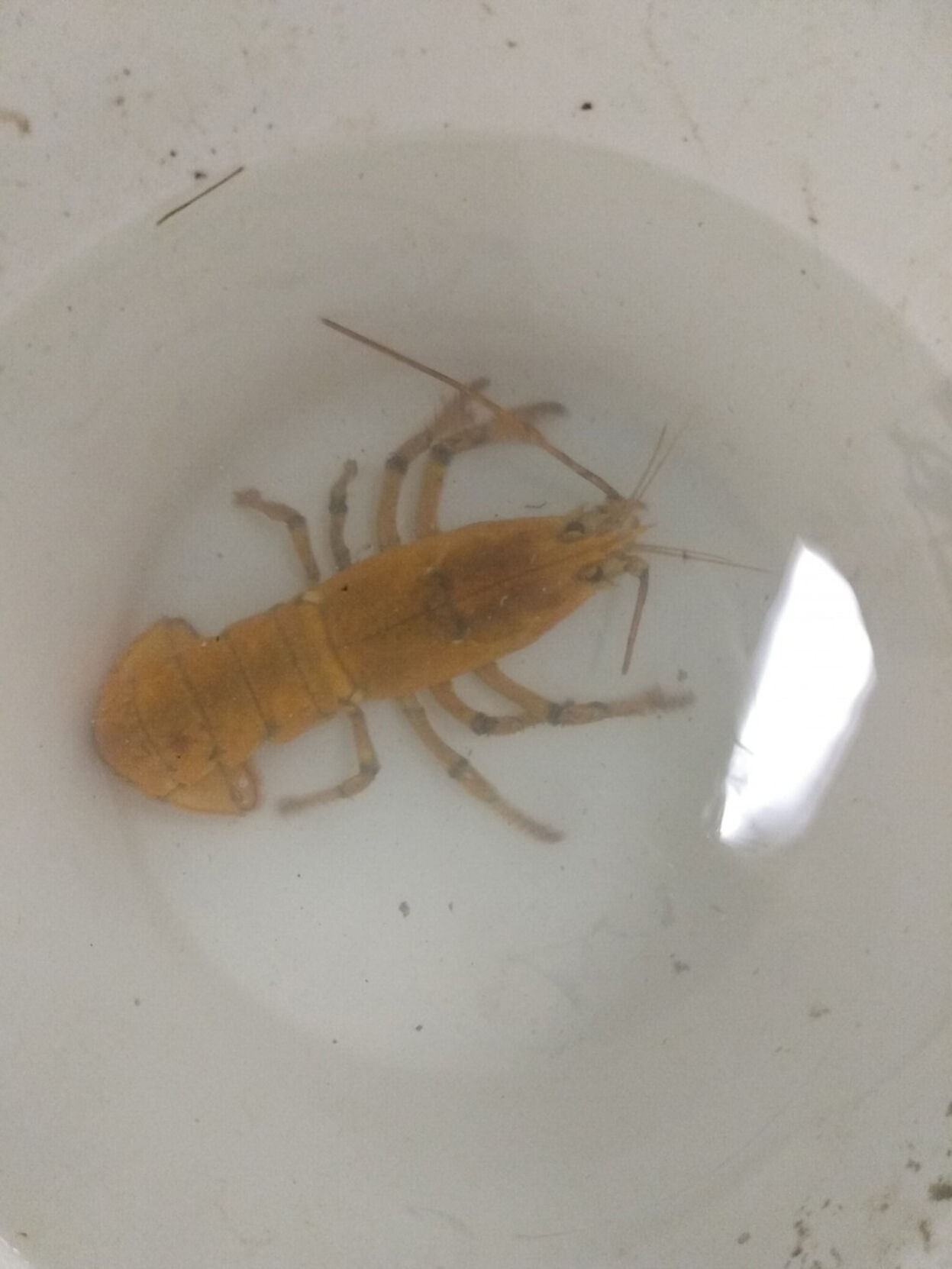
A rare yellow lobster has been caught off the coast of Maine and has been lovingly named Banana.
"UNE has cultivated strong connections with lobstermen and Maine DMR," Charles Tilburg, director of the School of Marine and Environmental Programs said in a statement. "It was through those connections that (researchers) learned about Banana and Lindsay was able to coordinate with Marley from there."
The University of New England is sharing an $860,000 grant from the National Science Foundation (NSF) with the Maine Department of Marine Resources, Bigelow Laboratory for Ocean Sciences, and Hood College in Maryland to study the impact that a warming Gulf of Maine is having on lobster larvae and their success in growing to adulthood.
"Banana is about a pound to a pound and a half and is settling in nicely here," Forrette said.
A Navy meteorologist lost his wallet in Antarctica and got it back 53 years later
Retired Navy meteorologist Paul Grisham had long forgotten the wallet he lost while stationed in Antarctica in 1968, so he was surprised when someone returned it to him two weeks ago -- 53 years later.
He was also surprised by how young he looked at his old ID card that was tucked inside.

Paul Grisham's wallet still had his ID card and other memorabilia from his service in Antarctica.
"It brought back memories, oh yeah. I had dark brown hair at the time," the 91-year-old said with a laugh.
Grisham said somebody found the wallet while demolishing some old buildings at McMurdo Station, including the building where he lived from 1967 to 1968.
The worn wallet is a time capsule of the 13 long months Grisham served in the Antarctic -- or "The Ice," as they called it. It held a beer ration card with 21 punches left, his motor vehicle operator's license, and a card with instructions for what to do in the event of a nuclear, chemical or biological attack.
"Thank God it was never used," Grisham said, adding that this was at the heart of the Cold War.

Paul Grisham holds the Navy ID card and the wallet he lost 53-years ago.
It also had a handwritten recipe for making homemade Kahlua liqueur.
Grisham never used that either (he's partial to gin martinis), but a lot of people have asked him for it after hearing his story.
Grisham was particularly busy during summer operations in Antarctica, monitoring the weather and providing reports for the airplanes and ships delivering personnel, equipment, and supplies.
"The entire station worked 12 (hours) on 12 off around the clock for a period of five months because there was so much to do" to get ready for the long, black winter, Grisham said.
There was a two-lane bowling alley, which was almost always in use, along with a small gym because it was too cold to safely exercise outside.
"McMurdo Station was in what we called the 'banana belt,' the temperature got up to about 25 degrees and I've seen it as cold as minus 65," he said. It got even colder as you went farther inland.
"It's almost inconceivable just how cold it is. It's almost impossible to describe to people who haven't been there," he said. "In fact, we spent a lot of time trying to figure out 'how do we explain this to the folks at home?' and we just never really came up with a good way to explain it."
He said it's 50 to 75 degrees colder than the North Pole and if you need a more tangible example, a soda can would freeze and burst open in 14 minutes if you left it outside.

Grisham, left, was promoted to lieutenant while serving in Antarctica.
"The one thing that really made life worth living down there was the people that were there," Grisham said. "We wintered 180 men and they were the most congenial, likable men that I ever had the pleasure to be around."
They played a lot of games during their downtime.
Grisham won a lot when they played poker and the wallet had a number of money order receipts from when he sent his winnings to his wife and young children. He was also good at chess but said there was one Russian scientist, who he just couldn't beat.
He said they didn't do much exploring outside the compound because of the extreme cold, but he did get to make the 850 mile trip to the South Pole while he was there.
Grisham also got to meet legendary explorer and mountain climber Sir Edmund Hillary, who picked his brain about the weather for about two hours before setting out on an expedition.
After his tour, he was able to get an assignment in San Diego, California, and later was assigned to an aircraft carrier in Vietnam.
He retired in 1977 after 25 years of service.
Grisham moved back to San Diego after marrying Carole Salazar, who he met in Paris in 2001 after his first wife died. They've been married for almost 18 years.
They said the family has had as much fun with this discovery as he has.
Granddaughter Christina Salazar said she was amazed when she first saw the wallet and thought it looked like he could still use it.
The 26-year-old said she's enjoyed his stories about his time in the Navy since she was a girl.
"Growing up, it was always my favorite to listen to him talk about the Emperor penguins that he would encounter," she said.
Now, she gets to hear about his adventures over one of his famous gin martinis.
"Anytime he has one nowadays, he claims it brings him back to his days on "The Ice," she said. "It's an honor to share a martini with him and listen to him talk endlessly about his time."
She said she learns something new about her grandpa every time he tells a story.
"He's still our go-to guy with any weather questions," Salazar said.
Correction: An earlier version of this story misspelled the last name of Paul Grisham.
Tennessee man leaves $5 million to pet border collie
NASHVILLE, Tenn. (AP) — It won't be a dog's life for a Tennessee canine whose owner recently died.
Lulu, an 8-year-old border collie, will be living the good life in Nashville after inheriting $5 million in her owner's will, WTVF-TV reported.
Martha Burton, Lulu's caretaker, told the station Lulu's owner, Bill Dorris, was a successful businessman who wasn't married and died late last year. His will states the money should be put into a trust for Lulu's care. It allows for Burton to be reimbursed for reasonable monthly expenses in the care of Lulu.
"He just really loved the dog," said Burton, who was friends with Dorris and would take care of the dog when he traveled.
She says she doesn't know if she could ever spend $5 million on Lulu.
"Well, I'd like to try," she said with a smile.
Dorris owned land along Interstate 65 where a controversial statue of Confederate Gen. Nathan Bedford Forrest is located. The fate of the statue and the rest of the estate may be determined in probate court, the news outlet reported.
The-CNN-Wire™ & © 2021 Cable News Network, Inc., a WarnerMedia Company. All rights reserved.


