Editor's note: This report is part of 'Hunting Clean Energy in the West,' a series by Lee Enterprises' Public Service Team Reporter Ted McDermott that examines efforts across the West to meet looming deadlines to decarbonize the region's power grid. Subsequent articles will examine hydrogen, wind and solar initiatives.
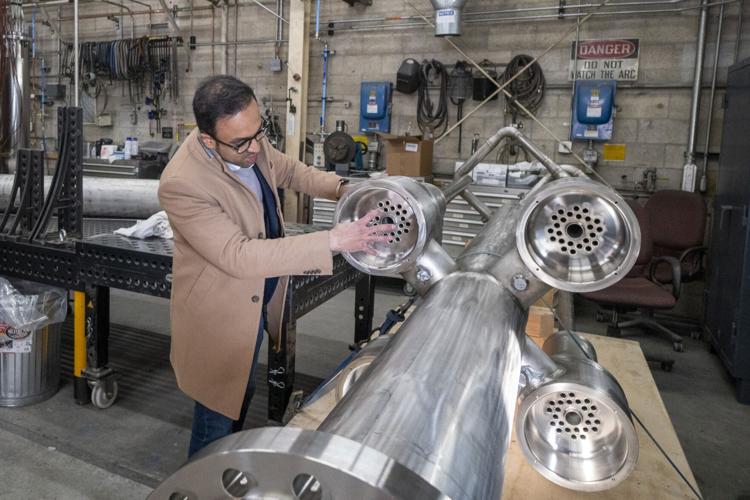
SCOVILLE, IDAHO — On a subzero December morning, the future of nuclear energy was lying on a plywood platform in a cinder-block building tucked inside a remote, heavily secured corner of the Idaho National Laboratory.
At least that’s how Yasir Arafat viewed the 12-foot-long system of stainless-steel pipes resting on its side next to him: as one of the first concrete steps toward deploying large numbers of small, cheap, safe and reliable reactors that could provide jobs, tax revenue and a stable foundation for the carbon pollution-free electricity sector that the United States government aims to create by 2035.
People are also reading…
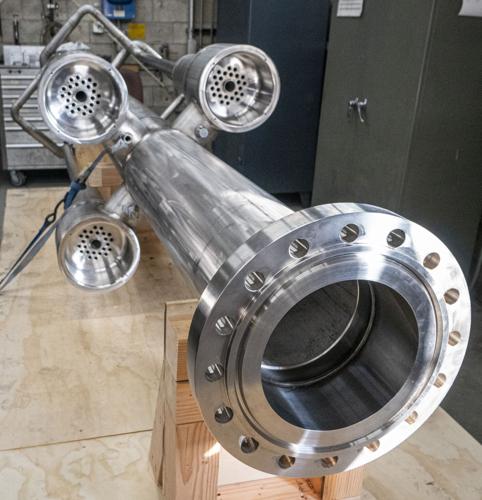
The PCAT — or the Primary Coolant Apparatus Test, as the object is officially known — is a full-scale model of a “microreactor” that Arafat has been designing for the U.S. government over the past few years and that he hopes to have producing power by early 2024.
Arafat, the 36-year-old chief designer and project lead for the U.S. Department of Energy’s Microreactor Applications Research Validation and Evaluation (MARVEL) project, isn’t the only nuclear engineer furiously working with government support to get new nuclear technology fired up and producing power.

Yasir Arafat, MARVEL chief designer and project lead, talks about the MARVEL microreactor PCAT prototype in the Materials and Fuels Complex’s machine shop Monday, Dec. 19, 2022, at the Idaho National Laboratory near Idaho Falls.
As part of its Advanced Reactor Demonstration Program, the U.S. Department of Energy has directed more than a billion dollars to Rockville, Maryland-based X-energy to pursue a high-temperature gas reactor that it hopes to begin operating near Richland, Washington, by 2028. Through the same program, the energy department awarded another nearly $2 billion to Bellevue, Washington-based, Bill Gates-fronted TerraPower, which has more than 600 engineers designing a sodium-cooled reactor that could start producing power in Kemmerer, Wyoming, as soon as 2030. About a half-billion dollars have also flowed from the federal government to Portland, Oregon-based NuScale Power, which is designing a small modular reactor called Voygr that’s slated to begin operations on Idaho National Laboratory land by 2029. Other companies are also pursuing new reactors with and without federal support.
The designs are all different — and the details are important — but they share a common feature: They are fundamentally different from the 92 commercial reactors that currently operate in 28 states.
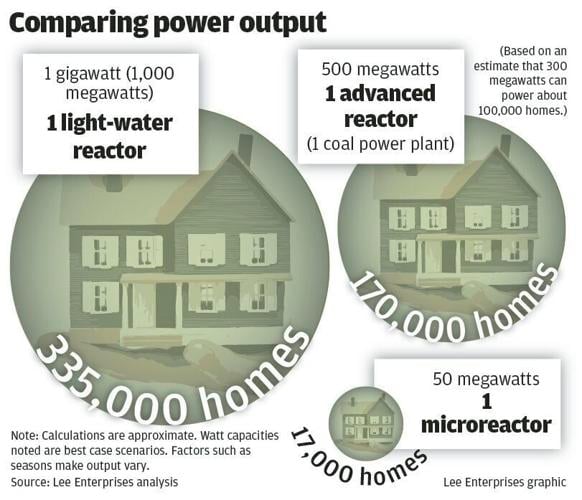
Those existing reactors are massive structures, built on-site from the ground up, relying on rods of relatively low-enriched uranium to produce an average of about 1 gigawatt of power and using water to keep the fission process cool enough to prevent a meltdown.
Combined, this relatively small reactor fleet accounts for almost 20 percent of the nation’s electricity. And it’s the kind of energy the country needs — the kind that produces no greenhouse-gas emissions — as the dangers of climate change come into clearer focus, as coal and gas plants shutter at a rapid pace and as local, state and federal governments pursue ambitious energy-transition goals.
But while existing nuclear plants currently account for about half of the nation’s coveted fossil-fuel-free electricity, they have their drawbacks. They are big, expensive, highly complex, prone to cost overruns and delays, and at risk of catastrophic meltdowns, like those that occurred in 2011 after a tsunami struck Fukushima, Japan. And safely storing their potentially dangerous waste is a huge problem that the country has not solved.
Because of these challenges and others, nuclear power has failed to take off, at least compared to some rosy predictions from the 20th century, when fission was envisioned as an almost inexhaustible source of cheap electricity that would power the future.
That's where the technologies being pursued at Idaho National Laboratory, X-energy, NuScale, Terrapower, and other private and public labs around the country come in.
They would offer a safer and more efficient path to expanding the supply of nuclear power, their designers claim. They would take advantage of factory production to be cheaper and faster to produce, their promoters argue. They would be deployable to more places and play a vital role in the broader clean-energy grid by providing a stable foundation for the solar, wind and hydropower that’s dependent on climatic conditions, government officials say. They would also be smaller and fit in neatly at retired coal plants, where they would reuse some of the same infrastructure and also rehire some of the same workers, advocates believe.
An Energy Department report released late last year found that 125 recently retired coal sites and 190 still-operating coal sites across the country are “amenable to host an advanced nuclear reactor.” If developed, the report claimed, these sites could have the capacity to produce over 260 gigawatts of electricity.
U.S. Energy Secretary Jennifer Granholm made the expansive case for new reactor technology in June of 2021 while heralding TerraPower’s decision to site its project in Kemmerer.
“The future of nuclear energy is here,” Granholm declared.
But while the federal government has put a multibillion-dollar bet on these so-called “advanced” and “small-modular” reactors, many of the nation’s leading nuclear experts have expressed doubt about whether this technology can really deliver safe, reliable, cost-effective and environmentally friendly power as well as jobs for workers in time to meet the government’s carbon-elimination goals.
And there are signs these naysayers may be right as cost projections increase, operation timelines incur delays, issues with fuel procurement arise and some municipalities back out of agreements to buy power from planned nuclear projects.
In November, a committee of “individuals chosen for their diverse perspectives and technical expertise” delivered a Congressionally mandated and Department of Energy-sponsored report to the National Academies of Sciences, Engineering, and Medicine on the merits, viability and waste aspects of advanced nuclear reactors. What they found, according to the text of the report, is that the advantages claimed by advanced-reactor developers and designers have been, in some cases, overstated or misstated — and that the government’s optimism about what can be achieved at current funding levels is mislaid.
“Different designs and associated fuel cycles have different potential benefits,” the authors state. “However, not one advanced reactor technology can concurrently provide for all the potential benefits relevant to the scope of this study.”
The authors also found that the development of such reactors will take more time and money than some advocates have claimed.
“Implementing just a few of the most promising reactor concepts and their associated fuel cycles at a large commercial scale would require substantial government and industry investments well beyond 2050,” the authors state.
One source of further delay could be a lack of access to the more highly enriched form of low-enriched uranium, known as HALEU, that the MARVEL, Natrium and Xe-100 will require. That fuel used to come from Russia, but since the war in Ukraine began, many companies have stopped importing that supply. TerraPower recently delayed the start of the Natrium reactor by at least two years, citing a lack of the fuel. X-energy, however, believes it will secure fuel in time to meet its planned start date.
While the government and reactor developers are working to create a domestic source of the fuel, the authors of the National Academies report cast doubt on whether a supply of this more highly enriched uranium can be found quickly, writing that “the United States will likely not have any significant reliable domestic supply of HALEU for at least one decade — maybe even longer.”
Allison Macfarlane, a member of the committee that authored the report and the former chairman of the Nuclear Regulatory Commission, believes these issues make it hard to envision that new forms of nuclear power will help address climate change over the next few decades.
“Nobody has anything to sell right now,” Macfarlane said of reactor developers.
With no reactors yet built and no electricity yet generated, developers are promoting the idea that they can fulfill the hope Granholm expressed: that they will disrupt, rethink and reinvent an industry plagued by delays, cost overruns and an inability to permanently and safely dispose of its radioactive waste.
Relatively few commercial reactors have been built with alternative forms of fuel and coolant like those being employed in the Natrium, Xe-100, MARVEL and other advanced reactor designs. A small number have been constructed in Russia and China in recent years, and the UK has eight gas-cooled reactors, but no commercial reactors using these alternative coolants are currently operating in the United States or elsewhere in Europe, despite efforts to bring them online. France abandoned plans for a large sodium-cooled reactor in 2019, after years of planning.
It’s not only reactors with alternative coolants that have struggled to thrive commercially. While the United States’ fleet of light-water reactors is larger than that of any other country, none have been added to the grid in three decades.
That will likely change this year, when a pair of Westinghouse AP1000 light-water reactors are expected to start producing commercial electricity in Georgia. But completion of the new reactors at Plant Vogtle in Georgia comes after a six-year delay and skyrocketing costs that put the project more than $16 billion over budget, with an estimated final cost above $30 billion.
While the Vogtle project was challenging, it worked out better than another AP1000 project in South Carolina, where developers spent $10 billion to begin construction of a nuclear power plant before abandoning it in 2017 due to ballooning costs and persistent delays.
The cost of the two projects led Westinghouse to file for bankruptcy. But the company’s design was supposed to inaugurate a revolutionary new era in the nuclear industry, one that upended the traditional way of constructing a nuclear reactor.
The “entirely new approach to nuclear unit construction,” as some Westinghouse officials described it, relied on a reproducible, standardized design that included “modules” that would be fabricated off-site, allowing “work to be done in parallel in multiple supplier shops rather than in sequence on the job sites.” The idea was to streamline the design and construction processes to make reactor construction faster, cheaper and reproducible.
But according to previous reporting, this modular approach had the opposite effect and was a key cause of Westinghouse’s delays and cost overruns in Georgia as well as its failure in South Carolina.

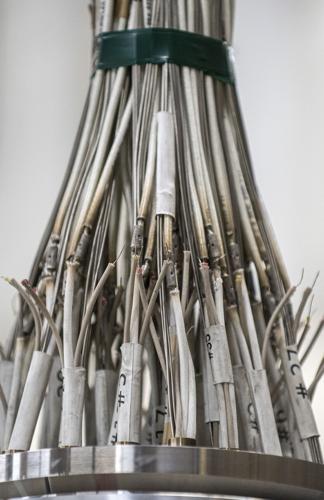
Wires are seen leading from the core of the MARVEL microreactor prototype Monday, Dec. 19, 2022, at the Idaho National Laboratory near Idaho Falls.
That hasn’t stopped other countries from ordering AP1000s, though. China already has four in operation and approved construction of six more last year. Ukraine has announced plans to add nine of the reactors, and Poland has ordered three more.
And the promise of prefabricated construction is at the heart of the argument for many of the planned new reactors.
Another selling point, advocates say, is the relatively small size of these planned reactors. MARVEL and other microreactors are being designed to fit on the back of a semi, allowing them to be deployed quickly and easily. They might replace diesel generators in off-grid locations or provide heat for industrial applications or even create power for troops at the front lines of a war. Advanced and small-modular reactors would also be suitable in more locations and for more uses.

The MARVEL microreactor prototype is seen on it's side in the Materials and Fuels Complex’s machine shop Monday, Dec. 19, 2022, at the Idaho National Laboratory near Idaho Falls.
But while a compact design has advantages, there are drawbacks. Light-water reactors like the AP1000 produce a gigawatt of electricity or more, while the new reactor designs the government is funding would produce significantly less power — at least initially.
The MARVEL microreactor, which Arafat believes will be built for about $50 million, would produce just 100 kilowatts of electricity. TerraPower’s Natrium reactor is expected to cost $4 billion and would produce 345 megawatts of electricity — about a third as much an AP1000 — from a single reactor in Wyoming. The Xe-100 slated for Washington has been designed as an 80-megawatt reactor that would be scaled to create what X-energy calls a 320-megawatt “four-pack” at an estimated cost of $2.4 billion. The NuScale reactor planned for Idaho would include six 77-megawatt modules, for a total of 462 megawatts, at a cost most recently estimated to be $9.3 billion.
Those prices are lower than the $15 billion spent on each AP1000 in Georgia, but the cost relative to the amount of power these smaller reactors produce could be higher. The cost per kilowatt will be roughly $13,000 for the AP1000s in Georgia, whereas NuScale’s new estimate works out to a price of about $20,000 per kilowatt.
But advocates argue that, wherever their costs begin, they will go down over time as their modular reactor designs are produced in greater quantities. TerraPower, for example, claims its Natrium reactors will cost $1 billion each after the first is complete.
They note that the first build of a reactor design will have to pass through the notoriously long and expensive licensing process of the Nuclear Regulatory Commission, whereas future iterations will already have that approval in hand. NuScale took an important step in that direction in January, when the NRC certified design of its 50-megawatt Voygr module. The commission, however, identified in November “several challenging and/or significant issues” with the 77-megawatt version slated for construction in Idaho.

In addition to overcoming such regulatory hurdles, later iterations of these new reactors are also expected to benefit from the increased learning and experience of workers and subcontractors and from manufacturing costs that will decline as more and more orders come in.
Ben Reinke, X-energy’s senior director for corporate strategy, said the path to such declining costs starts with design features in the Xe-100 and other advanced reactors that improve their safety while reducing their complexity.
“If you start with a reactor that can’t melt down, then you just don’t have many of the systems that otherwise would exist in a reactor. And that simplification leads to less steel and concrete, leads to a simpler design, leads to a simpler laydown, and the ability to really learn these things. So they’re far less custom, they’re much more replicated designs.”
That, he says, will allow his company to deploy modular reactors “in droves.” And they will be used, Reinke said, for more than just producing electricity.
X-energy has inked a deal with Dow Chemical to provide process heat and power to a manufacturing facility with a reactor. Reinke said this is one example of the potential that modular reactors have to be used by “a whole host of heavy industry that today does not have a good decarbonization strategy.” With their high heat outputs, he noted, advanced reactors could also be used to produce carbon-free hydrogen.
But some have raised doubts about whether this new technology will take off enough to begin reaping the rewards of mass production. Count M.V. Ramana, a scholar at the University of British Columbia, is among the skeptics.
Ramana has written extensively on the technical, operational and economic challenges of advanced and small-modular reactors, and he believes public investment in such technologies is ill-fated.
While Ramana expects a small number of reactors will be built “simply because the nuclear industry is so powerful,” he also believes “they’ll never be able to build them in numbers that are large enough to make any significant dent on the climate problem.”
His pessimism comes, in part, from what he describes as the nuclear industry’s long-standing inability to manage the “very dangerous” and “very complex” nature of reactor technology in a cost-effective and timely way. But it also comes from how much money and time has already been invested in advanced and small-modular reactors that are still in the planning and design phase.
The federal government’s initial investment came in 1999 when Congress appropriated $19 million to help the energy department to research advanced and small-modular reactors. Soon after, the department’s Office of Nuclear Energy determined that SMRs could be deployed “before the end of the decade, provided that certain technical and licensing issues are addressed.”
In the years since, the federal government has continued to spend money to support private firms’ efforts to bring advanced and modular technologies online quickly. Some of the firms that received significant money — including an Ohio-based firm called Babcock & Wilcox that received over $200 million from the Department of Energy and spent about half of that money — have already been dropped by their developers. But other private companies have continued to pursue their projects with federal support that continues to grow, even as advanced and small-modular reactors remain conceptual.
The Department of Energy has awarded $2 billion to TerraPower for the Natrium project in Kemmerer, $1.2 billion for the Xe-100 in Washington and $1.4 billion for the NuScale reactor in Idaho.
Last year, Congress passed the Inflation Reduction Act, which not only invested $700 million in developing a supply of HALEU but also gave a 30% tax credit for new carbon-free power plants — including nuclear ones — that come online in 2025 or later. The impact of those subsidies is significant. Of the NuScale Voygr’s $9.3 billion price tag, $4.2 billion is coming from energy department awards and Inflation Reduction Act credits.
But NuScale has struggled to keep its project on time, on budget and attractive to customers. The company is developing the project in partnership with the Utah Associated Municipal Power System (UAMPS), a nonprofit with 50 member utilities. Before NuScale can submit its application to build and operate Voygr to federal regulators, purchase agreements must be in place for all of the reactor's output. But as of January, purchase agreements were in place for only about a quarter of the reactor’s electricity, according to LaVarr Webb, a UAMPS spokesman. And the price of that power got higher in January, when the expected price per megawatt hour of electricity from the reactor went up from an estimated $58 to $89.
TerraPower has partnered with PacifiCorp, a utility with two million customers in six Western states, on its Natrium project. And while PacifiCorp has joined with TerraPower to study constructing five more reactors by 2035, the utility’s commitment to the project depends on it penciling out.
“PacifiCorp will only move forward with the project if it provides value to customers,” a spokesperson wrote in an email. “PacifiCorp will acquire the plant, subject to regulatory review and approval, only if performance, construction and operational conditions are satisfied.”
So while TerraPower currently expects the Natrium plant to cost $4 billion, with electricity costing between $50 and $60 per megawatt hour, PacifiCorp would reevaluate its commitment if the price tag rises, as has happened with NuScale.
The seemingly strong demand for nuclear’s firm, carbon-free power and the high cost of first-of-a-kind reactor technology has some wondering if the answer might be to build more of what has already been built: large light-water reactors.
Koroush Shirvan, an MIT professor who helps direct a reactor technology course for utility executives and is a principal investigator on a program with the Department of Energy’s Advanced Reactor Demonstration Program, believes the solution lies with the AP1000.
The reason he pushes for a technology that has struggled with cost overruns and delays is simple: the AP1000 has already experienced all the problems inherent to a brand new reactor design. Instead of starting over again with advanced and small-modular reactors, Shirvan believes we should reap the rewards of that costly investment in the AP1000, as China and some European countries are doing. And Shirvan has crunched the numbers, finding in a recent paper that “proposed SMRs feature substantially higher cost than large water reactors” like the AP1000.
And as the clock ticks on decarbonization deadlines, the urgency among government officials and private developers to bring new reactors to the market is mounting. And Arafat acknowledges it will be a hard road ahead.

Yasir Arafat, MARVEL chief designer and project lead, talks about reactor design Monday, Dec. 19, 2022, at the Idaho National Laboratory near Idaho Falls.
“I don’t want to undermine the challenges, the level and the amount of challenges that we have ahead of us,” said Arafat, who is currently a graduate student. “Otherwise, we would’ve been done by now. There’s going to be hundreds and thousands of challenges at different degrees of severity that we’re going to see in all of the projects because they’re all first-of-a-kind.”
But he’s optimistic these hurdles will be overcome swiftly and methodically, that the PCAT will be finished and shipped to a private contractor in Pennsylvania, where it will be filled with a sodium-potassium coolant, loaded with an electronic reactor designed to simulate a nuclear one and fired up early this year.
If it works — if the cooling system can keep the reactor core cool — and if they can secure a supply of HALEU in time, Arafat believes he and his colleagues will be on their way to turning on a brand-new kind of reactor sometime in early 2024. That, he believes, will help kickstart further progress in the field of micro, advanced and small-modular reactors.
“If we can pass on those learnings to commercial industry, we’re going to see a lot more innovation coming in,” Arafat said. “And from that perspective, I think MARVEL is probably the most important project in the nuclear space in the country.”
Lee Enterprises' journalists spent a day at the Idaho National Laboratory learning about nuclear energy and how it might change the way America looks at energy production in the future.
But it’s hard to know how the dominos will fall. And some worry what it will mean if the new reactors never become a reality in places like Kemmerer, where a pair of coal units are slated to retire in December 2025 and a gas unit is slated to close in 2029.
Shannon Anderson, staff attorney for the Powder River Basin Resource Council, believes “there's just too many unknowns right now for it to seem like a credible idea.” And while her group is focused on environmental issues, Anderson said she is less worried about the impact of mining and waste associated with an advanced reactor in her state than she is about the reactor never being built at all.
“There’s a community in Wyoming that’s really banking on this to happen, and it doesn’t seem like it actually will,” Anderson said.
But Bill Thek, Kemmerer’s mayor, sees things differently. He has no doubt that TerraPower will follow through on its pledge to get its Natrium reactor up and running as soon as a domestic supply of HALEU is secured, that it will bring some 2,000 construction jobs and 250 permanent jobs, and that a successful project in his town will pave the way for safer and cheaper nuclear power across the world.
“I’m not concerned about it all,” Thek said. “I absolutely believe that it is going to happen. It’s certainly what we’re told by TerraPower. And I believe that to be true.”
Reporter Ted McDermott may be reached at ted.mcdermott@lee.net
Editor’s note: This story has been changed to more accurately describe high assay low enriched uranium (HALEU), which is the highest enrichment level of low enriched uranium, not a highly enriched form of uranium.
Idaho National Laboratory looks to the future

The sun peeks around the dome of Experimental Breeder Reactor-II on Monday, Dec. 19, 2022, at the Idaho National Laboratory near Idaho Falls.

The entrance to the dome of Experimental Breeder Reactor-II is seen Monday, Dec. 19, 2022, at the Idaho National Laboratory near Idaho Falls.

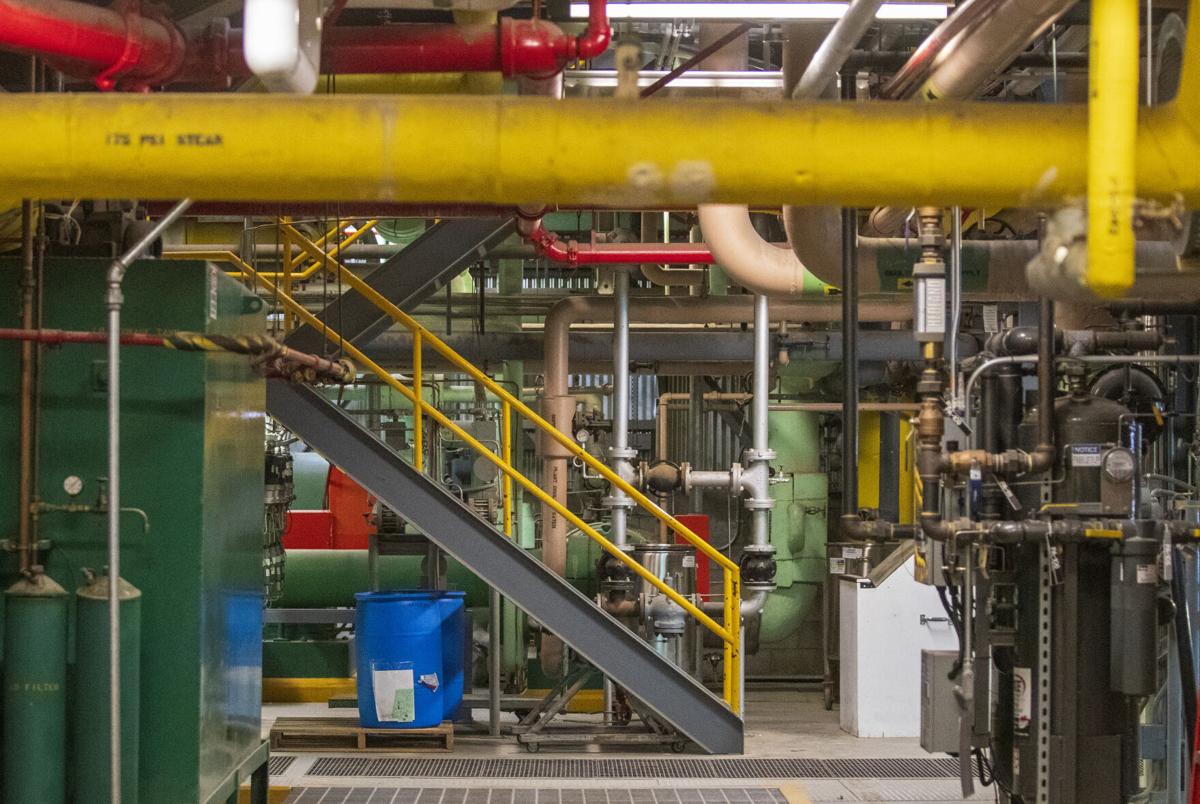
Piping is seen throughout the Energy Systems Laboratory on Monday, Dec. 19, 2022, in Idaho Falls.

Piyush Sabharwall, senior staff nuclear research scientist, talks about the future of energy Monday, Dec. 19, 2022, at the Center for Advanced Energy Studies in Idaho Falls.

Shannon Bragg-Sitton, director for the Integrated Energy & Storage Systems Division talks about her work Monday, Dec. 19, 2022, at the Energy Systems Laboratory in Idaho Falls.

The Materials and Fuels Complex Power Plant is seen along with the Experimental Breeder Reactor-II dome on Monday, Dec. 19, 2022, at the Idaho National Laboratory near Idaho Falls.
Yasir Arafat, MARVEL chief designer and project lead, talks about the MARVEL microreactor PCAT prototype in the Materials and Fuels Complex’s machine shop Monday, Dec. 19, 2022, at the Idaho National Laboratory near Idaho Falls.

The MARVEL microreactor prototype is seen on its side in the Materials and Fuels Complex’s machine shop Monday, Dec. 19, 2022, at the Idaho National Laboratory near Idaho Falls.
The MARVEL microreactor prototype is seen on it's side in the Materials and Fuels Complex’s machine shop Monday, Dec. 19, 2022, at the Idaho National Laboratory near Idaho Falls.

The Transient Reactor Test Facility is seen on a cold Monday, Dec. 19, 2022, at the Idaho National Laboratory near Idaho Falls.

Doug Crawford, director of the Transient Reactor Test Facility, talks about the facility and its functions Monday, Dec. 19, 2022, at the Idaho National Laboratory near Idaho Falls.

The top of the Transient Reactor Test Facility (TREAT) reactor is seen Monday, Dec. 19, 2022, at the Idaho National Laboratory near Idaho Falls.

The Transient Reactor Test Facility (TREAT) reactor is seen Monday, Dec. 19, 2022, at the Idaho National Laboratory near Idaho Falls. According to the Idaho National Laboratory website, "the Transient Reactor Test (TREAT) Facility is an air-cooled, graphite moderated, thermal spectrum nuclear test reactor designed to test reactor fuels and structural materials."

Piyush Sabharwall, senior staff nuclear research scientist, talks about the viability of nuclear energy Monday, Dec. 19, 2022, at the Center for Advanced Energy Studies in Idaho Falls.

Matt Evans, a communications lead, shares a laugh during a briefing Monday, Dec. 19, 2022, at the Center for Advanced Energy Studies in Idaho Falls.

Shannon Bragg-Sitton, director of the Integrated Energy and Storage Systems Division, talks about system integration Monday, Dec. 19, 2022, at the Energy Systems Laboratory in Idaho Falls.

A myriad of pipes are seen near the Experimental Breeder Reactor-II dome on Monday, Dec. 19, 2022, at the Idaho National Laboratory west of Idaho Falls.
Yasir Arafat, MARVEL chief designer and project lead, talks about reactor design Monday, Dec. 19, 2022, at the Idaho National Laboratory near Idaho Falls.

Derek Sommer, a manager at the Materials and Fuels Complex, talks about working as a team to bring a nuclear design to fruition Monday, Dec. 19, 2022, at the Idaho National Laboratory near Idaho Falls.
Wires are seen leading from the core of the MARVEL microreactor prototype Monday, Dec. 19, 2022, at the Idaho National Laboratory near Idaho Falls.

Wires are seen leading from the core of the MARVEL microreactor prototype Monday, Dec. 19, 2022, at the Idaho National Laboratory near Idaho Falls.

Doug Crawford, director of the Transient Reactor Test Facility, talks about the facility and its function Monday, Dec. 19, 2022, at the Idaho National Laboratory near Idaho Falls.

A section of the Idaho National Laboratory can be seen at sunrise Monday, Dec. 19, 2022, west of Idaho Falls.