

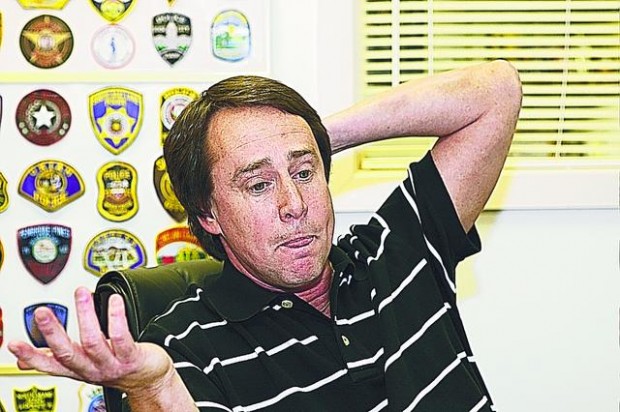
PHILADELPHIA — When he launched the first National Night Out in 1984, Matt A. Peskin envisioned an event in which people across America would turn on their lights and sit on their porches in a symbolic gesture to fight crime.
Peskin's idea quickly evolved into a night of coordinated neighborhood block parties. About 11,000 communities, including Tucson, celebrated National Night Out on Tuesday.
Little did Peskin imagine that his concept would grow and endure, thanks partly to federal subsidies of $2.7 million in the last 10 years.
And nobody imagined the event would reward Peskin so richly.
His organization, the National Association of Town Watch, devoted about a third of its budget in 2005 to pay Peskin a $255,000 salary and $42,000 in benefits, according to the group's most recent tax filings.
People are also reading…
According to the NonProfit Times, a business publication covering nonprofit management, the average salary for a charity with less than $1 million in annual revenue — the size of Peskin's organization — is about $70,000. Peskin's pay is in line with that of chief executives of large nonprofits with annual revenue greater than $50 million, according to the trade journal.
Peskin is paid more than any federal official other than the president, who makes $400,000. He is paid more than the governor of any state.
Personable and earnest, Peskin oversees a staff of one full-time employee and some seasonal part-time workers out of the Philadelphia offices.
"I can't go by what somebody else makes," said Peskin, 53, who got his start as the unpaid editor of the Lower Merion Town Watch newsletter. "I just go by what I think I deserve and the amount of time I put in. I think I do a good job. I'm the one who put all this together, put the concept together, sold it at the beginning."
The National Association of Town Watch is governed by a five-man board of directors that includes Peskin and his brother, Hal, whom the organization pays $28,000 a year for part-time assistance. The other board members are Peskin family friends with connections to Lower Merion, Pa.
"I'm not a big fan of gigantic boards," Peskin said.
The board chairman, Herbert M. Gross, 79, now retired to Florida, said that Peskin did the work of two people and that he was "more than worth" his salary.
One reason the association can afford to pay Peskin so handsomely is that American taxpayers subsidize about a third of his organization's $900,000 budget. The Justice Department last year gave Peskin's association a $296,000 crime-prevention grant.
While the grants for National Night Out are a fraction of the Bureau of Justice Assistance's annual $1.5 billion budget, the money continues to flow at a time when violent crime is increasing and local law enforcement officials complain about reductions in federal assistance.
Some studies indicate that neighborhood-watch programs are not effective at reducing crime because they do not fundamentally change the behavior of criminals.
Town Watch has "no effect on violent crime," said Lawrence W. Sherman, director of the Jerry Lee Center of Criminology at the University of Pennsylvania. "And events like National Night Out — one night of marching and protesting — there's zero evidence that works."
But there is zero evidence that political leaders or law enforcement officials are inclined to reduce support for neighborhood-watch groups.
"They sound good and feel good," Sherman said. "You organize a lot of people, and that's good, politically."
Peskin is confident of continued federal funding — the association spends $77,500 each year on a Washington communications firm, APCO Worldwide Inc., whose primary function, he said, is to secure the annual grant.
"Nobody will ever complain about our $300,000 in federal money for a program like this," he said. "They get the biggest bang for their buck for this program than any other grant they give. Three hundred thousand dollars for them? ... Congress, and state reps, they love this thing."
The leaders of several prominent town-watch organizations say the academic studies that downplay the effectiveness of neighborhood watch groups undervalue the importance of improving community relations with police.
"Neighborhood block clubs are making their blocks a better place to live," said John Bauman, who manages community crime-prevention programs for the Minneapolis Police Department. "Sometimes the studies miss that kind of qualitative stuff."


