

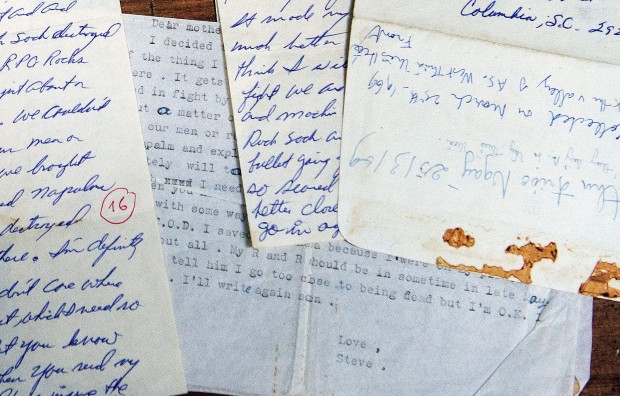
HANOI, Vietnam - "If Dad calls, tell him I got too close to being dead but I'm OK. I was real lucky. I'll write again soon."
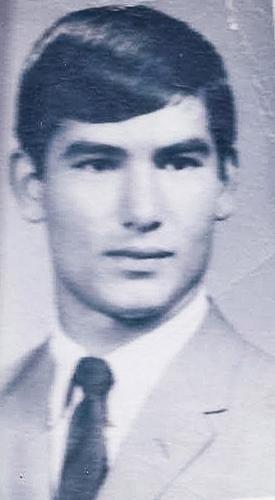
That poignant message never reached the mother of Army Sgt. Steve Flaherty. He was killed in Vietnam in 1969 before he could mail the letters he was carrying, including one he might have been writing when he died. The letters were taken by the Vietnamese after his death, U.S. officials said in releasing excerpts on Monday.
The letters, chronicling the carnage and exhaustion of war, were given to Defense Secretary Leon Panetta in exchange for a Vietnamese soldier's diary that was taken from his body by an American GI. The letters will be returned to Flaherty's family in South Carolina.
Vietnamese Defense Minister Phung Quang Thanh and Panetta made the exchange in a ceremony in which the Vietnamese also agreed to open three new sites in the country for excavation by the United States to search for troop remains from the war. Acidic soil in Vietnam erodes bones quickly, leaving in many cases only teeth for military teams to use to try to identify service members.
People are also reading…
Ron Ward, U.S. casualty resolution specialist at the Joint POW/MIA Accounting Command in Hanoi, said there are at least four U.S. troops believed to be lost in the three areas that are being opened. That leaves eight sites still restricted by the Vietnamese, he said.
Memories of the Vietnam War are fading for many Americans, and the war is the stuff of textbooks for others. But it is brought vividly alive in Sgt. Flaherty's letters.
Flaherty, who was with the 101st Airborne, was killed in the northern section of South Vietnam in March 1969. It's clear he saw some heavy combat.
"Our platoon started off with 35 men but winded up with 19 men when it was over," he tells his mother. "We lost platoon leader and whole squad."
Officials said parts of Flaherty's letters were read in propaganda broadcasts by the Vietnamese during the war.
This is the first time such a joint exchange of war artifacts has occurred, they said.
Vietnamese Col. Nguyen Phu Dat had kept Flaherty's letters, and last August he mentioned them in an online publication.
Early this year, Robert Destatte, a retired Defense Department employee who had worked for the POW/MIA office, noticed the publication, and the Pentagon began to work to get the letters back to Flaherty's family. Flaherty's sister-in-law, Martha Gibbons, 73, of Irmo, S.C., said she learned of the letters' existence about six weeks ago.
Gibbons said her husband met Flaherty when the boy was a 6-year-old living in a Japanese orphanage and her husband persuaded his mother, with whom they lived, to adopt the child. He grew up to be a well-liked, athletic boy, who dropped out of college to join the Army despite a baseball scholarship.
"He decided to enlist in the Army and go fight for his country in Vietnam, and he didn't make it back," said Kenneth L. Cannon, 80, of Prosperity, S.C., Flaherty's uncle. "It was very hard to take. It was hard."
Cannon said the family was told that he was in a field, taking a break to eat lunch or write letters.
"He never let us know how afraid and scared he was," Gibbons said. "He was in danger. We knew it was bad. We just didn't know how bad, I guess."
She's thrilled the information has been released.
"I had a very emotional morning all over again. But it was a wonderful emotion this time. It's good for both countries. It's good for all the soldiers who were killed for both countries."
Gibbons said the family would store the letters with Flaherty's medals, scrapbook and flag.
Defense officials reviewing the packet of papers given to Panetta said it appears there are three sets of letters, including the four written by Flaherty. It was not clear how many other service members' letters were there, but officials were going through them Monday
The small diary belonged to Vu Dinh Doan, a Vietnamese soldier who was killed in a machine gun fight, according to defense officials. They said a Marine, Robert "Ira" Frazure of Walla Walla, Wash., saw the diary - with a photo and some money inside - on the chest of the dead soldier and took it back to the United States.
The diary came to light earlier this year when the sister of a friend of Frazure's was doing research for a book and Frazure asked her help in returning the diary. The sister, Marge Scooter, brought the diary to the PBS television program "History Detectives."
The show then asked the Defense and State departments to help return the diary.
There are nearly 1,300 cases of troops still unaccounted for, and officers briefing Panetta said about 600 of those remains could be recoverable.
Letter excerpts
Here are some excerpts of Army Sgt. Steve Flaherty's letters:
Letter to "Betty"
"I'm sorry for not writing so long, but we have been in a fierce fight with N.V.A. We took in lots of casualties and death. It has been trying days for me and my men. We dragged more bodies of dead and wounded than I can ever want to forget."
"Thank you for your sweet card. It made my miserable day a much better one but I don't think I will ever forget the bloody fight we are having."
"RPG rockets and machine guns really tore my rucksack."
"I felt bullets going past me. I have never been so scared in my life. Well I better close for now before we go in again to take that hill."
Letter to "Mother"
"I definitely will take R&R, I don't care where so long as I get a rest, which I need so badly, soon. I'll let you know exact date."
"If Dad calls, tell him I got too close to being dead but I'm OK. I was real lucky. I'll write again soon."
"Our platoon started off with 35 men but winded up with 19 men when it was over. We lost platoon leader and whole squad."
"The NVA soldiers fought until they died and one even booby trapped himself and when we approached him, he blew himself up and took two of our men with him."
Letter to "Mrs. Wyatt"
"Our platoon leader was killed and I was the temporary platoon leader until we got the replacement. Nothing seems to go well for us but we'll take that ridge line."
"This is a dirty and cruel war but I'm sure people will understand the purpose of this war even though many of us might not agree."


