

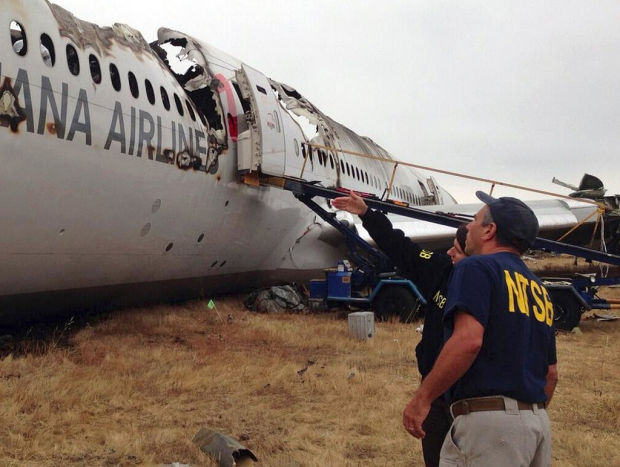
SOUTH SAN FRANCISCO, Calif. - The pilots of Asiana Flight 214 relied on automated cockpit equipment to control the jetliner's speed as they landed at San Francisco airport, but realized too late they were flying too low and too slowly before the aircraft crashed, investigators said Tuesday.
The new details were not conclusive about the cause of Saturday's crash, but they raised potential areas of focus: Was there a mistake made in setting the automatic speed control, did it malfunction or were the pilots not fully aware of what the plane was doing?
One of the most puzzling aspects of the crash has been why the wide-body Boeing 777 jet came in far too low and slow, clipping its landing gear and then its tail on a rocky seawall just short the runway. The crash killed two of the 307 people and injured scores of others, most not seriously.
Among those injured were two flight attendants in the back of the plane, who survived despite being thrown onto the runway when the plane slammed into the seawall and the tail broke off.
People are also reading…
National Transportation Safety Board Chairwoman Deborah Hersman said the training captain who was instructing the pilot flying the aircraft has told investigators he thought the autothrottle, similar to a car's cruise control, was programmed for a speed of 137 knots - the target speed the pilots had selected for how fast they wanted the plane to be flying when it crossed the runway threshold.
Instead, investigators said, the plane reached speeds as low as 103 knots and was in danger of stalling because it was losing lift before it hit the seawall.
The pilot told investigators he realized the autothrottle was not engaged just seconds before they hit. Their last-second efforts to rev the plane back up and abort the landing failed, although numerous survivors report hearing the engines roar just before impact.
"We just seemed to be flying in way too low. Last couple seconds before it happened the engines really revved into high gear. Just waaah! Like the captain was saying 'Oh no, we gotta get out of here.' And then, boom! The back end just lifted up, just really jolted everybody in their seats," said crash survivor Elliot Stone, owner of a martial arts studio.
Asked if the autothrottle was malfunctioning, Hersman said that is something investigators are looking into as they examine hundreds of parameters of data downloaded from the plane's flight data recorders.
An overreliance on automated cockpit systems has figured in dozens of air crashes and incidents in recent years.
A final determination on the cause of the crash is months away and Hersman cautioned against drawing any conclusions based on the information revealed so far.


