

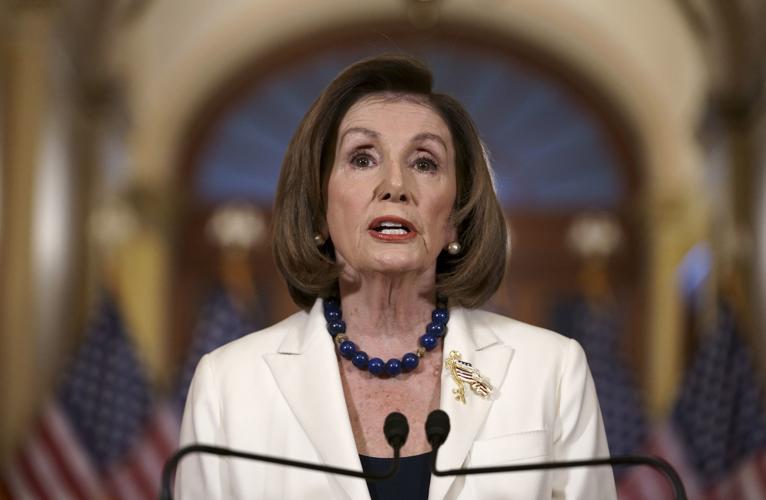
WASHINGTON — House Speaker Nancy Pelosi announced Thursday that the House is moving forward to draft articles of impeachment against President Donald Trump.
‘’Our democracy is what is at stake," Pelosi said. “The president leaves us no choice but to act.”
Pelosi delivered the historic announcement as Democrats push toward a vote, possibly before Christmas.

The House has released a sweeping report accusing President Donald Trump of "serious misconduct." Here's a look at some of the key points from…
With somber tones, drawing on the Constitution and the Founding Fathers, Pelosi stood at the speaker's office at the Capitol and said she was authorizing the drafting of formal charges “sadly but with confidence and humility.”
“The president's actions have seriously violated the Constitution,” she said. “He is trying to corrupt, once again, the election for his own benefit. The president has engaged in abuse of power, undermining our national security and jeopardizing the integrity of our elections.
People are also reading…
“Sadly, but with confidence and humility, with allegiance to our founders and a heart full of love for America, today I am asking our chairmen to proceed with articles of impeachment," she said.
At the heart of the impeachment probe is a July call with the president of Ukraine, in which Trump pressed the leader to investigate Democrats and political rival Joe Biden as Trump was withholding military aid to the country.

Richard Nixon resigned, but Congress never in American history has removed a president from office.
Trump tweeted that if Democrats “are going to impeach me, do it now, fast." He said he wants to get on to a “fair trial” in the Senate. The president also said that Democrats have “gone crazy."
At the White House, press secretary Stephanie Grisham tweeted that Pelosi and the Democrats “should be ashamed, then she, too, looked past the likely impeachment in the Democratic-controlled House to trial in the Republican-majority Senate.
The chairmen of the House committees conducting the impeachment inquiry will begin drafting the articles, and some lawmakers are expecting to remain in Washington over the weekend.
On Wednesday, Pelosi met behind closed doors with her Democratic caucus, asking, "Äre you ready?"
The answer was a resounding yes, according to those in the room.
Democrats are charging toward a vote on removing the 45th president, a situation Pelosi hoped to avoid but which now seems inevitable.
Three leading legal scholars testified Wednesday to the House Judiciary Committee that Trump’s attempts to have Ukraine investigate Democratic rivals are grounds for impeachment, bolstering the Democrats' case.
A fourth expert called by Republicans warned against rushing the process, arguing this would be the shortest of impeachment proceedings, with the “thinnest" record of evidence in modern times, setting a worrisome standard.
Trump is alleged to have abused the power of his office by putting personal political gain over national security interests, engaging in bribery by withholding $400 million in military aid Congress had approved for Ukraine, and then obstructing Congress by stonewalling the investigation.
Democrats in the House say the inquiry is a duty. Republican representatives say it's a sham. And quietly senators of both parties conferred on Wednesday, preparing for an eventual Trump trial.
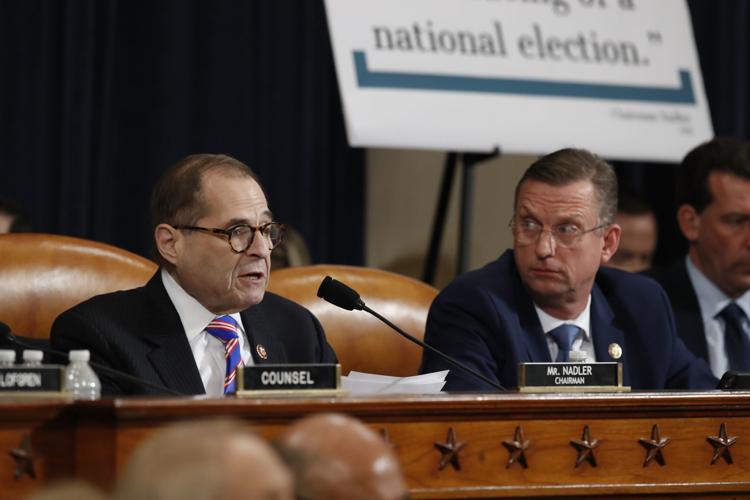
Rep. Jerrold Nadler, D-N.Y., chair of the Judiciary panel, which would draw up the articles of impeachment, said Trump's phone call seeking a “favor” from Ukrainian President Volodymyr Zelenskiy wasn’t the first time he had sought foreign help to influence an American election, noting Russian interference in 2016. He warned against inaction with a new campaign underway.
“We cannot wait for the election," he said. “ If we do not act to hold him in check, now, President Trump will almost certainly try again to solicit interference in the election for his personal political gain.”
Once an outsider to the GOP, Trump now has Republicans' unwavering support. They joined in his name-calling the Judiciary proceedings a “disgrace" and unfair, the dredging up of unfounded allegations as part of an effort to undo the 2016 election and remove him from office.
“You just don't like the guy,” Rep. Doug Collins of Georgia, the top Republican on the Judiciary panel, said Wednesday. Trump rewarded some of his allies with politically valuable presidential tweets as the daylong hearing dragged into the evening.
At their private meeting Wednesday, Democratic lawmakers also delivered a standing ovation to Rep. Adam Schiff, whose 300-page Intelligence Committee report cataloged potential grounds for impeachment, overwhelmingly indicating they want to continue to press the inquiry rather than slow its advance or call a halt for fear of political costs in next year's congressional elections.
Meanwhile, Trump's team fanned out across the Capitol with Vice President Mike Pence meeting with House Republicans and White House officials conferring with Senate Republicans to prepare for what could be the first presidential impeachment trial in a generation.
White House Counsel Pat Cipollone, who has declined for now to participate in the House proceedings, relayed Trump's hope that the impeachment effort can be stopped in the House and there will be no need for a Senate trial, which seems unlikely.
White House officials and others said Trump is eager to have his say. Sen. Roy Blunt, R-Mo., said, “He feels like he has had no opportunity to tell his side of the story."
Trump lambastes the impeachment probe daily and proclaims his innocence of any wrongdoing at length, but he has declined to testify before House hearings or answer questions in writing.
Based on two months of investigation sparked by a still-anonymous government whistleblower's complaint, the Intelligence Committee's impeachment report found that Trump "sought to undermine the integrity of the U.S. presidential election process and endangered U.S. national security.” When Congress began investigating, it says, Trump obstructed the investigation like no other president in history.
Republicans defended the president in a 123-page rebuttal claiming Trump never intended to pressure Ukraine when he asked for investigations of Biden and his son.
While liberal Democrats are pushing the party to incorporate the findings from former special counsel Robert Mueller’s report on Russian interference in the 2016 election and other actions by Trump, more centrist and moderate Democrats prefer to stick with the Ukraine matter as a simpler narrative that Americans understand.
Associated Press writers Matthew Daly, Zeke Miller, Alan Fram, Andrew Taylor, Colleen Long, Eric Tucker and Padmananda Rama contributed to this report.
'Everyone was in the loop': Takeaways from two weeks of impeachment hearings
Intro
WASHINGTON (AP) — President Donald Trump asked a foreign country to investigate a political rival as he enters his reelection campaign. That has been established almost beyond doubt. But Republicans and Democrats agree on little else as they engage in on only the fourth impeachment inquiry in the nation's history.
Here are key takeaways from two weeks of hearings.
This for that

Ambassador Gordon Sondland, U.S. Ambassador to the European Union, center, appears before the House Intelligence Committee on Capitol Hill in Washington, Wednesday, Nov. 20, 2019, during a public impeachment hearing of President Donald Trump's efforts to tie U.S. aid for Ukraine to investigations of his political opponents. (AP Photo/Andrew Harnik)
In the most anticipated testimony, Gordon Sondland, the European Union ambassador, repeatedly described the administration’s dealings with Ukraine as a quid pro quo — one thing in return for another.
“I know that members of this committee have frequently framed these complicated issues in the form of a simple question: Was there a `quid pro quo?’ As I testified previously, with regard to the requested White House call and White House meeting, the answer is yes,” Sondland said.
The deal, he said, involved arranging a White House visit for Ukraine’s new president, Volodymyr Zelenskiy, in return for Zelenskiy’s announcing investigations of Burisma, a Ukrainian gas company, and a discredited conspiracy theory that Ukraine had interfered in the 2016 U.S. presidential election. Democrat Joe Biden’s son Hunter was a Burisma board member.
That proposed arrangement was pushed by Rudy Giuliani, Trump’s personal lawyer, who conveyed Trump’s wishes to multiple administration officials.
But in testimony that Republicans sought to exploit, Sondland said no one ever told him military aid to Ukraine was contingent on the country announcing investigations — though he said he came to presume that was the case.
‘Everyone was in the loop’

Vice President Mike Pence delivers remarks to the Strada Education Network's National Symposium Welcome Reception in Indianapolis, Wednesday, Nov. 20, 2019. (AP Photo/Michael Conroy)
Sondland was central to Trump’s efforts to secure investigations by Ukraine.
But he insisted that this was no rogue effort, and he would not be a fall guy. He testified how officials across the government were aware of Trump’s demand that Ukraine commit to the investigations.
Those officials, he said, included Secretary of State Mike Pompeo and the White House’s acting chief of staff, Mick Mulvaney.
“Everyone,” Sondland said repeatedly, “was in the loop. It was no secret.” That also included Vice President Mike Pence, he said.
Marc Short, Pence’s chief of staff, disputed that account and said that Pence never spoke with Sondland “about investigating the Bidens, Burisma, or the conditional release of financial aid to Ukraine based upon potential investigations.”
In Brussels, Pompeo dismissed Sondland’s testimony, but didn’t comment on specifics.
‘Domestic political errand’

Former White House national security aide Fiona Hill, and David Holmes, a U.S. diplomat in Ukraine, right, testify before the House Intelligence Committee on Capitol Hill in Washington, Thursday, Nov. 21, 2019, during a public impeachment hearing of President Donald Trump's efforts to tie U.S. aid for Ukraine to investigations of his political opponents. (AP Photo/Manuel Balce Ceneta)
Fiona Hill, a former White House adviser and Russia expert, recounted a tense relationship with Sondland. If other people were supportive of the ambassador’s efforts, Hill very certainly was not among them.
Her testimony vividly outlined the diverging objectives of Trump’s official staff and parallel effort led by Giuliani that also involved Sondland.
“He was being involved in a domestic political errand,” Hill said of Sondland, “and we were being involved in national security foreign policy.”

In one June blowup, when Hill confronted Sondland over his assertion that he was in charge of Ukraine policy, he replied that Trump had given him authority. She was angry and irritated over the lack of coordination and warned him that “this is all going to blow up.”
“And,” she pointedly added, “here we are.”
What did Ukraine know, and when did it know it?

Deputy Assistant Secretary of Defense Laura Cooper testifies before the House Intelligence Committee on Capitol Hill in Washington, Wednesday, Nov. 20, 2019, during a public impeachment hearing of President Donald Trump's efforts to tie U.S. aid for Ukraine to investigations of his political opponents. (AP Photo/Andrew Harnik)
Sondland’s appearance dominated the day, but a Defense Department official named Laura Cooper provided her own subtly tantalizing testimony.
She revealed that Ukrainian Embassy officials had asked about military aid on July 25, earlier than previously known. That could undercut a Republican argument that there couldn’t have been a quid pro quo involving military aid because the Ukrainians didn’t know that the aid was being held up
She said she also has been recently informed that a Ukrainian Embassy contact had asked a member of her staff that same day “what was going on” with the aid.
The July 25 date is significant: it’s the same day Trump spoke by phone with Zelenskiy and pressed for an investigation of Joe Biden.
Cooper told lawmakers she "cannot say for certain" that Ukraine knew the money was being withheld, but she said “it's the recollection of my staff that they likely knew."
‘It’s Lieutenant Colonel Vindman, please’

National Security Council aide Lt. Col. Alexander Vindman departs after testifying before the House Intelligence Committee on Capitol Hill in Washington, Tuesday, Nov. 19, 2019, during a public impeachment hearing of President Donald Trump's efforts to tie U.S. aid for Ukraine to investigations of his political opponents. (AP Photo/Alex Brandon)
With those words, Alexander Vindman, an Army officer and Purple Heart recipient, sought to shut down Republican attacks on his credibility.
Republicans went after him, nonetheless.
Republican Rep. Chris Stewart called Vindman’s uniform a good reminder of his military service but also questioned why Vindman felt it necessary to wear it rather than a suit.
He wanted to know, too, if Vindman always insisted on being referred to by military rank rather than “Mr.” as he did in an exchange earlier with Rep. Devin Nunes, the committee’s top Republican. In that moment, he corrected Nunes and asked to be called “Lt. Col. Vindman, please.”
The committee attacks mirrored the combative approach of the White House, which used its official Twitter account to retweet attacks on Vindman, who continues to work at the White House.
Some Republican attacks struggled to land. After Rep. Jim Jordan suggested that Vindman’s peers questioned his judgment, Vindman read from a glowing performance review that called him “brilliant” and “unflappable.”
Other attacks, including from the White House’s director of social media, sought to imply that Vindman, a naturalized American citizen who was a toddler when his family fled Ukraine, may have dual loyalties.
Under questioning from GOP impeachment counsel Steve Castor, Vindman revealed that he was offered three times the post of Ukraine’s defense minister while attending Zelenskiy’s inauguration, but “immediately dismissed these offers.” He says he notified his chain of command and counterintelligence officials upon returning to the U.S.
Castor questioned whether that created the impression of a conflict, to which Vindman replied, “It's more important what my American chain of command thinks.”
‘Very intimidating’

Former U.S. Ambassador to Ukraine Marie Yovanovitch testifies before the House Intelligence Committee on Capitol Hill in Washington, Friday, Nov. 15, 2019, during the second public impeachment hearing of President Donald Trump's efforts to tie U.S. aid for Ukraine to investigations of his political opponents. (AP Photo/Alex Brandon)
The testimony of Marie Yovanovitch, the former U.S. ambassador to Ukraine who last spring was abruptly recalled from Kyiv and directed to return home on the next possible flight, was barely underway when Trump ridiculed her on Twitter, saying without evidence that things “turned bad” wherever she went during her decades-long career.
Yovanovitch left no doubt that she interpreted some of the Trump’s cryptic comments about her — “she’s going to go through some things,” he told Ukraine’s president in the July phone call — in the most chilling way.
“It didn’t sound good,” she said. “It sounded like a threat.”
She said the effect of the president’s comments “is very intimidating” not just for her but for others who might be similarly inclined root out corruption.
Rep. Adam Schiff, the Democratic chairman of the House intelligence committee, read Trump’s tweet to Yovanovitch and suggested it was part of a campaign of “witness intimidation.”
“Well, I want to let you know, Ambassador, that some of us here take witness intimidation very, very seriously.”
Trump, asked about it later, said, “I have the right to speak. I have freedom of speech.”
The 'big stuff’

David Holmes, a U.S. diplomat in Ukraine, testifies before the House Intelligence Committee on Capitol Hill in Washington, Thursday, Nov. 21, 2019, during a public impeachment hearing of President Donald Trump's efforts to tie U.S. aid for Ukraine to investigations of his political opponents. (AP Photo/Jose Luis Magana)
The July 26 lunch on an outdoor terrace in a Kyiv restaurant started out social enough. There was a bottle of wine and affable chatter about marketing strategies for Sondland’s hotel business.
Then, according to David Holmes, a counselor at the U.S. embassy in Kyiv, Sondland said he was going to call Trump to give him an update. The conversation Holmes overheard was loud — and memorable.
At one point, Holmes said, he heard Sondland tell Trump that Zelenskiy “loves your ass.”
“I then heard President Trump ask, ‘So, he’s gonna do the investigation?’ Ambassador Sondland replied that ‘he’s gonna do it.’” He said Sondland told Trump that Zelenskiy will do “anything you ask him to.”
When the call ended, Holmes said he asked Sondland if it was true that Trump did not “give a s--t about Ukraine.” Sondland said that it was indeed the case.
“I noted that there was ‘big stuff’ going on in Ukraine, like a war with Russia, and Ambassador Sondland replied that he meant ‘big stuff’ that benefits the president, like the ‘Biden investigation’ that Mr. Giuliani was pushing.”
‘Fictional narrative’

Russian President Vladimir Putin chairs a Security Council meeting at the Novo-Ogaryovo residence outside Moscow, Russia, Friday, Nov. 22, 2019. (Yekaterina Shtukina, Sputnik, Government Pool Photo via AP)
The British-born Hill is a Russia expert who’s written extensively on the Kremlin, and she made that clear from the outset when she scolded Republican lawmakers for propagating what she said was a “fictional narrative” — that somehow Ukraine, not Russia, interfered in the 2016 U.S. presidential election.
Those discredited theories have been advanced by Trump himself, who in a July 25 phone call at the center of the impeachment inquiry asked Ukraine’s leader to investigate the possibility.
Hill said the unwillingness by some to accept Russia’s role has profound consequences at a time when Russia’s security services have “geared up to repeat their interference in the 2020 election.” Putin, she said, deploys millions of dollars to “weaponize our own political opposition research and false narratives.”
“When we are consumed by partisan rancor, we cannot combat these external forces as they seek to divide us against each another, degrade our institutions, and destroy the faith of the American people in our democracy,” Hill said.
At another point, she implored impeachment investigators — and the country at large — to stop advancing fictions that she said distract from the attention needed to fight Russian interference.
“In the course of this investigation, I would ask that you please not promote politically driven falsehoods that so clearly advance Russian interests,” Hill said.
'It was crazy'

Top U.S. diplomat in Ukraine William Taylor appears before the House Intelligence Committee on Capitol Hill in Washington, Wednesday, Nov. 13, 2019, during the first public impeachment hearing of President Donald Trump's efforts to tie U.S. aid for Ukraine to investigations of his political opponents. (AP Photo/Andrew Harnik)
On the first day of hearings, Democrats called on William Taylor, a West Point graduate, Vietnam veteran and career diplomat who was recruited out of retirement to serve as a top diplomat in Ukraine.
Taylor was unsparing, and colorful, in his characterization of making military aid to Ukraine contingent on the country announcing investigations into the 2016 U.S. election.
He was presented with oversized images of a September text message exchange with two other envoys in which he said it would be “crazy” to withhold military assistance to Ukraine in exchange for that nation investigating Trump’s political rival.
Those text messages were the among the first documentary pieces of evidence to become public as part of the House impeachment inquiry and established not only the possible contours of a quid pro quo but also laid bare diplomatic concerns about the Trump administration’s dealings with Ukraine.
“It was counterproductive to all of what we had been trying to do, Taylor said. “It was illogical, it could not be explained, it was crazy.”


