


EDITOR'S NOTE — The anxiety surrounding college admissions has intensified sharply in recent years, as a growing number of students fight for slots in the most selective colleges. The trend is taking its toll on students emotionally and even physically. This is the final installment in an occasional series exploring the latest developments in the admissions game.
RICHMOND, Va. — Lucas S. Morales has what a lot of colleges are looking for.
He's smart for starters — with good grades, good test scores, and eight Advanced Placement courses.
He's male, at a time when many colleges are struggling to recruit boys. He's Hispanic. He comes from a low-population state, New Mexico, which would help most schools improve their geographic diversity.
So when the computers at college marketing and direct-mail outfits like Richmond-based Royall & Company come across students such as Morales, a personalized recruiting campaign ensues. Slick, carefully tailored brochures are printed and mailed.
People are also reading…
Following cues from students about how they communicate, colleges fire out e-mails, instant messages, phone calls and may even contact parents.
As they approach their senior year, even average high school students can acquire a box (and an inbox) full of college promotional materials. Students like Morales who perform well and also hit a demographic sweet spot get that much every week.
"There would just be a giant fistful of envelopes in the mailbox," said Morales, a senior at Mayfield High School in Las Cruces.
Room for nearly everybody
Colleges have always taken steps to sell themselves. But over the last decade, the scope and sophistication of college marketing have grown significantly.
For-profit schools were the first to imitate other types of businesses in treating prospective students like prospective customers.
But traditional, not-for-profit schools are catching up — and raising some concerns about whether they are going too far.
The average, private, four-year college spends more than $2,000 on marketing and recruiting for each student it successfully enrolls, according to a survey by Noel-Levitz, a college recruiting advisory firm.
Private college tuition rose 6 percent last year to an average of $22,218, according to the College Board.
Getting information to students "is not all bad by any means," said Don Hossler, a professor of education at Indiana University. But, he said, "the question that's increasingly getting kicked around in various circles is, 'Is there a point at which it becomes excessive, in terms of these dollars coming from some place?' "
The marketing explosion also reflects an important truth: Students are in demand.
The average acceptance rate for colleges nationally is 70 percent, and there is room for nearly everyone.
A "telecounselor" on the phone
The problem some educators see is that the ramped-up recruiting of the last decade has fueled anxiety and commercialized the selection process.
Critics also say colleges are interested in drumming up applications just so they can turn down more students. That makes them look more selective.
Many colleges, meanwhile, insist sophisticated marketing is necessary, effective — and actually good for students.
Barely half of students who enter a college earn a degree there within six years, notes Bill Royall, founder of the direct-mail company that bears his name.
Learning about colleges otherwise off their radar screens improves the chances of finding the right place.
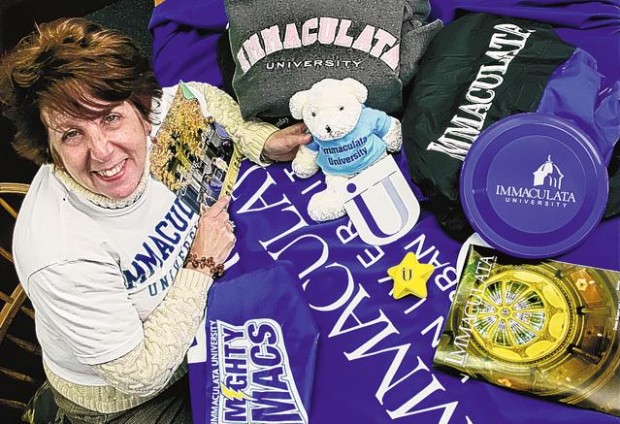
Immaculata University in Pennsylvania was a Roman Catholic women's school bringing in fewer than 100 students per year a few years ago.
In the fall of 2005, it enrolled its first class that included men. And in recent years it has transformed how it recruits.
The process starts with the purchase of about 100,000 names of prospective students. Printed materials play a big role, with about 10 mailings per year. But the college, near Philadelphia, is actually spending less on mail than it used to.
Much of the effort has shifted to blast e-mails, coordinated by a company called TargetX, and blogs. "Telecounselors" call prospective students and parents at home to tell them they may be eligible for scholarships.
The school doesn't give up easily.
"We don't let it go with just one," said Becky Bowlby, director of admissions for the college of undergraduate studies. If one pitch fails, the college will try a different approach. It seems to be working. The entering classes are up over 300.
Pamela Kiecker, Royall & Co.'s head of research, says students are focused on three key questions: What does it take to get in? Can I study what I want? And, what will it cost?
Getting that information to students requires hitting them with a range of electronic and print media. And it means reaching them early.
The company tells clients that contact with high school sophomores is particularly effective, especially for reaching two much-in-demand groups — minorities and students with high standardized test scores.
Morales, the Las Cruces student, said none of the material he got changed his top two choices: New Mexico State and Gettysburg College in Pennsylvania, a school he found on his own using a search tool to identify colleges strong in science and Japanese.
Still, the advertising barrage was a healthy reminder about impending deadlines.
"I can be lazy and not want to look at anything," he said. "All these letters coming in the mail forced me to consider my options."


