

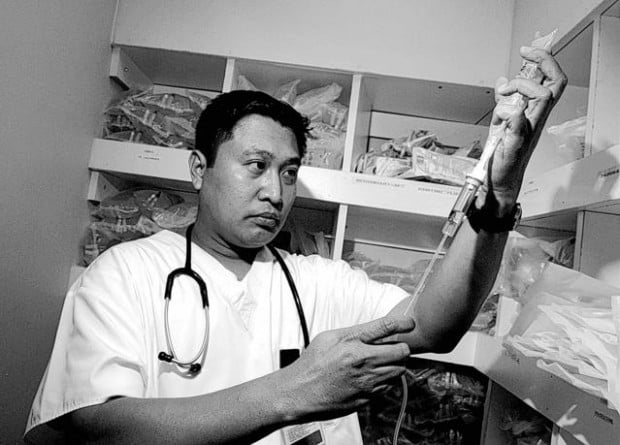
NEW YORK — The hospital lobby is a blur of surgical scrubs as a shift-change approaches. But when Elmer Jacinto slips in early in pressed whites and sneakers, he draws barely a glance from the guard behind the security desk.
It's 2:15 p.m. and soon he'll begin preparing IV drips and checking temperatures, tasks assigned to an entry-level nurse. Except for the fact that he's one of only two male nurses on the floor at St. Vincent's Midtown Hospital, he's just one of the girls. Well, here anyway.
But a world away, in his native Philippines, Jacinto remains at the center of a roiling controversy — a sellout to his critics, a paragon of hard work and admirable ambition to his supporters. Once upon a time, Elmer Jacinto was his nation's most promising young doctor. But doctors in the Philippines are not well paid, and so he boarded a plane to America.
People are also reading…
To make more money. To become … a nurse.
It hasn't worked out quite as he expected. Life in New York has proved exhausting and full of unforeseen pitfalls. And back home, many of his countrymen still find his choice difficult to accept, because the parable of Elmer Jacinto raises grim doubts about their future.
"Jacinto encapsulates perfectly the country's fundamental question today," one Filipino newspaper columnist opined. "Namely, why should anyone want to stay in it?"
On the Filipino island of Basilan, electricity is a sometimes event. Telephone lines deposit calls at dead ends. Both are blamed on the Abu Sayyaf, a Muslim extremist group with a reputation for violence. So when Jacinto graduated from high school there, eight years ago, he and his father set aside talk of dreams to examine reality. "There is money in nursing," the older man counseled.
Jacinto graduated first in his nursing class, and found work at the local hospital before leaving for a better-paying job in the city. In hindsight, the move seemed fated.
Co-worker slain
Not long after, Abu Sayyaf guerrillas stormed the hospital, taking nurses as hostages. One of Jacinto's former co-workers was killed during a shootout with Filipino soldiers.
But in Manila, Jacinto pushed ahead. He enrolled in medical school, rose to the top of his class, then joined 1,800 other aspiring doctors to take the national medical exam. When scores were out, Jacinto was the nation.s No. 1 young doctor.
Jacinto, though, was already making other plans. He set aside the goal of becoming a neurologist to work as a nurse in America for far greater pay.
His choice should not have been a surprise. Nearly a million Filipinos take jobs abroad each year. But now the Philippines was bleeding doctors.
Dr. Jaime Galvez Tan, a former minister of health, estimates that in the last five years, 9,000 Filipino doctors — out of about 56,000 — have retrained as nurses, and 5,000 have gone abroad. Some rural hospitals have few, if any, doctors and nurses, and care suffers.
Money is a major factor. A nurse in the Philippines makes $150 to $250 a month; doctors make $300 to $800. But the average registered nurse in the U.S. earns $4,000 a month.
The decision, though, remains intensely personal, and as an issue, it had generated limited attention — that is, until Jacinto set out to explain himself to a nation of 84 million.
Decision struck a nerve
In early 2004, Jacinto quietly began telling others of his plans.
"Even before he announced his decision, we already felt it was coming," says Reynaldo Olazo, dean of medicine at Our Lady of Fatima University. "It was I who brought it up because I could see his embarrassed smile."
Jacinto acknowledges wanting to draw attention to the shaky economic status of health-care workers as an issue too long ignored.
"Patriotism is a two-way process," he recalls thinking. "It's not only you as a citizen. It's also about the government that should also give you work, or something for yourself, to be able to live a dignified life."
His decision struck a nerve — and it was raw. Jacinto's story "was like a slap in the face," Tan says. "Even ordinary people that I would meet, it was like, 'Hey, what has happened to our country?' "
"Deplorable ambition," one newspaper proclaimed. Soon, his private decision was public property. "We cannot begrudge you, but only appeal to you to stay," a leading politician, Sen. Aquilino Pimentel Jr., said in a speech to Jacinto and nearly 950 other new doctors.
Exciting new world
A fellow doctor, Willie Ong, got to thinking. He wrote a "doctor's covenant," then convinced 1,800 physicians to sign it, pledging to remain in the country for three years.
But another 2,200 turned him down. So last year, Ong started the Movement of Idealistic and Nationalistic Doctors, or MIND, campaigning at medical schools to convince doctors to stay even before they become doctors.
Filipino lawmakers, too, found their way to the issue. They've proposed requiring all new nurses to serve in the Philippines for two to three years before being allowed to work overseas.
The question now is whether U.S. lawmakers will speed the exodus. When the Senate approved an immigration overhaul last summer, it included a measure allowing an unlimited number of foreign nurses to enter the country. If that change becomes law, "the Philippine health care system will bleed to death," Tan says.
By the time U.S. lawmakers had taken up the issue, though, Jacinto had already arrived.
On a Friday night in November 2005, a China Airlines jet touched down in New York. Twenty newly minted nurses walked down the gangway, and a recruiter met them.
Jacinto and seven others were sent to Avalon Gardens, a nursing home in Smithtown, N.Y., about 50 miles from Manhattan. For Jacinto, this new world was exciting, but alien. Yet the jarring adjustment was minor compared with problems that over time became increasingly troubling, he and other nurses allege. Their account is strongly disputed by the nursing-home operator.
A small, dingy home
The new employer, who had promised two months free housing, assigned eight nurses to a small, dingy home — a tight fit with three bedrooms and a single bathroom that did not always work. Jacinto and another man slept on pullout couches.
After a few weeks of doing clerical work, Jacinto and the other nurses say they were assigned to nursing duties but paid less than promised. By spring, they'd had enough. On April 7, Jacinto and 10 others quit. In all, 26 nurses left, including five trained as doctors.
It took just weeks for the nurses to find work, thanks to an insatiable health-care labor market. He and three others have settled into a spare, but spotless walk-up apartment. Once a month, he walks to the bakery and wires $500 to his parents back in Basilan.
The past year has been so tiring, he talks of remaining a nurse rather than trying to become a doctor in the United States. Still, Jacinto says he is finding a place for himself — and a sense of peace.
Back home, the expectation is "that you should become the model Filipino, doing it for your country. I want something for myself," Jacinto says. "I want to move on." He knows some in his homeland still judge him.
Well, he says, let them talk.


