

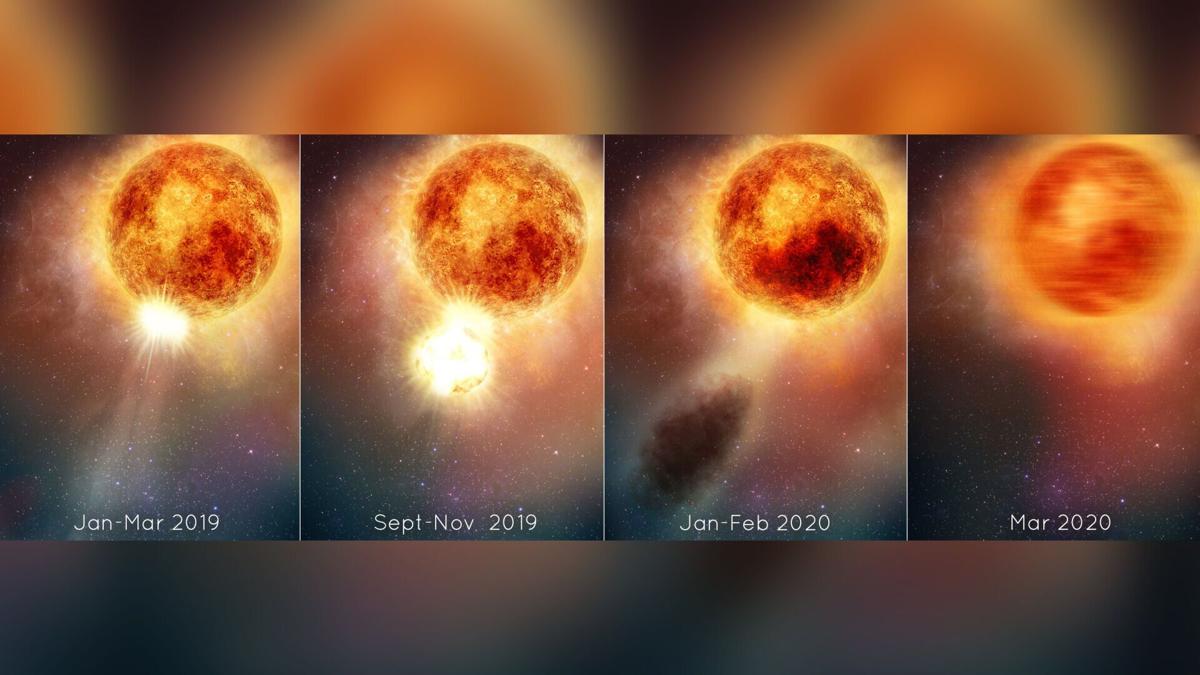
The red supergiant Betelgeuse, a colossal star in the Orion constellation, experienced a massive stellar eruption -- the likes of which have never been seen before, according to astronomers.
Betelgeuse first drew attention in late 2019 when the star, which glitters like a red gem in the upper-right shoulder of Orion, experienced an unexpected darkening. The supergiant continued to grow dim in 2020.
Some scientists speculated that the star would explode as a supernova, and they've been trying to determine what happened to it ever since.
Now, astronomers have analyzed data from the Hubble Space Telescope and other observatories, and they believe the star experienced a titanic surface mass ejection, losing a substantial part of its visible surface.
How would the explosion affect us?
"We've never before seen a huge mass ejection of the surface of a star. We are left with something going on that we don't completely understand," said Andrea Dupree, an astrophysicist at the Center for Astrophysics | Harvard & Smithsonian in Cambridge, Massachusetts, in a statement.
People are also reading…
"It's a totally new phenomenon that we can observe directly and resolve surface details with Hubble. We're watching stellar evolution in real time."
Our sun regularly experiences coronal mass ejections in which the star releases parts of its outer atmosphere, known as the corona. If this space weather hits Earth, it can have an impact on satellite-based communications and power grids.
But the surface mass ejection Betelgeuse experienced released more than 400 billion times as much mass as a typical coronal mass ejection from the sun.
The lifetime of a star
Observing Betelgeuse and its unusual behavior has allowed astronomers to watch what happens late in the lifetime of a star.
As Betelgeuse burns through fuel in its core, it has swollen to massive proportions, becoming a red supergiant. The massive star is 1 billion miles (1.6 billion kilometers) in diameter.
Ultimately, the star will explode in a supernova, an event that could be briefly visible during the daytime on Earth. Meanwhile, the star is experiencing some fiery temper tantrums.
The amount of mass that stars lose late in their lives as they burn through nuclear fusion can affect their survival, but even losing a significant amount of its surface mass isn't a sign that Betelgeuse is ready to blow, according to astronomers.
Astronomers such as Dupree have studied how the star behaved before, during and after the eruption in an effort to understand what happened.
Scientists believe that a convective plume, stretching more than 1 million miles (1.6 million kilometers) across, originated from inside the star. The plume created shocks and pulsations that triggered an eruption, peeling off a chunk of the star's outer shell called the photosphere.
The piece of Betelgeuse's photosphere, which weighed several times as much as the moon, was released into space. As the mass cooled, it formed a large dust cloud that blocked the star's light when viewed through telescopes on Earth.
Betelgeuse is one of the brightest stars in Earth's night sky, so its dimming -- which lasted for a few months -- was noticeable through observatories and backyard telescopes alike.
Recovering from the blast
Astronomers have measured Betelgeuse's rhythm for 200 years. This star's pulse is essentially a dimming and brightening cycle that restarts every 400 days. That pulse has ceased for now -- a testament to how consequential the eruption was.
Dupree believes that the star's interior convection cells that drive the pulsation are still reverberating from the blast and compared it to the sloshing of an unbalanced washing machine tub.
Telescope data has shown that the star's outer layer has returned to normal as Betelgeuse slowly recovers, but its surface remains springy while the photosphere rebuilds.
"Betelgeuse continues doing some very unusual things right now," Dupree said. "The interior is sort of bouncing."
Astronomers have never seen a star lose so much of its visible surface before, suggesting that surface mass ejections and coronal mass ejections could be two very different things.
Researchers will have more follow-up chances to observe the mass ejected from the star by using the James Webb Space Telescope, which could reveal additional clues through otherwise-invisible infrared light.
Photos: NASA releases Webb telescope images
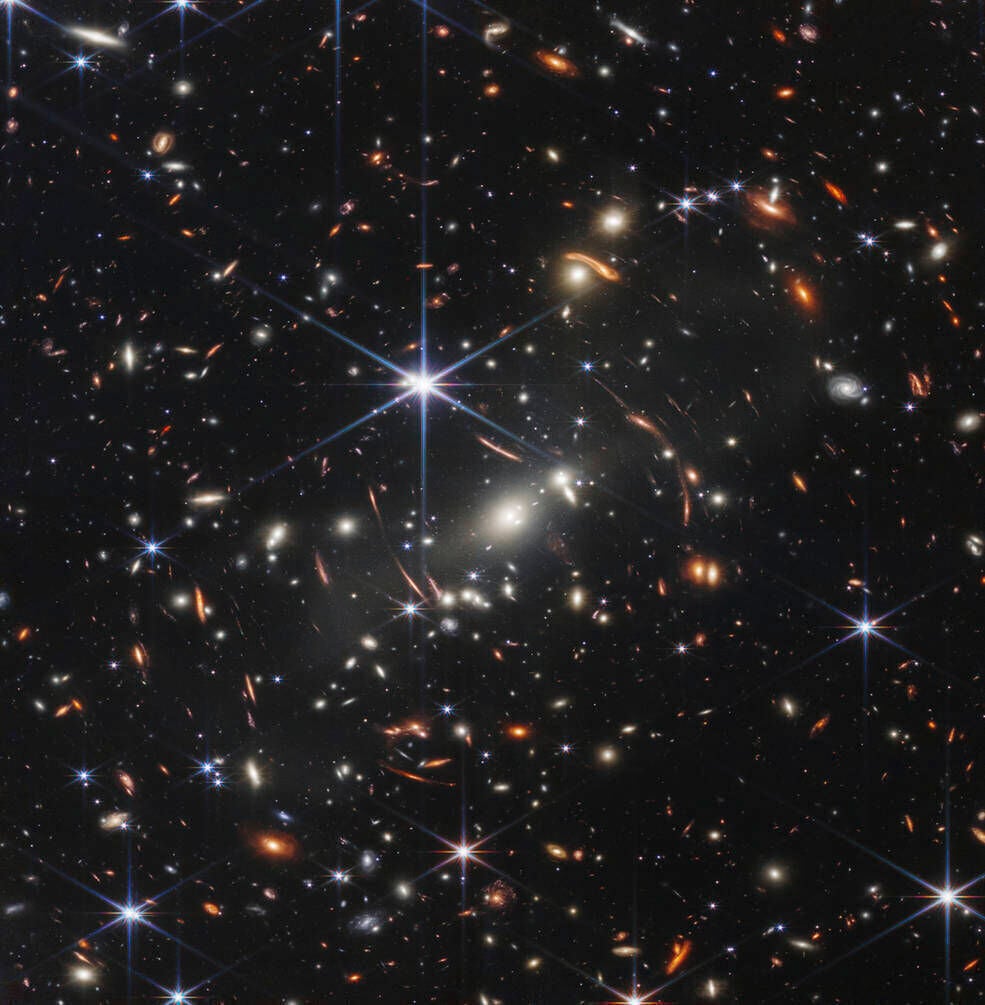
This image provided by NASA on Monday, July 11, 2022, shows galaxy cluster SMACS 0723, captured by the James Webb Space Telescope. The telescope is designed to peer back so far that scientists can get a glimpse of the dawn of the universe about 13.7 billion years ago and zoom in on closer cosmic objects, even our own solar system, with sharper focus.

This combo of images provided by NASA on Tuesday, July 12, 2022, shows a side-by-side comparison of observations of the Southern Ring Nebula in near-infrared light, at left, and mid-infrared light, at right, from the Webb Telescope.

This image released by NASA on Tuesday, July 12, 2022, shows the bright star at the center of NGC 3132 for the first time in near-infrared light.

This image provided by NASA on Tuesday, July 12, 2022, shows Stephan's Quintet, a visual grouping of five galaxies, as observed from the Webb Telescope. This mosaic was constructed from almost 1,000 separate image files, according to NASA.

This image provided by NASA on Tuesday, July 12, 2022, shows Stephan's Quintet, a visual grouping of five galaxies captured by the Webb Telescope's Mid-Infrared Instrument (MIRI).


This image released by NASA on Tuesday, July 12, 2022, shows the edge of a nearby, young, star-forming region NGC 3324 in the Carina Nebula. Captured in infrared light by the Near-Infrared Camera (NIRCam) on the James Webb Space Telescope, this image reveals previously obscured areas of star birth, according to NASA.

This image released by NASA on Tuesday, July 12, 2022, combined the capabilities of the James Webb Space Telescope's two cameras to create a never-before-seen view of a star-forming region in the Carina Nebula. Captured in infrared light by the Near-Infrared Camera (NIRCam) and Mid-Infrared Instrument (MIRI), this combined image reveals previously invisible areas of star birth.
The-CNN-Wire
™ & © 2022 Cable News Network, Inc., a WarnerMedia Company. All rights reserved.


