

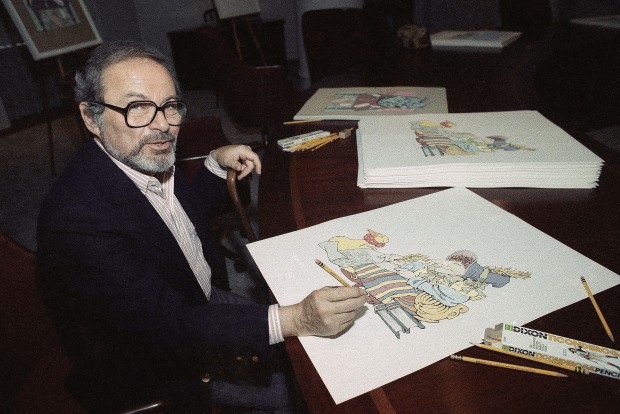
Maurice Sendak, an author and illustrator whose dozens of works, notably "Where the Wild Things Are," transformed children's literature from a gentle playscape into a medium to address the psychological intensity of growing up, died Tuesday at a hospital in Danbury, Conn., after a recent stroke.
His death at 83 was confirmed by Sandee Roston, executive director of publicity for HarperCollins Children's Books.
Sendak was shaped foremost by a sickly and homebound childhood in Depression-era Brooklyn, the deaths of family members in the Holocaust and vivid memories as a youngster reading about the kidnapping and murder of aviator Charles Lindbergh's infant son.
An admitted obsession with "children and their survival" and the "humongous heroism of children" fueled a career of groundbreaking darkness in children's literature.
People are also reading…
President Bill Clinton presented him with the National Medal of Arts in 1996, saying, "His books have helped children to explore and resolve their feelings of anger, boredom, fear, frustration and jealousy."
Sendak's illustrations were instantly recognizable, whether of a mischievous child in a wolf costume who tames minotaurs in a wild kingdom (from "Where the Wild Things Are") or of plump, red-nosed pastry chefs who fold children into their cake batter ("In the Night Kitchen"). His pen-and-ink drawings and watercolors - with their echoes of William Blake and Henri Matisse, among others - became the subject of numerous exhibitions.
Sendak illustrated more than 100 books, more than a dozen of which he also wrote. They were translated into dozens of languages and won almost every top honor in his profession, from the Caldecott Medal to the Hans Christian Andersen Award.
In addition, Sendak worked in film, television and opera.
His greatest achievement was to elevate the picture book "to an individual, contained art form that integrates words and illustration," said Cathryn M. Mercier, director of the Center for the Study of Children's Literature at Simmons College in Boston.
Mercier said the Sendak trilogy of "Where the Wild Things Are" (1963), "In the Night Kitchen" (1970) and "Outside Over There" (1981) "crashed open the gates" for what themes authors could address in children's literature.


