Veuer’s Elizabeth Keatinge tells us why the shipping container shortage may put a damper on holiday time.
The makers of some of the most popular toys in the United States sounded the alarm this past week about the global shipping crisis and labor shortages limiting their ability to keep stores stocked throughout the fall holiday shopping season.
Two leading toy company CEOs who recently spoke with CNN Business said they fear their supply chain woes and the resulting inflated prices will mean many children won't get the toys they want for Christmas. That's why they're warning parents to get their holiday shopping done early.
"There is going to be a major shortage of toy products this year," MGA Entertainment CEO Isaac Larian told CNN Business. "The demand is going to be there. What is not going to be there is the product to fill the demand."
People are also reading…
Keep scrolling to see how toys have changed over time
Larian's privately held company owns and distributes Little Tikes, Rainbow High dolls, Bratz dolls and LOL Surprise!, one of the hottest toy brands of the last few years and the top toy of 2020, according to NPD Group, a leading market research company.
He admitted to being "very frustrated" this week with shipping container companies such as Maersk, who he and other toy industry insiders accused of taking advantage of the global shortage on freight containers by dramatically raising their prices.
"The container that cost $3,200 last year is now $22,000," Larian said. "The installation of raw material and labor has gone up exponentially. We've seen a 23% increase in cost of product in China without the logistics. That is going to translate to higher prices with retail."

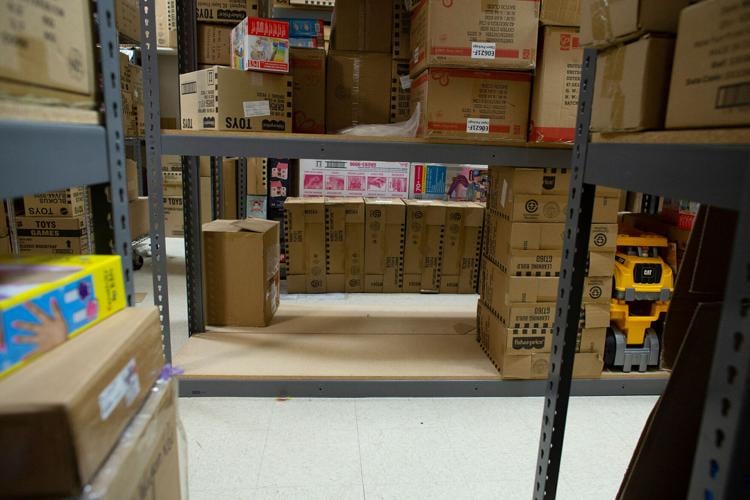
Empty shelves are seen at Mary Arnold Toys on August 2.
Even after paying more to get his products to US shores, Larian said a trucker shortage is preventing him from getting his toys into warehouses and ultimately onto store shelves.
"We've had hundreds of containers on 46 ships sitting in the ocean at the port of LA and Long Beach for the past 30 days," he said. "There are people to unload it, but there are not enough trucks to pick it up."
Basic Fun CEO Jay Foreman expressed a similar frustration this week. Foreman's privately held company owns and distributes Fisher Price toys, Tonka trucks, K'nex and Care Bears among other brands. He said some of his products have been stuck on shipping containers "when those containers can be found." Other Basic Fun toys, he said, are "stacking up" in factories in China, making it harder for him to keep stores stocked in the coming weeks.
"You're going to find various times during the holiday season where the store shelves are going to have empty holes in them," Foreman told CNN Business. "You're going to see constant outages of the key products that consumers are looking for."
A problem, big and small
Executives at Hasbro and Mattel, two of the three largest toymakers in the world along with Lego, told analysts in late July that their companies have secured enough shipping containers to keep up with demand this holiday season, even though they'll have to raise prices to compensate for higher shipping costs.
Consumers can expect price increases of 5% to 10%, according to toy industry insider Jim Silver, CEO of Toys, Tots, Pets & More, a leading consumer video review site.
"We have the inventories to meet the demand that we need for the second half of the year," Hasbro CEO Brian Goldner said during the company's latest earnings call. "It's a little different than past years where direct import could play a bigger role than it has in the past. But again, working with our retailers around the world, we feel, most importantly, we want to meet the high demand."

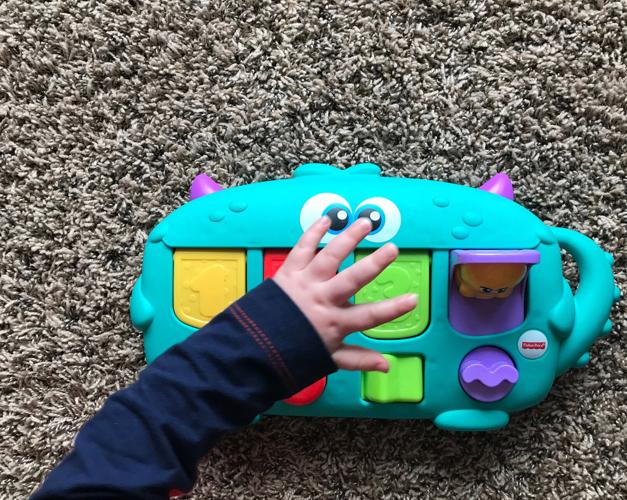
A child plays with Fisher-Price Monster Pop-Up Surprise in Tiffin, Iowa in 2019.
The toy industry landscape is yet another example of the largest companies winning big and smaller companies losing out during the pandemic recovery, according to industry analyst Neil Saunders, managing director of the retail segment for GlobalData. Saunders said shipping companies cater more to their largest clients, including toymakers Hasbro and Mattel and retail giants Walmart, Target and Amazon.
"The bigger companies that have more money, more economic clout because they place more orders, definitely have more scope to mitigate [supply chain constraints]," Saunders told CNN Business. "Smaller chains just don't have that economic power."
Both Foreman and Larian expressed doubt that even the largest toy makers can keep up with holiday season demand this year due to supply chain limitations.
"Whoever is telling you it's only the small toy companies' problem is full of it," Larian said. "MGA is the fourth-largest toy company. We are not small. The beauty of MGA is we are private, so I can talk to you openly."
Toy sales have continued to flourish throughout the pandemic as parents turn to dolls, Legos and board games to keep their kids entertained while many have been forced to spend more time at home. Pandemic conditions and stimulus money from the federal government resulted in a holiday sales boom last year. James Zahn, senior editor of "Toy Insider," a leading trade publication, said he expects similar success this year provided the Delta variant doesn't force retailers to shutter and stores can keep toys stocked.
"Families have money to spend, and if the toys are available, they're going to buy them," Zahn told CNN Business. "No matter what, kids will still play and parents will do whatever they can to do right by their kids."
***
Evolution of play: How toys have changed over time
Evolution of play: How toys have changed over time

Kids love toys and always have. The earliest toys date back to 4000 B.C. and were made of natural materials like sticks, rocks, and stone. Some children even played with animal bones. Throughout the centuries and decades, children’s toys have evolved. Natural materials gave way to plastic. The invention of talking toys, video game consoles, and tablets brought technology to the forefront of the toy industry and forever changed the way children play.
By examining the history of childhood play and development, Lovevery compiled a list of 15 toys, games, and devices to show how children’s play has evolved.
The toys on this list include an iconic puzzle that every ’80s kid tried to solve, an accidental invention from a cleaning compound, and a toy that started out as art therapy and allowed kids to express themselves and get messy. They represent more than 200 years of play and joy. Each toy helps children build or reinforce a necessary childhood skill such as imagination, creativity, fine motor skills, and self-control. Many of these toys still exist today, though in an advanced, updated form.
Join Lovevery as it brings you the evolution of play with a thought-provoking review of toys throughout history.
1817: The kaleidoscope

Invented by Scottish scientist David Brewster, the first kaleidoscopes were made of metal and brass and were all the rage in London, not only with children, but with adults as well. The picture tubes fueled creativity and allowed people to see wondrous works of art by peering into the tube. Besides being mesmerizing, kaleidoscopes can be used to teach children about scientific principles such as the reflection of light.
1899: Martha Chase dolls

Being the wife of a physician and a seamstress helped Martha Jenks Chase in the pursuit of her doll-making venture. Put off by the hard and heavy European dolls, Chase’s dolls were soft and inspired children to truly treat their dolls like babies. She also disliked mechanical American dolls because she felt like the technology hampered children’s imaginations when it came to playing. A 2020 study conducted by Cardiff University neuroscientists and Barbie found evidence to support the fact that playing with dolls stimulates parts of the brain that have to do with feelings of empathy and social information processing.
1915: Raggedy Ann dolls

An artist and illustrator, Johnny Gruelle received a patent for the Raggedy Ann doll in 1915. Gruelle’s daughter Marcella, who may have played a role in the inspiration of the doll, died at 13. While Raggedy Ann was created as a doll, she was first brought to the public’s attention in 1918 in a series of stories written by Gruelle that taught children lessons about kindness.
1923: Radio Flyer wagon

This popular and beloved wagon conjures up images of parents carting their children around their neighborhoods. Many young children used the mobile wagon to help them with their paper routes, creating industrious entrepreneurs. The steel wagons were created by Italian immigrant Antonio Pasin.
1929: Pop-up books

While pop-up books have been around since the 14th century, S. Louis Giraud and Theodore Brown published the first in a series of pop-ups, the “Daily Express Children’s Annual No. 1” in 1929. The books breathed new life into reading by bringing three-dimensionality to young readers everywhere.
1936: Finger paint

Ruth Faison Shaw, an American teacher, developed finger painting as an art education form of child therapy. Her book “Finger Painting, a Perfect Medium for Self-Expression” focused on letting kids be kids even if it was messy. The theory caught on, and finger painting became and remained wildly popular, allowing kids everywhere to express themselves in a creative and fun way.
1949: Legos

First created as a set of red and white blocks that interlocked, Legos were the idea of Ole Kirk Christiansen, a Danish carpenter. Lego, which means “play well,” is taken from the Danish phrase “leg godt.” The plastic toys were not actually patented until 1958. Playing with Legos, or other types of blocks, can help children develop fine motor and spacial skills, and experts also believe block play may serve as a foundation for STEM learning.
1955: Fashion dolls

Modern fashion dolls got their start with the German fashion doll Bild Lilli, which was marketed toward adults. Toy company Mattel acquired rights for the doll, renamed her “Barbie” and began selling her in 1959. Controversy has followed Barbie throughout the years, but overall, the doll encourages imaginative play and is even considered to be a role model by many. In the past several years, the doll’s body dimensions and appearance have shifted to become more inclusive, and Barbies with more diverse backgrounds, interests, and accomplishments have been introduced.
1955: Play-doh

This modeling compound accidentally became a bestselling children’s toy that is still wildly popular. Not only does this soft, malleable clay foster creativity and imagination, but it also helps with fine motor skills and muscle development in the fingers and hands.
1964: Action figures

The G.I. Joe doll was considered the first action figure and marketed by Hasbro to young boys as their version of Barbie. The “real American hero” also inspired a television show, and boys could be found playing right along with their sisters. More action figures would pop up throughout the years and would often be tied to pop culture. G.I. Joe played a major role in eliminating, or at least lessening the stigma people have regarding boys playing with dolls.
1972: Video game console

Atari, a video game console created by Ted Dabney and Nolan Bushnell, and the Magnavox Odyssey, were both introduced in 1972. While video game systems remain popular, they often get a bad rap. Studies have shown, however, that video games actually improve hand-eye coordination and reaction time.
1974: Rubik’s Cube

Though invented by Ernö Rubik in the ’70s, this three-dimensional, color-coded puzzle became iconic in the 1980s. Worldwide cubing competitions still exist, and the puzzle isn’t just for entertainment. It helps develop spatial awareness, as well as with principles of math and science, and is generally a useful tool in STEM education.
1983: Tumbling tower

With the invention of Jenga, a game where players stack and pull blocks from a tower, kids and parents got to play a fun, though often stressful, game. Other building towers have popped up and even made their way into education. They are particularly useful as a sensory tool to improve fine-motor skills and manual dexterity, and can help teach kids about self-control and patience.
2000s: Electronic tablets

The first electronic tablet was actually invented in the 1960s, sort of. Alan Kay and his colleagues at the Xerox Palo Alto Research Centre came up with the idea for the Dynabook in 1968, and it was intended to function as a typewriter, an art tool, and a musical instrument. The Dynabook was never developed, though in the decades since many companies have created advanced versions of the electronic kid’s tablet including Amazon, Apple, and LeapFrog.
Mid-2000s and on: STEM coding toys

With the rise of electronics, especially as educational tools, emphasis has been placed on digital literacy. Children can now learn not only how to use electronic devices, but how to program them as well. These toys can be both basic and advanced, and they help kids focus on developing their science, technology, engineering and math skills.
However, while tablets and other electronic devices offer tools that could be beneficial from a learning standpoint, experts advocate limiting screen time for babies and for young children. The World Health Organization recommends that babies under 18 months are not exposed to screens at all and suggests children under 5 should not have more than an hour a day of screen time, but that less is even better. A 2019 study published in JAMA Pediatrics found that the brains of children who spent more time in front of screens had decreased levels of the white matter that aids in the development of cognitive, language, and literacy skills.
Montessori principles veer away from introducing screens to babies and elementary school-aged children altogether. In today's world, limiting technology altogether can be a challenge for parents, so setting specific restrictions around screen-based activities is recommended.
This story was produced and distributed in partnership with Stacker Studio.
The-CNN-Wire
™ & © 2021 Cable News Network, Inc., a WarnerMedia Company. All rights reserved.