

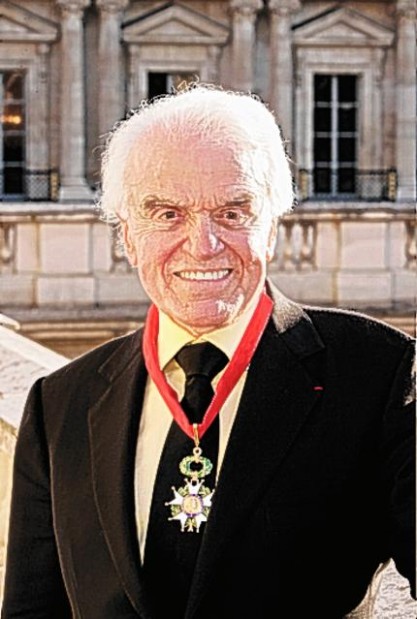
LOS ANGELES — Jack Valenti, the former White House aide and film industry lobbyist who instituted the modern movie ratings system and guided Hollywood from the censorship era to the digital age, died Thursday. He was 85.
Valenti had a stroke in March and was hospitalized for several weeks at Johns Hopkins University Medical Center in Baltimore.
He died of complications from the stroke at his Washington, D.C., home, said Seth Oster of the Motion Picture Association of America.
"In a sometimes unreasonable business, Jack Valenti was a giant voice of reason," Steven Spielberg said in a statement. "He was the greatest ambassador Hollywood has ever known, and I will value his wisdom and friendship for all time."
Valenti was a special assistant and confidant to President Lyndon Johnson when he was lured to Hollywood in 1966 by movie moguls Lew Wasserman and Arthur Krim.
People are also reading…
When he took over as president of the Motion Picture Association of America, Valenti was caught between Hollywood's outdated system of self-censorship and the liberal cultural explosion taking place in America.
Valenti abolished the industry's restrictive Hays Code, which prohibited explicit violence and frank treatment of sex, and in 1968 oversaw creation of today's letter-based ratings system.
"While I believe that every director, studio has the right to make the movies they want to make, everybody else has a right not to watch it," Valenti told The Associated Press shortly before his retirement in 2004. "All we do is give advance cautionary warnings and say this is what we think is in this movie."
Dan Glickman, his successor at the MPAA, said Thursday that Valenti embodied the "theatricality" of the industry.
"Jack was a showman, a gentleman, an orator, and a passionate champion of this country, its movies, and the enduring freedoms that made both so important to this world," Glickman said in a statement.
Valenti's Washington career was born from tragedy. As a Texas-based political consultant working for then-Vice President Johnson, Valenti was riding in the presidential motorcade on Nov. 22, 1963, when President John F. Kennedy was assassinated in Dallas. Valenti, six cars behind the president, initially didn't know what happened.
"Without a trace of warning, the car in front of us accelerated from eight miles an hour to eighty," he wrote in his memoir, "This Time, This Place," to be published in June. "The whole spectacle turned bizarre, like an arcade game run amok, as we drove madly toward or away from some unnamed terror."
Born in Houston, the grandson of Sicilian immigrants, Valenti swept floors and made popcorn in a local theater as a boy. He never lost his wonder at what he called the "miraculous, unfathomable alchemy" of moviemaking.
After earning the Distinguished Flying Cross for piloting bombing missions over Italy in World War II, he worked his way through night school at the University of Houston, then earned a master's in business administration from Harvard.


