

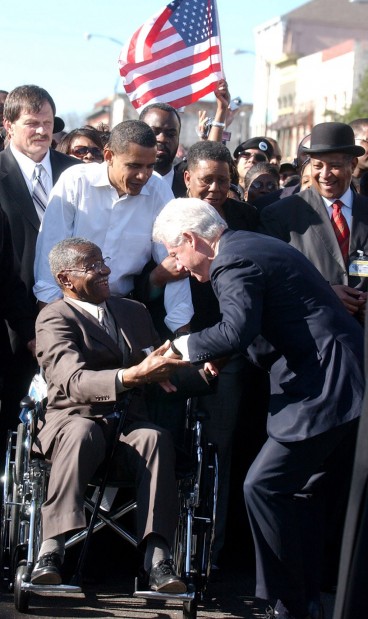
BIRMINGHAM, Ala. - The Rev. Fred L. Shuttlesworth, who was bombed, beaten and repeatedly arrested in the fight for civil rights and hailed by the Rev. Martin Luther King Jr. for his courage and tenacity, has died. He was 89.
Relatives and hospital officials said Shuttlesworth died Wednesday at Princeton Baptist Medical Center in Birmingham. A former truck driver who studied religion at night, Shuttlesworth became pastor of Bethel Baptist Church in Birmingham in 1953 and soon emerged as an outspoken leader in the struggle for racial equality.
"My church was a beehive," Shuttlesworth once said. "I made the movement. I made the challenge. Birmingham was the citadel of segregation, and the people wanted to march."
In his 1963 book "Why We Can't Wait," King called Shuttlesworth "one of the nation's most courageous freedom fighters ... a wiry, energetic and indomitable man."
People are also reading…
Shuttlesworth survived a 1956 bombing, an assault during a 1957 demonstration, chest injuries when Birmingham authorities turned fire hoses on demonstrators in 1963, and countless arrests.
"I went to jail 30 or 40 times, not for fighting or stealing or drugs," Shuttlesworth told grade school students in 1997. "I went to jail for ... trying to make a difference."
Alabama's first black federal judge, U.W. Clemon, said Shuttlesworth flung himself at injustice well knowing he could be killed at any moment. "He was the first black man I knew who was totally unafraid of white folks," said Clemon, who retired from the bench and is now a practicing attorney.
Shuttlesworth remained active in the movement in Alabama even after moving in 1961 to Cincinnati, where he was a pastor for most of the next 47 years. He moved back to Birmingham in February 2008 for rehabilitation after a mild stroke. That summer, the once-segregated city honored him with a four-day tribute and named its airport after him. His statue also stands outside the Birmingham Civil Rights Institute.
And in November 2008, Shuttlesworth watched from a hospital bed as Sen. Barack Obama was elected the nation's first African-American president. The year before, Obama had pushed Shuttlesworth's wheelchair across the Edmund Pettus Bridge in Selma during a commemoration of the Selma-to-Montgomery voting rights march - a moment Obama recalled Wednesday.
In Washington, Obama lauded Shuttlesworth as a "testament to the strength of the human spirit" and said America owes him a "debt of gratitude" for his fight for equality.
In the early 1960s, Shuttlesworth had invited King back to Birmingham. Televised scenes of police dogs and fire hoses being turned on black marchers, including children, in the spring of 1963 helped the nation grasp the depth of racial animosity in the Deep South.
Shuttlesworth was relatively little known outside Alabama. But he was a key figure in Spike Lee's 1997 documentary, "4 Little Girls," about the September 1963 Birmingham church bombing that killed four black children.


