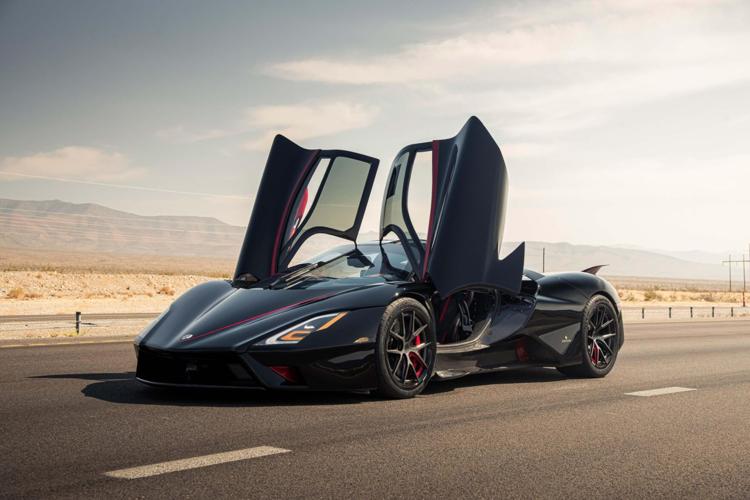
A little-known American automaker has just snatched the title of world's fastest production car.
SSC North America announced Monday that its Tuatara hypercar reached an average speed of 316.11 miles per hour during two record-breaking dashes outside Las Vegas.
The vehicle, which was tested on a seven-mile stretch of a Nevada highway on Saturday, also reached the highest speed ever achieved on a public road, at 331.15 miles per hour, according to the company. The official top speed of 316 miles per hour is the result of two runs in opposite directions, to account for wind and road variations.
SSC said that two independent witnesses were on site to verify the world records.
The Tuatara, which has butterfly doors and produces 1,750 horsepower from a turbocharged V-8 engine, is the second vehicle built by SSC to earn the title of world's fastest production car, according to the company. It says the model's aerodynamic design was inspired by fighter jets, taking more than a decade of research and development.
People are also reading…

SSC North America announced that its Tuatara hypercar reached an average speed of 316.11 miles per hour during two record-breaking dashes outside Las Vegas.
SSC, which bills itself as "America's first hypercar company," was founded in 1998 in Richland, Washington. SSC CEO Jerod Shelby, who is not related to legendary auto designer and racer Carroll Shelby, said the team's performance exceeded his own expectations, and was especially gratifying after "years of setbacks and challenges."
The company is currently planning to produce 100 Tuatara hypercars to sell to customers.
SSC isn't the only company pushing the envelope for production cars.
Just over a year ago, Bugatti was able to get a specially modified Bugatti Chiron to average 304.8 miles per hour during two test runs on a German track.
At the time, the French company said that it was the first production manufacturer to make a car that exceeded 300 miles per hour. (Cars built solely to compete for speed records have gone as fast as over 700 miles per hour.)
In 2017, a Koenigsegg Agera RS averaged 277.87 miles per hour over two runs in Nevada.
SSC believes its car can go even faster.
— Peter Valdes-Dapena contributed to this report.

SSC North America announced that its Tuatara hypercar reached an average speed of 316.11 miles per hour during two record-breaking dashes outside Las Vegas.
Fall road trips: 10 tips for planning the perfect car-based getaway
Fall road trips: 10 tips for planning the perfect car-based getaway
1. Take care of routine maintenance before the trip

Every car manual should include a routine maintenance schedule detailing intervals for oil changes, spark plugs, transmission fluid, air filters and more. Look at the odometer reading and take care of all recommended maintenance items as mileage intervals approach.
Head to a trusted mechanic or dealer for an inspection before setting out on a trip that could mean hundreds of miles on the road. AAA offers a list of recommended auto repair shops that meet quality standards set by the club.
Don't forget to top off windshield wiper fluid before heading out, and check other fluid levels while under the hood.
2. Find the best gas prices on the road

Retail gas prices have dipped in 2020 throughout the country, reaching a national average of around $1.87 per gallon at the height of stay-home orders in late April and May, according to investment research platform YCharts.
Prices have since rebounded slightly, hovering around an average of $2.26 per gallon nationwide in early October. That's still an improvement compared with this time last year when prices averaged almost 50 cents more per gallon.
Find the best prices on the go by using an app such as GasBuddy, which allows users to submit the latest gas prices to the platform. Waze also offers users gas price information.
3. Keep emergency supplies handy, just in case

When embarking on a multi-day adventure on the road, it's worth coming prepared with supplies in case of an emergency. Jumper cables, a first-aid kit, basic tools, snacks, extra water, blankets, rain gear and flashlights are among items that should be in a car's kit.
Make sure to know how to change a tire in case of a flat. Ensure that the spare tire is properly inflated and that all tools, such as a lug wrench and scissor jack, are accounted for.
Consider a subscription to an emergency roadside service such as AAA. Many insurers will also offer roadside assistance as an add-on option, as will some auto manufacturers.
4. Download offline maps to keep navigation going

Depending on where the road takes you, some remote stretches of highway or backroads may not have cellphone service. One way to keep navigation going is by downloading offline maps in advance.
The Google Maps app allows users to download offline maps by drawing a border around the area where maps are needed. Apple Maps and Waze will continue offering turn-by-turn guidance even away from cell service, as long as the route was started with an internet connection.
5. Use digital resources to find unique side stops

Just like there are apps for navigation and finding gas prices, there are also digital resources for finding unique, off-the-beaten-path stops.
Roadtrippers aids trip planning by suggesting unique side trips in categories including "attractions and culture," "outdoors and recreation" and "points of interest." Historic sites, recreation areas, cemeteries and one-of-a-kind waypoints (like the smallest church in America) pop up while poking around the platform, which also offers mobile apps.
Roadside America offers a similar service, but the mobile app is only available on iPhones and Apple devices.
Many cities, counties and states have visitors bureaus with tourist information available online. Some of them offer mobile apps as well.
6. Ask the locals for advice

While many hidden gems and side stops can be found by browsing the internet and utilizing smartphone apps, others can only be found by seeking out local wisdom.
Where's the best place in town to grab barbecue food? Are there any antique stores or boutiques worth checking out? What about hole-in-the-wall bars?
Sometimes, the best bites, shops and experiences can only be unearthed by asking the right people the right questions. Usually, locals are more than willing to share their knowledge.
7. Know local COVID-19 restrictions for destinations

While some states have effectively slowed the spread of COVID-19, others are popping up as hot spots and should be avoided on a leisure trip. Other cities and states might be OK to visit but have local restrictions on restaurants and bars, plus mask mandates.
AAA offers an interactive map showing states that have effectively reopened, which ones have mask mandates and which ones have no travel restrictions at all. The map also points out citywide and countywide restrictions and rules, as well as COVID-19 cases by state and county.
8. Take plenty of photos along the way

Taking photos on vacation has been something that friends and families have long done - it's just easier now than ever before. Photos that used to take days or weeks to process on film can now be viewed instantly on digital screens.
Will you bring along a DSLR and tripod to capture fantastic fall foliage? Or will you shoot with the iPhone and post to social media along the way? The choice is yours to make, but capturing happy snaps on the journey will help in remembering the ride for years to come.
9. Find a great playlist (or podcast)

An already great road trip can be made even better with the right tunes to accompany the miles and smiles spent on the pavement.
Spotify has playlists for seasonal sounds in different genres, as does Apple Music and Prime Music. Pandora has similar stations tailored for autumn listens. Or make a custom playlist to suit individual tastes and moods for hitting the open road.
Alternatively, explore podcasts from popular news outlets such as NPR and The New York Times (or the Orlando Sentinel!) or delve into an original storytelling podcast. Audiobooks can also provide a chance to learn on the go.
10. Plan ahead to secure safe lodging

Which hotels are the safest and cleanest for an overnight stay? Are Airbnb rentals safer? What about camping or renting an RV? These are among looming questions facing travelers amid the COVID-19 pandemic.
Major hotel chains are taking additional precautions in sanitizing rooms. Wear masks and be mindful of personal hygiene when in common spaces. Become familiar with each hotel's procedures before booking.
Airbnb hosts are also being held to a higher standard of cleanliness when offering up rooms and homes for travelers to book. In some cases, vacation rental homes can be considered safer than hotels when there aren't common areas to be shared with other strangers.
Camping is a safe way to enjoy an overnight stay in a new destination. Sanitization should be considered when in public restrooms or facilities, but having an outdoor, distanced campsite is one way travelers can stay safe.
The-CNN-Wire™ & © 2020 Cable News Network, Inc., a WarnerMedia Company. All rights reserved.