NEW YORK — Tracking down accurate information about Philadelphia’s elections on Twitter used to be easy. The account for the city commissioners who run elections, @phillyvotes, was the only one carrying a blue check mark, a sign of authenticity.
After the social media platform overhauled its verification service last month, the check mark disappeared. That’s made it harder to distinguish @phillyvotes from a list of random accounts not run by the elections office but with very similar names.
The election commission applied weeks ago for a gray check mark — Twitter’s new symbol to help users identify official government accounts – but has yet to hear back from Twitter, commission spokesman Nick Custodio said. It’s unclear whether @phillyvotes is an eligible government account under Twitter’s new rules.
That’s troubling, Custodio said, because Pennsylvania has a primary election May 16 and the commission uses its account to share important information with voters in real time. If the account remains unverified, it will be easier to impersonate — and harder for voters to trust — heading into Election Day.
People are also reading…
Impostor accounts on social media are among many concerns election security experts have heading into next year’s presidential election. Experts warn that foreign adversaries or others may try to influence the election, either through online disinformation campaigns or by hacking into election infrastructure.
Election administrators across the country have struggled to figure out the best way to respond after Twitter owner Elon Musk threw the platform’s verification service into disarray.
Some are taking other steps allowed by Twitter, such as buying check marks for their profiles or applying for a special label reserved for government entities, but success has been mixed. Experts say the inconsistency of Twitter’s new verification system is a misinformation disaster waiting to happen.
“The lack of clear, at-a-glance verification on Twitter is a ticking time bomb for disinformation,” said Rachel Tobac, CEO of the cybersecurity company SocialProof Security. “That will confuse users — especially on important days like election days.”
The blue check marks that Twitter once doled out to notable celebrities, public figures, government entities and journalists began disappearing from the platform in April. To replace them, Musk told users that anyone could pay $8 a month for an individual blue check mark or $1,000 a month for a gold check mark as a “verified organization.”
The policy change opened the door for pranksters to pose convincingly as celebrities, politicians and government entities, which could no longer be identified as authentic. While some impostor accounts were clear jokes, others created confusion.
Fake accounts posing as Chicago Mayor Lori Lightfoot, the city’s Department of Transportation and the Illinois Department of Transportation falsely claimed the city was closing one of its main thoroughfares to private traffic.
The fake accounts used the same photos, biographical text and home page links as the real ones. Their posts amassed hundreds of thousands of views before being taken down.
Twitter’s new policy invites government agencies and certain affiliated organizations to apply to be labeled as official with a gray check. But at the state and local level, qualifying agencies are limited to “main executive office accounts and main agency accounts overseeing crisis response, public safety, law enforcement, and regulatory issues,” the policy says.

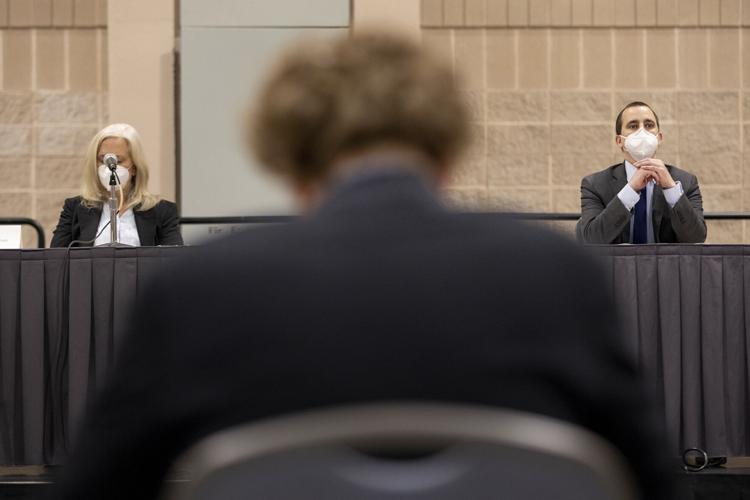
Garrett Dietz, foreground, Philadelphia supervisor of elections, reports the election results to Philadelphia City Commissioner, Lisa Deeley, left, and Deputy Commissioner Nick Custodio, Nov. 17, 2020, at the Pennsylvania Convention Center in Philadelphia.
The rules do not mention agencies that run elections. So while the main Philadelphia city government account quickly received its gray check mark last month, the local election commission has not heard back.
An email sent to Twitter’s press office and a company safety officer requesting comment was answered only with an auto-reply of a poop emoji.
When anyone can buy verification and when government accounts are not consistently labeled, the check mark loses its meaning, Colorado Secretary of State Jena Griswold said.
Griswold’s office received a gray check mark to maintain trust with voters, but she told the AP she would not buy verification for her personal Twitter account because “it doesn’t carry the same weight” it once did.
Experts and advocates tracking election discourse on social media say Twitter’s changes do not just incentivize bad actors to run disinformation campaigns — they also make it harder for well-meaning users to know what’s safe to share.
“Because Twitter is dropping the ball on verification, the burden will fall on voters to double check that the information they are consuming and sharing is legitimate,” said Jill Greene, voting and elections manager for Common Cause Pennsylvania.
That dampens an aspect of Twitter that until now had been seen as one of its strengths — allowing community members to rally together to elevate authoritative information, said Mike Caulfield, a research scientist at the University of Washington’s Center for an Informed Public.
“The first rule of a good online community user interface is to ‘help the helpers.’ This is the opposite of that,” Caulfield said. “It takes a community of people who want to help boost good information, and robs them of the tools to make fast, accurate decisions.”