WASHINGTON — Pay and benefits for America's workers grew at a healthy but more gradual pace in the final three months of 2022, a third straight slowdown, which could help reassure the Federal Reserve that wage gains won't fuel higher inflation.
Wages and benefits, such as health insurance, grew 1% in the October-December quarter compared with the previous three months. That marked a solid gain, though it was slower than the 1.2% increase in the July-September quarter.

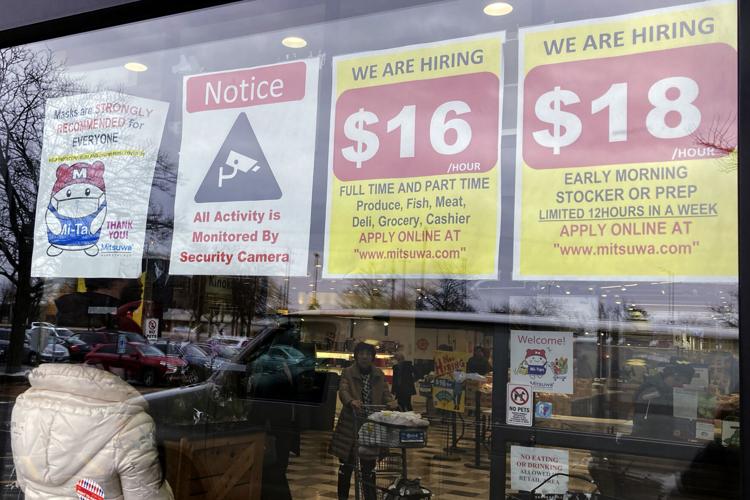
Hiring signs are displayed at a grocery store Jan. 13 in Arlington Heights, Ill.
Fed Chair Jerome Powell and economists consider the data released Tuesday, known as the employment cost index, to be the most comprehensive gauge of labor costs. Powell last year cited a sharp increase in the index as a key reason the Fed accelerated its interest rate hikes.
Powell has said that he sees rapid wage gains, particularly in the labor-intensive service sector, as the biggest impediment to bringing inflation down to the Fed’s 2% target. When restaurants, hotels, veterinary clinics and other services companies raise pay, they often pass along those higher costs by charging their customers higher prices.
People are also reading…
In last year’s first quarter, total worker compensation had jumped 1.4% — the most on records dating to 2001. Before then, quarterly compensation growth had rarely topped 1%.
On an annual basis, wages and benefits grew 5.1% in the fourth quarter compared with a year earlier. That matched last year’s April-June figure as the strongest such figure in the roughly two decades that the data has been tracked. With the unemployment rate matching a 53-year low, businesses rapidly raised pay to try to attract and keep workers.
But now, evidence increasingly suggests that the robust pay growth of the past year is slowing.
Strong wage gains, though beneficial for workers, tend to fuel high inflation. Unless companies achieve greater worker efficiencies or are willing to post lower profits, they typically pass their higher labor costs on to their customers by charging more. Those higher prices, in turn, elevate inflation.

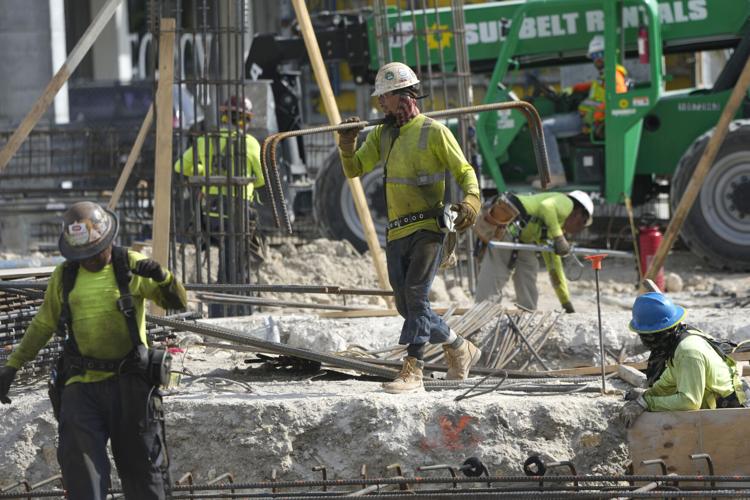
People work at a construction site on Jan. 24 in Miami.
The new report of slower-growing labor costs, though the latest sign that inflation could continue to ease, won't likely alter the Fed's plans to further tighten credit in the short run.
“The Fed is still likely to keep raising interest rates at the next couple of meetings, but we expect a further slowdown in wage growth over the coming months to convince officials to pause the tightening cycle after the March meeting,” said Andrew Hunter, an economist at Capital Economics.
Last quarter, Hunter noted, wage growth slowed particularly sharply for restaurant, hotel and entertainment workers, a group that has enjoyed some of the biggest pay gains. With many companies in those industries struggling to fill jobs, pay and benefits grew 0.9% in the fourth quarter — exactly half its pace of the previous quarter. That suggested that labor demand is declining even in areas of the economy that remain most eager to fill jobs.
Overall inflation is steadily cooling, having eased to 6.5% in December compared with a year ago. That is down from a 40-year high of 9.1% in June. Powell's concern, though, is that fast-growing wages will cause inflation to plateau at around 4% — still twice as high as the Fed's target.
The Fastest-Growing Jobs in Construction
4. Radio, cellular, and tower equipment installers and repairers

Photo Credit: Zakhar Mar / Shutterstock
- 10-year projected employment growth (percent): +21.6%
- 10-year projected employment growth (total): +400
- Total employment (current): 1,900
- Median annual wage (current): $51,690
The construction industry recovered faster from COVID shutdowns than other sectors

Heightened demand and investment has also aided the construction industry’s employment. Construction was not as hard-hit as other parts of the economy by mass layoffs at the outset of the COVID-19 pandemic, and the industry has also recovered jobs more quickly. Construction employment had a strong bounceback after lockdowns and other restrictions began to ease in the late spring of 2020, and has continued to grow since. As a result, job recovery in construction has consistently outpaced recovery in total private sector employment for more than two years. Employment in the industry passed pre-pandemic levels in January 2022, several months before the economy as a whole hit the same milestone.
Construction industry employment is projected to grow slower than average over the next decade

In part because of the construction industry’s faster COVID-19 recovery, the Bureau of Labor Statistics estimates that job growth in the construction industry will be slower than average over the next decade. Construction employment is projected to grow just 2.8% between now and 2031, compared to an average 5.3% rate of job growth across all industries—many of which are still recovering from the pandemic. Additionally, technological changes in the industry are poised to make many processes more efficient and less labor-intensive, while changing demand in industries that rely on construction projects, like energy, may create jobs in some areas while reducing employment in others.
Some roles in construction are set for increased employment in the years ahead, however, with projected employment outpacing both the estimates for the construction industry as a whole and the all-industry average. As the industry changes and modernizes, many of the professions set for the greatest rate of growth are in fact jobs not commonly associated with construction, like market research analysts, software developers, and lawyers. But it is transformations in energy and communications infrastructure that will provide the fastest employment growth in the industry.
The data used in this analysis is from the U.S. Bureau of Labor Statistics. To identify the fastest-growing jobs in construction, researchers at Construction Coverage calculated the projected change in employment between 2021 and 2031 for the most popular construction industry jobs.
Here are the fastest-growing jobs in the construction industry.
15. Computer and information systems managers

Photo Credit: mojo cp / Shutterstock
- 10-year projected employment growth (percent): +8.6%
- 10-year projected employment growth (total): +200
- Total employment (current): 2,400
- Median annual wage (current): $129,910
14. Electricians

Photo Credit: Varavin88 / Shutterstock
- 10-year projected employment growth (percent): +9.0%
- 10-year projected employment growth (total): +46,100
- Total employment (current): 512,900
- Median annual wage (current): $59,000
13. Market research analysts and marketing specialists

Photo Credit: David Gyung / Shutterstock
- 10-year projected employment growth (percent): +11.9%
- 10-year projected employment growth (total): +1,700
- Total employment (current): 14,000
- Median annual wage (current): $60,130
12. Financial managers

Photo Credit: wutzkohphoto / Shutterstock
- 10-year projected employment growth (percent): +12.4%
- 10-year projected employment growth (total): +2,000
- Total employment (current): 15,900
- Median annual wage (current): $126,230
11. Construction managers

Photo Credit: sirtravelalot / Shutterstock
- 10-year projected employment growth (percent): +12.4%
- 10-year projected employment growth (total): +28,900
- Total employment (current): 232,500
- Median annual wage (current): $98,500
10. Floor layers, except carpet, wood, and hard tiles

Photo Credit: Elizaveta Galitckaia / Shutterstock
- 10-year projected employment growth (percent): +12.6%
- 10-year projected employment growth (total): +1,800
- Total employment (current): 14,500
- Median annual wage (current): $48,270
9. Tile and stone setters

Photo Credit: Martin Dworschak / Shutterstock
- 10-year projected employment growth (percent): +12.7%
- 10-year projected employment growth (total): +4,300
- Total employment (current): 33,700
- Median annual wage (current): $48,090
8. Telecommunications line installers and repairers

Photo Credit: PongMoji / Shutterstock
- 10-year projected employment growth (percent): +13.2%
- 10-year projected employment growth (total): +4,100
- Total employment (current): 30,700
- Median annual wage (current): $47,710
7. Mechanical door repairers

Photo Credit: Andrey Popov / Shutterstock
- 10-year projected employment growth (percent): +14.5%
- 10-year projected employment growth (total): +2,400
- Total employment (current): 16,800
- Median annual wage (current): $45,250
6. Software developers

Photo Credit: wutzkohphoto / Shutterstock
- 10-year projected employment growth (percent): +15.1%
- 10-year projected employment growth (total): +300
- Total employment (current): 2,300
- Median annual wage (current): $89,400
5. Lawyers

Photo Credit: Flamingo Images / Shutterstock
- 10-year projected employment growth (percent): +16.1%
- 10-year projected employment growth (total): +300
- Total employment (current): 1,600
- Median annual wage (current): $152,650
3. Logisticians

Photo Credit: Kzenon / Shutterstock
- 10-year projected employment growth (percent): +27.8%
- 10-year projected employment growth (total): +400
- Total employment (current): 1,500
- Median annual wage (current): $64,000
2. Solar photovoltaic installers

Photo Credit: anatoliy gleb / Shutterstock
- 10-year projected employment growth (percent): +30.2%
- 10-year projected employment growth (total): +3,900
- Total employment (current): 12,900
- Median annual wage (current): $47,710
1. Wind turbine service technicians

Photo Credit: Aunging / Shutterstock
- 10-year projected employment growth (percent): +60.5%
- 10-year projected employment growth (total): +1,400
- Total employment (current): 2,400
- Median annual wage (current): $50,630